Chat with us 1
Practical Training Certified Trainers Safer Workplaces

Black Code Mock Drill Training

Corporate Training in Bangalore, Hyderabad & Pan-India

A Bomb Threat Emergency is one of the most critical security incidents an organization can face. Whether communicated through a phone call, email, written note, social media message, suspicious package, or verbal warning, every bo...
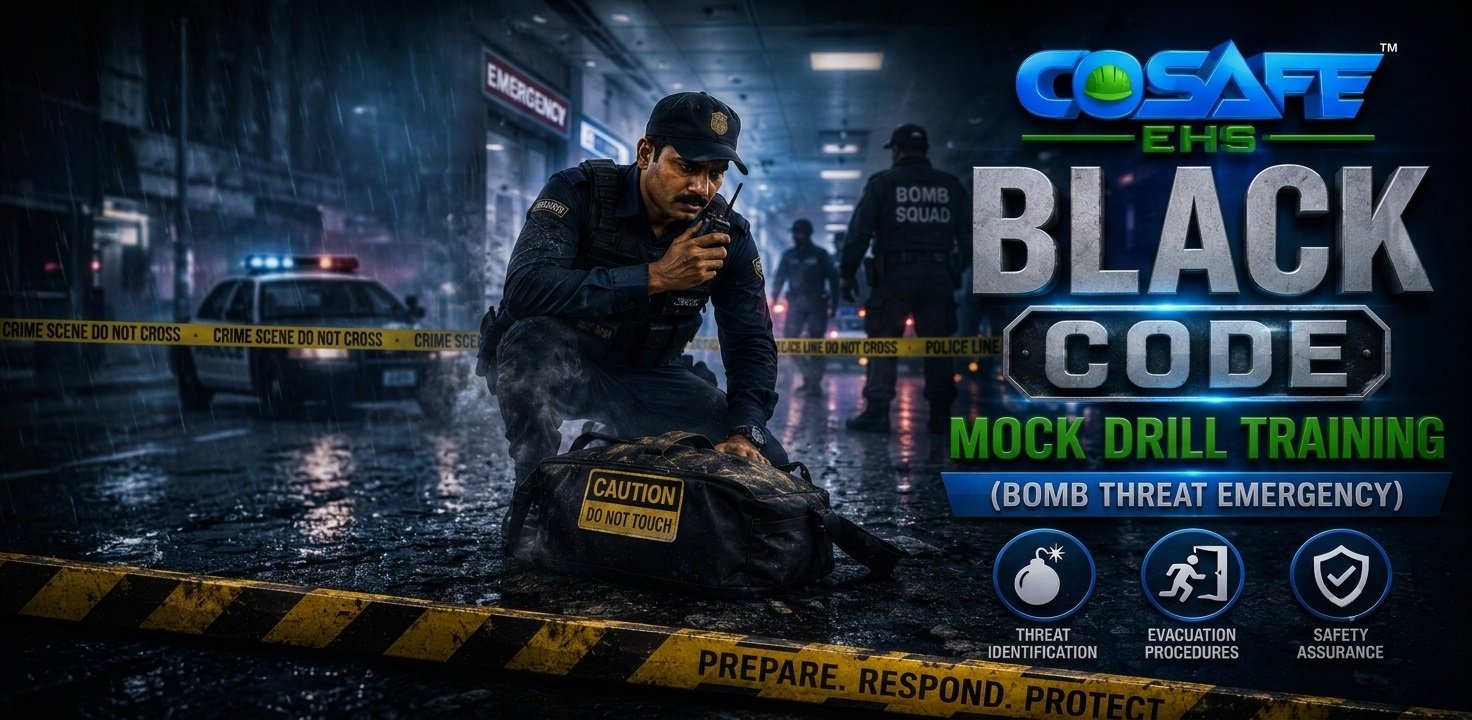
Black Code Mock Drill Training

Flexible Delivery Options

As per your organizational needs

On-SiteClassroomOnline

Practical & Scenario-Based

Real-life examples, live demonstrations and workplace scenarios

Certificate Provided

Issued to every participant after successful completion of the training

Black Code Mock Drill Training session

Overview

Professional Black Code Mock Drill Training (Bomb Threat Emergency) by Cosafe EHS Bangalore & Hyderabad

A Bomb Threat Emergency is one of the most critical security incidents an organization can face. Whether communicated through a phone call, email, written note, social media message, suspicious package, or verbal warning, every bomb threat must be treated as a genuine emergency until assessed by competent authorities. An inappropriate response can lead to panic, operational disruption, property damage, injuries, or loss of life.

At Cosafe EHS Bangalore Hyderabad, our Black Code Mock Drill Training (Bomb Threat Emergency) is designed to prepare organizations with the knowledge, practical skills, and confidence required to effectively manage bomb threats and related security emergencies. Through realistic scenario-based simulations, emergency evacuation exercises, Incident Command System (ICS) implementation, security awareness training, and comprehensive mock drills, participants learn how to respond calmly, coordinate effectively, and minimize risks while ensuring the safety of employees, visitors, contractors, and business assets.

The program follows internationally recognized emergency preparedness principles, organizational security best practices, business continuity planning, and emergency response methodologies to help organizations strengthen resilience against security threats.

What is a Black Code?

A Black Code is an emergency notification activated when an organization faces a Bomb Threat Emergency or another serious security threat requiring immediate assessment, coordinated response, evacuation, and communication with emergency authorities.

A Black Code may be activated due to:

  • Bomb threat received via telephone

  • Email bomb threat

  • Suspicious package or parcel

  • Improvised Explosive Device (IED) threat

  • Vehicle-borne explosive threat

  • Anonymous security threats

  • Terrorism-related threats

  • Explosive device discovery

  • Security intelligence alerts

  • Coordinated external threats

The objective of a Black Code is to ensure rapid threat assessment, protect occupants, coordinate emergency services, minimize disruption, and safely restore normal operations.

Countries Where Black Code or Similar Bomb Threat Emergency Systems Are Commonly Applied

Although emergency colour codes vary between organizations and countries, structured Bomb Threat Emergency Response systems are widely adopted across:

  • India

  • United States

  • Canada

  • United Kingdom

  • Australia

  • New Zealand

  • Singapore

  • Malaysia

  • United Arab Emirates (UAE)

  • Saudi Arabia

  • Qatar

  • Oman

  • South Africa

  • Ireland

  • Hong Kong

Many organizations use Black Code for bomb threats or major security emergencies, while others may use alternative emergency terminology or security alert systems. Therefore, every organization should conduct training according to its approved Emergency Response Plan (ERP), Security Management System, Business Continuity Plan (BCP), and local legal requirements.

Why Black Code Mock Drills are Important

Bomb threats are often intended to create fear, disrupt operations, or test organizational preparedness. Even when a threat is ultimately determined to be false, every incident demands a disciplined and professional response.

Without proper preparedness, organizations may experience:

  • Delayed emergency response

  • Panic among employees

  • Unsafe evacuation

  • Communication failures

  • Poor coordination

  • Operational disruption

  • Property damage

  • Regulatory non-compliance

  • Financial losses

  • Reputational damage


Regular Black Code Mock Drills help organizations:

  • Strengthen emergency preparedness

  • Improve evacuation efficiency

  • Enhance security awareness

  • Validate emergency response plans

  • Improve decision-making under pressure

  • Strengthen communication systems

  • Build employee confidence

  • Improve coordination with emergency agencies

  • Protect lives and assets

  • Improve business continuity

Objectives of Black Code Mock Drill Training

The program aims to:

  • Understand Black Code activation procedures

  • Identify different types of bomb threats

  • Improve threat assessment capabilities

  • Strengthen emergency communication

  • Practice safe evacuation procedures

  • Enhance security awareness

  • Improve Incident Command System implementation

  • Coordinate with police and bomb disposal units

  • Test emergency response plans

  • Build organizational resilience

Key Benefits of Black Code Mock Drill Training

Organizations conducting regular Black Code drills benefit through:

  • Faster emergency response

  • Improved evacuation performance

  • Enhanced employee safety

  • Better security preparedness

  • Stronger leadership during emergencies

  • Improved communication

  • Reduced operational downtime

  • Better compliance with safety standards

  • Enhanced business continuity

  • Increased stakeholder confidence

Who Should Attend?

This training is suitable for:

  • EHS Managers

  • Safety Officers

  • Security Officers

  • Fire & Safety Personnel

  • Emergency Response Teams (ERT)

  • Incident Response Teams

  • Facility Managers

  • Operations Managers

  • HR Managers

  • Administration Teams

  • Engineering & Maintenance Personnel

  • Business Continuity Teams

  • Crisis Management Teams

  • Corporate Employees

  • Educational Institution Staff

  • Manufacturing Personnel

  • Logistics & Warehouse Teams

  • Airport and Aviation Personnel

  • Hotel & Hospitality Staff

  • Healthcare Support Teams

A Black Code (Bomb Threat Emergency) requires calm leadership, rapid assessment, effective communication, disciplined evacuation, and seamless coordination with emergency authorities. Regular Black Code Mock Drills enable organizations to validate emergency plans, strengthen preparedness, reduce response times, and improve overall resilience against security threats.

At Cosafe EHS Bangalore & Hyderabad, our Black Code Mock Drill Training (Bomb Threat Emergency) equips organizations with the knowledge, practical skills, and confidence needed to effectively manage bomb threat incidents while protecting people, assets, and business operations. Through realistic simulations, structured evaluations, and internationally aligned emergency management practices, we help organizations create safer workplaces, stronger emergency response systems, and resilient operations.

Prepare. Assess. Evacuate. Protect. Partner with Cosafe EHS for Professional Black Code Mock Drill Training (Bomb Threat Emergency) in Bangalore & Hyderabad.

Enquire Now

Get a customized Black Code Mock Drill Training proposal for your organization.

Who Should Attend?

All Employees
Managers & Team Leaders
Safety Officers & HR Professionals
Emergency Response Teams
New Joinees
Leadership Teams

Training Modules

Our Black Code Mock Drill Training program is structured to provide clear understanding, practical insights and real-world examples for better awareness and compliance.

01 Hospital emergency management fundamentals
02 Emergency code classifications
03 Black Code concepts
04 Security threat recognition
05 Emergency response activation
06 Healthcare emergency preparedness
07 Bomb threats
08 Suspicious packages
09 Terrorism-related threats
10 Security incidents
11 Hostile intruder situations
12 Critical external threats
13 Incident Command System (ICS)
14 Hospital Incident Command System (HICS)
15 Command roles and responsibilities
16 Emergency operations center activation
17 Resource management
18 Coordination structures
19 Threat assessment procedures
20 Risk evaluation techniques
21 Security vulnerability assessment
22 Suspicious behavior recognition
23 Threat reporting protocols
24 Risk prioritization methods
25 Black Code activation procedures
26 Emergency announcements
27 Internal communication systems
28 Staff notification protocols
29 Communication hierarchy
30 Public information management
31 Security team activation
32 Perimeter control
33 Access management
34 Crowd control
35 Restricted area management
36 Threat containment procedures
37 Horizontal evacuation
38 Vertical evacuation
39 Critical care patient movement
40 ICU evacuation planning
41 Emergency transport coordination
42 Patient tracking systems
43 Staff accountability systems
44 Departmental coordination
45 Shift management
46 Emergency staffing plans
47 Resource allocation
48 Emergency reporting
49 Lockdown procedures
50 Controlled entry and exit
51 Visitor management
52 Access control systems
53 Security screening
54 Emergency restrictions
55 Police coordination
56 Bomb disposal squad coordination
57 Fire department interaction
58 Emergency medical services
59 Government authorities
60 Disaster management agencies
61 Evacuation decision-making
62 Safe assembly points
63 Shelter-in-place procedures
64 Area isolation
65 Movement control
66 Occupant accountability
67 Emergency leadership principles
68 Decision-making under pressure
69 Crisis communication
70 Situation assessment
71 Resource prioritization
72 Operational continuity
73 Continuity planning
74 Essential service protection
75 Recovery procedures
76 Operational restoration
77 Incident documentation
78 Lessons learned processes
79 Bomb threat simulation
80 Suspicious package response
81 Emergency communication activation
82 Security deployment
83 Patient protection measures
84 Incident command operations
85 Drill performance evaluation
86 Gap identification
87 Corrective actions
88 Improvement planning
89 Emergency plan updates
90 Future preparedness strategies

Training Methodology

01
Emergency preparedness presentations
02
Bomb threat awareness workshops
03
Security management discussions
04
Case study analysis
05
Interactive learning sessions
06
Group discussions
07
Hazard identification
08
Security risk assessments
09
Vulnerability analysis
10
Threat recognition exercises
11
Scenario planning
12
Emergency response planning
13
Telephone bomb threats
14
Suspicious packages
15
Email threats
16
Security alerts
17
Evacuation decision-making
18
Incident command coordination
19
Black Code activation
20
Emergency communication
21
Safe evacuation
22
Occupant accountability
23
Security perimeter establishment
24
Coordination with emergency services
25
Bomb threat response
26
Emergency notification
27
Building evacuation
28
Occupant accountability
29
Security operations
30
Incident Command implementation
31
Emergency coordination
32
Recovery planning
33
Management Teams
34
Security Personnel
35
Emergency Response Teams
36
Fire Wardens
37
Facility Management
38
HR Departments
39
Engineering Teams
40
Operations Personnel
41
Response times are measured
42
Communication effectiveness is evaluated
43
Evacuation efficiency is reviewed
44
Operational gaps are identified
45
Lessons learned are documented
46
Improvement plans are developed
47
Written knowledge evaluations
48
Scenario-based exercises
49
Practical demonstrations
50
Team performance
51
Mock drill participation
52
Emergency response competency assessments
53
Experienced emergency preparedness and security consultants
54
Practical, scenario-based bomb threat simulations
55
Industry-specific emergency planning
56
Incident Command System (ICS) integration
57
Comprehensive evacuation and accountability training
58
Coordination with emergency response agencies
59
Customized on-site mock drills
60
Detailed post-drill evaluation reports
61
Regulatory compliance and audit readiness support
62
Strong focus on life safety, business continuity, and organizational resilience

Industries We Serve

Our Black Code Mock Drill Training is relevant for organizations across all industries, including:

IT & ITES
Manufacturing
Healthcare
Education Institutions
Hospitality
Construction & Infrastructure
Logistics & Warehousing
Corporate Offices & All Other Sectors

Why Choose CoSafe EHS?

Experienced Trainers
Customized Training Programs
Practical & Interactive Approach
Flexible Delivery Modes
Industry-Focused Content

Frequently Asked Questions

View All FAQs
Black Code Mock Drill Training prepares organizations to respond effectively to bomb threats and serious security emergencies through threat assessment, communication, evacuation, coordination, and realistic emergency simulations.
Black Code is an emergency notification activated for a Bomb Threat Emergency or serious security threat requiring immediate assessment, coordinated response, evacuation, and communication with emergency authorities.
The training addresses telephone and email threats, suspicious packages, IED threats, vehicle-borne explosive threats, anonymous threats, security alerts, and other serious security incidents.
Regular drills help strengthen emergency preparedness, improve evacuation, enhance security awareness, validate response plans, improve communication, and protect people and assets.
The program is suitable for EHS and safety officers, security personnel, ERT members, facility and operations managers, HR and administration teams, business continuity teams, corporate employees, and other relevant personnel.
Training covers threat identification, risk assessment, emergency communication, security response, evacuation, accountability, lockdown, external agency coordination, crisis management, business continuity, and incident command.
Yes. Participants take part in tabletop exercises, practical demonstrations, and full-scale simulations involving bomb threat response, emergency notification, evacuation, security operations, accountability, and Incident Command implementation.
Yes. The training includes safe evacuation, assembly point management, shelter-in-place procedures, movement control, occupant accountability, and coordinated emergency response.
Yes. Cosafe EHS provides industry-specific emergency planning and customized on-site mock drills designed around organizational security and emergency preparedness requirements.
Yes. Participants are assessed through written evaluations, scenario-based exercises, practical demonstrations, team performance, mock drill participation, and emergency response competency assessments. Certificates are awarded upon successful completion.

Let's Create a Safer and More
Compliant Workplace Together

Contact us today to get a customized Black Code Mock Drill Training proposal for your organization.