Chat with us 1
Practical Training Certified Trainers Safer Workplaces

Red Code Mock Drill Training

Corporate Training in Bangalore, Hyderabad & Pan-India

Fire emergencies are among the most serious workplace incidents, capable of causing injuries, fatalities, business interruption, environmental damage, and significant property losses within minutes. Whether caused by electrical fa...
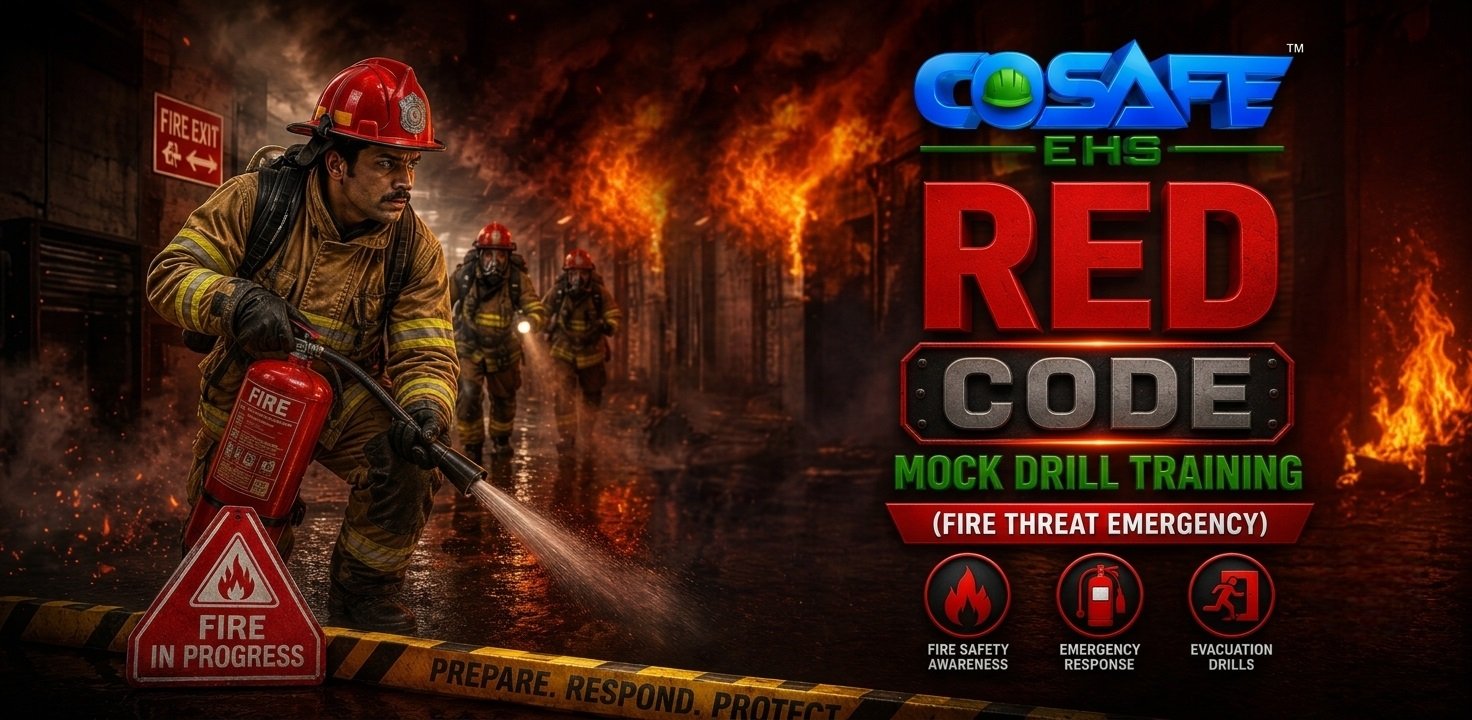
Red Code Mock Drill Training

Flexible Delivery Options

As per your organizational needs

On-SiteClassroomOnline

Practical & Scenario-Based

Real-life examples, live demonstrations and workplace scenarios

Certificate Provided

Issued to every participant after successful completion of the training

Red Code Mock Drill Training session

Overview

Professional Red Code Mock Drill Training (Fire Threat Emergency) by Cosafe EHS Bangalore & Hyderabad

Fire emergencies are among the most serious workplace incidents, capable of causing injuries, fatalities, business interruption, environmental damage, and significant property losses within minutes. Whether caused by electrical faults, flammable liquids, combustible materials, hot work activities, gas leaks, equipment failures, or human error, every fire emergency demands an immediate, coordinated, and well-practiced response.

At Cosafe EHS Bangalore & Hyderabad, our Red Code Mock Drill Training (Fire Threat Emergency) is designed to prepare organizations with the knowledge, practical skills, and confidence required to effectively manage fire emergencies. Through realistic fire simulations, emergency evacuation exercises, Incident Command System (ICS) implementation, fire extinguisher demonstrations, emergency communication drills, and full-scale mock exercises, participants learn how to respond quickly while protecting lives, property, and business continuity.

Our training combines internationally recognized fire safety principles, emergency preparedness, fire prevention strategies, evacuation planning, and practical emergency response techniques to build a proactive fire safety culture across organizations.

What is a Red Code?

A Red Code is an emergency notification activated when a fire, smoke, burning smell, or suspected fire threatens the safety of people or property within an organization. In many hospitals and organizations worldwide, Code Red is widely recognized as the emergency alert for a fire or smoke incident, although organizations should always follow their own approved emergency response procedures because emergency code systems are not globally standardized.

A Red Code may be activated due to:

  • Fire outbreak

  • Smoke detection

  • Burning smell

  • Electrical fire

  • Flammable liquid fire

  • LPG or combustible gas fire

  • Chemical fire

  • Machinery fire

  • Warehouse fire

  • Office fire

  • Kitchen fire

  • Industrial fire

  • Fire alarm activation

  • Suspected fire emergency

The objective of a Red Code is to rapidly detect the incident, protect occupants, control the emergency where safe to do so, coordinate evacuation, notify emergency services, and minimize damage.

Countries Where Red Code (Fire Emergency) Systems Are Commonly Applied

Emergency colour-code systems or equivalent fire emergency notification systems are widely implemented across:

  • India

  • United States

  • Canada

  • Australia

  • New Zealand

  • Singapore

  • Malaysia

  • United Arab Emirates (UAE)

  • Saudi Arabia

  • Qatar

  • Oman

  • South Africa

  • Ireland

  • Hong Kong

In many healthcare facilities and organizations across North America, Australia, and New Zealand, Code Red commonly indicates a fire, smoke, or suspected fire emergency. However, terminology may differ between industries and countries, so every organization should train according to its approved Emergency Response Plan (ERP), Fire Safety Plan, and local fire regulations.

Why Red Code Mock Drills are Important

Fire emergencies can escalate within seconds. Without regular practice, organizations may experience:

  • Delayed emergency response

  • Panic during evacuation

  • Improper use of fire extinguishers

  • Communication failures

  • Unsafe evacuation

  • Blocked escape routes

  • Business interruption

  • Property damage

  • Regulatory non-compliance

  • Loss of life

Regular Red Code Mock Drills help organizations:

  • Improve fire emergency preparedness

  • Strengthen evacuation procedures

  • Enhance fire prevention awareness

  • Validate emergency response plans

  • Improve communication systems

  • Strengthen Incident Command implementation

  • Increase employee confidence

  • Improve coordination with Fire & Rescue Services

  • Protect lives and assets

  • Support business continuity

Objectives of Red Code Mock Drill Training

The program aims to:

  • Understand Red Code activation procedures

  • Identify fire hazards and ignition sources

  • Strengthen fire prevention practices

  • Improve emergency communication

  • Practice safe evacuation

  • Develop fire extinguisher competency

  • Improve Incident Command System implementation

  • Coordinate with Fire & Rescue Services

  • Test emergency response plans

  • Build organizational resilience

Key Benefits of Red Code Mock Drill Training

Organizations conducting regular Red Code drills benefit through:

  • Faster emergency response

  • Improved evacuation efficiency

  • Enhanced fire safety awareness

  • Better emergency leadership

  • Reduced fire-related risks

  • Improved teamwork

  • Stronger regulatory compliance

  • Better business continuity

  • Increased employee confidence

  • Enhanced organizational resilience

Who Should Attend?

This training is ideal for:

  • EHS Managers

  • Safety Officers

  • Fire & Safety Officers

  • Emergency Response Teams (ERT)

  • Fire Wardens

  • Security Personnel

  • Facility Managers

  • Operations Managers

  • HR Managers

  • Engineering & Maintenance Teams

  • Administration Teams

  • Manufacturing Personnel

  • Warehouse Personnel

  • Logistics Teams

  • Corporate Employees

  • Educational Institution Staff

  • Hotel & Hospitality Personnel

  • Healthcare Support Teams

  • Industrial Workers

A Red Code (Fire Threat Emergency) requires immediate action, effective communication, disciplined evacuation, and coordinated emergency response. Regular Red Code Mock Drills enable organizations to validate fire emergency procedures, strengthen employee preparedness, improve evacuation efficiency, and enhance overall resilience against fire-related emergencies.

At Cosafe EHS Bangalore & Hyderabad, our Red Code Mock Drill Training (Fire Threat Emergency) equips organizations with the knowledge, practical skills, and confidence needed to respond effectively to workplace fire emergencies while protecting people, property, and business operations. Through realistic simulations, structured evaluations, and internationally recognized fire safety practices, we help organizations build safer workplaces, stronger emergency response capabilities, and resilient business operations.

Prevent. Prepare. Respond. Protect. Choose Cosafe EHS for Professional Red Code Mock Drill Training (Fire Threat Emergency) in Bangalore & Hyderabad.

Enquire Now

Get a customized Red Code Mock Drill Training proposal for your organization.

Who Should Attend?

All Employees
Managers & Team Leaders
Safety Officers & HR Professionals
Emergency Response Teams
New Joinees
Leadership Teams

Training Modules

Our Red Code Mock Drill Training program is structured to provide clear understanding, practical insights and real-world examples for better awareness and compliance.

01 Fire safety fundamentals
02 Fire emergency management
03 Red Code principles
04 Fire prevention
05 Emergency preparedness
06 Organizational resilience
07 Fire triangle and fire tetrahedron
08 Stages of fire development
09 Heat transfer
10 Fire spread mechanisms
11 Smoke hazards
12 Flashover and backdraft awareness
13 Fire hazard recognition
14 Ignition source identification
15 Fuel source assessment
16 Workplace fire risk assessment
17 Housekeeping practices
18 Preventive controls
19 Fire alarm systems
20 Smoke detectors
21 Heat detectors
22 Manual call points
23 Emergency notification systems
24 Alarm response procedures
25 Fire reporting procedures
26 Alarm activation
27 Emergency communication
28 Internal notification
29 Escalation procedures
30 Incident documentation
31 Types of fire extinguishers
32 Fire classes (A, B, C, D, Electrical & Cooking Oil)
33 PASS Technique
34 Safe extinguisher operation
35 Extinguisher selection
36 Practical demonstrations
37 Fire hydrants
38 Hose reels
39 Automatic sprinkler systems
40 Fire pumps
41 Fire water storage
42 Fixed suppression systems
43 Emergency evacuation planning
44 Exit route management
45 Assembly point procedures
46 Occupant accountability
47 Evacuation for persons requiring assistance
48 Re-entry authorization
49 ICS principles
50 Emergency leadership
51 Resource coordination
52 Command responsibilities
53 Decision-making
54 Documentation
55 Fire Warden duties
56 Area searches
57 Occupant guidance
58 Assembly point management
59 Accountability procedures
60 Emergency reporting
61 Fire & Rescue Services
62 Emergency Medical Services
63 Police
64 Disaster Management Authorities
65 Facility Management
66 Mutual Aid Teams
67 Business continuity planning
68 Critical operations protection
69 Emergency recovery
70 Damage assessment
71 Operational restoration
72 Lessons learned
73 Incident preservation
74 Fire scene awareness
75 Initial reporting
76 Root cause awareness
77 Corrective actions
78 Preventive measures
79 Red Code activation
80 Fire emergency response
81 Alarm activation
82 Emergency communication
83 Fire extinguisher deployment (where safe)
84 Building evacuation
85 Occupant accountability
86 Incident Command activation
87 Coordination with Fire & Rescue Services
88 Performance evaluation
89 Response time analysis
90 Evacuation assessment
91 Communication review
92 Gap identification
93 Corrective action planning
94 Emergency plan updates

Training Methodology

01
Fire safety presentations
02
Fire prevention workshops
03
Emergency preparedness seminars
04
Interactive discussions
05
Fire case studies
06
Group learning sessions
07
Fire hazard identification
08
Workplace inspections
09
Vulnerability assessments
10
Emergency planning
11
Fire load evaluation
12
Preventive action planning
13
Portable fire extinguisher operation
14
Fire hose reel familiarization
15
Hydrant system awareness
16
Alarm activation
17
Fire suppression techniques
18
Safe response procedures
19
Electrical fires
20
Warehouse fires
21
Office fires
22
LPG fires
23
Smoke emergencies
24
Evacuation decision-making
25
Incident Command coordination
26
Red Code activation
27
Fire emergency response
28
Alarm notification
29
Building evacuation
30
Occupant accountability
31
Fire Warden deployment
32
Incident Command implementation
33
Coordination with emergency responders
34
Management Teams
35
Fire Wardens
36
Security Personnel
37
Emergency Response Teams
38
Engineering Departments
39
Maintenance Teams
40
HR Departments
41
Operations Personnel
42
Response times are evaluated
43
Evacuation performance is assessed
44
Communication effectiveness is reviewed
45
Fire response procedures are analyzed
46
Operational gaps are identified
47
Corrective action plans are developed
48
Written assessments
49
Practical fire extinguisher demonstrations
50
Scenario-based exercises
51
Emergency response performance
52
Team participation
53
Mock drill evaluations
54
Experienced fire safety and emergency preparedness consultants
55
Practical, scenario-based fire emergency simulations
56
Industry-specific fire emergency planning
57
Incident Command System (ICS) integration
58
Comprehensive evacuation and accountability training
59
Hands-on fire extinguisher training
60
Customized on-site mock drills
61
Detailed post-drill evaluation reports
62
Regulatory compliance and audit readiness support
63
Strong focus on life safety, fire prevention, and business continuity

Industries We Serve

Our Red Code Mock Drill Training is relevant for organizations across all industries, including:

IT & ITES
Manufacturing
Healthcare
Education Institutions
Hospitality
Construction & Infrastructure
Logistics & Warehousing
Corporate Offices & All Other Sectors

Why Choose CoSafe EHS?

Experienced Trainers
Customized Training Programs
Practical & Interactive Approach
Flexible Delivery Modes
Industry-Focused Content

Frequently Asked Questions

View All FAQs
Red Code Mock Drill Training prepares organizations to respond effectively to fire emergencies through realistic simulations, evacuation exercises, emergency communication, fire extinguisher demonstrations, and Incident Command System (ICS) implementation.
A Red Code is an emergency notification activated when a fire, smoke, burning smell, or suspected fire threatens people or property within an organization.
Regular drills help improve fire emergency preparedness, strengthen evacuation procedures, validate emergency response plans, improve communication, and increase employee confidence during fire emergencies.
EHS Managers, Safety Officers, Fire & Safety Officers, ERT members, Fire Wardens, Security Personnel, Facility Managers, Operations Managers, HR teams, engineering and maintenance personnel, and other relevant employees can attend.
The training covers fire emergency management, fire behaviour, hazard identification, fire detection and alarms, Red Code activation, fire extinguishers, evacuation, ICS, Fire Warden responsibilities, emergency services coordination, and business continuity.
Yes. Participants receive practical training covering different types of extinguishers, fire classes, the PASS technique, safe extinguisher operation, extinguisher selection, and practical demonstrations.
Yes. Participants perform Red Code activation, fire emergency response, alarm activation, emergency communication, safe fire extinguisher deployment, building evacuation, occupant accountability, Incident Command activation, and coordination
Tabletop simulations can include electrical fires, warehouse fires, office fires, LPG fires, smoke emergencies, evacuation decision-making, and Incident Command coordination.
Yes. Cosafe EHS provides industry-specific fire emergency planning and customized on-site mock drills focused on life safety, fire prevention, emergency preparedness, and business continuity.
Yes. Participants are evaluated through written assessments, practical fire extinguisher demonstrations, scenario-based exercises, emergency response performance, team participation, and mock drill evaluations. Certificates are awarded upon successful completion.

Let's Create a Safer and More
Compliant Workplace Together

Contact us today to get a customized Red Code Mock Drill Training proposal for your organization.