Bangalore Office
Warehouse No 4, Survey No 198/6, Janatha Colony, Dommsandra Bangalore Karnataka 562125

Warehouse No 4, Survey No 198/6, Janatha Colony, Dommsandra Bangalore Karnataka 562125
Godown No 3/C, Survey No. 217, Beside ORR, Shamshabad, R.R. District, Hyderabad, Telangana - 501218
+91 7892978960
corporate@cosafe.in
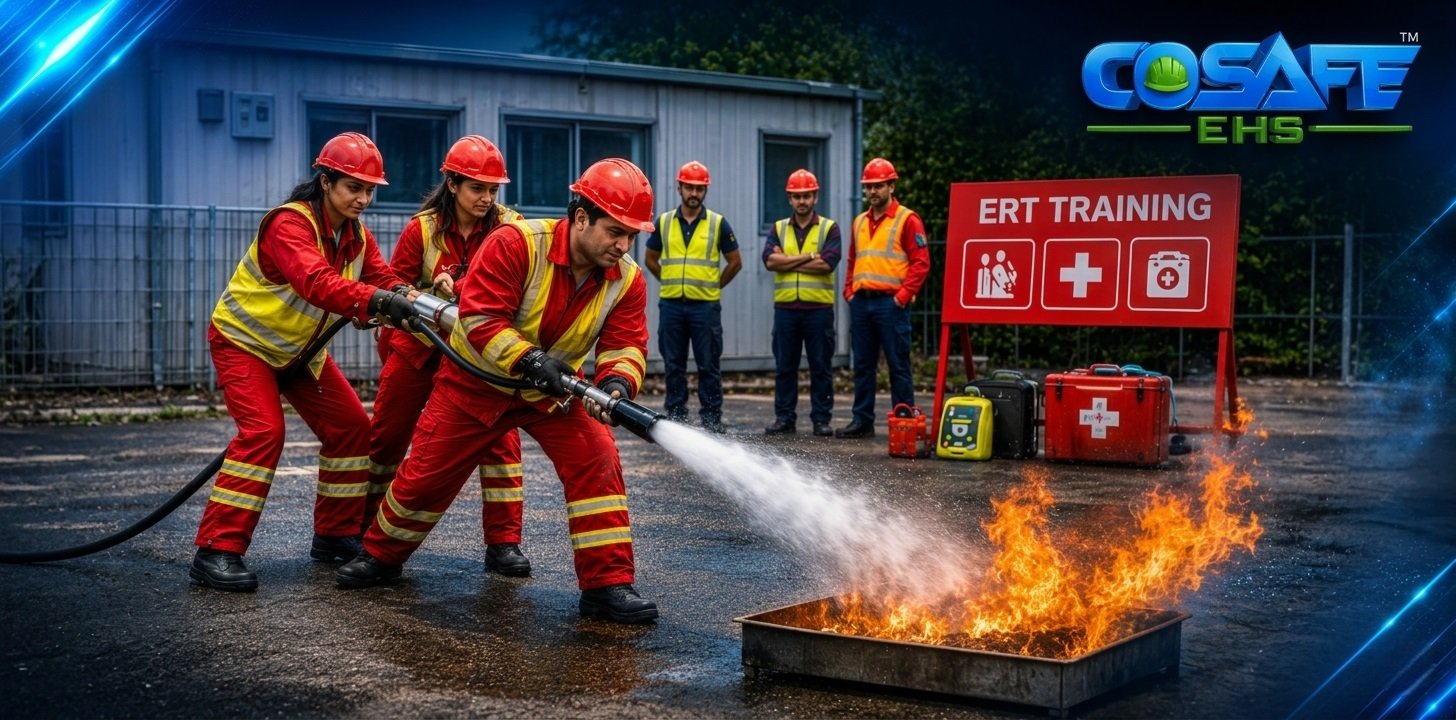
Emergencies can arise without warning in workplaces, industrial facilities, commercial establishments, educational institutions, and public environments. In such critical moments, the ability to respond quickly, efficiently, and confidently can make the difference between controlled situations and major disasters.
This is why Emergency Response Team (ERT) Training is not just important—it is essential. A well-trained ERT ensures immediate action during emergencies, minimizing risks to life, property, and business operations.
An Emergency Response Team (ERT) is a group of trained employees or designated personnel within an organization responsible for managing and responding to various emergency situations.
A well-structured ERT plays a critical role in reducing injuries, preventing property damage, minimizing downtime, and saving lives.
At Cosafe EHS Banglore, we deliver specialized Emergency Response Team (ERT) Training programs designed to build a highly skilled and responsive workforce.
With extensive expertise in industrial safety and emergency preparedness, we ensure that your team is fully equipped to act decisively in real-life emergency situations.
Emergencies are unpredictable, but preparedness is a choice. Organizations that invest in building a competent Emergency Response Team create a safer, more resilient work environment.
Our ERT Training program empowers your workforce with the knowledge, skills, and confidence to handle emergencies of any scale—whether it’s a fire incident, medical emergency, or industrial hazard.
By choosing Cosafe EHS Bangalore & Hyderabad, you are not only meeting compliance requirements but also safeguarding your people, protecting your assets, and ensuring business continuity.
Choosing the right training partner ensures your investment in safety is worthwhile. At Cosafe EHS Bangalore & Hyderabad:
Prepare your team today. Respond with confidence tomorrow.
At Cosafe EHS Bangalore & Hyderabad, our Emergency Response Team (ERT) Training program is designed with clear, practical, and industry-focused objectives to build a competent and confident emergency response workforce.
Our ERT Training program at Cosafe EHS Bangalore & Hyderabad is structured to cover all critical aspects of emergency preparedness and response. The modules are flexible and can be customized based on industry type, operational risks, and specific client requirements.
At Cosafe EHS Bangalore & Hyderabad, we follow a highly practical and hands-on training methodology designed to bridge the gap between theoretical knowledge and real-world emergency response.
Our approach includes:
This structured and engaging methodology ensures that participants not only understand emergency concepts but also develop the confidence and competence to respond effectively in critical situations.
General Guidelines for ERT Team Ratio
The required number of Emergency Response Team (ERT) members varies depending on industry type, risk level, and workforce size. However, the following benchmarks are widely accepted across industries:
1 ERT member for every 20–25 employees
1 ERT member for every 30–40 employees
Minimum 10% of the total workforce should be trained as ERT members
The required ERT ratio must be maintained for each shift to ensure complete emergency coverage at all times
Implementing the right ERT ratio ensures faster response, better coordination, and improved safety outcomes during emergencies.
Legal & Compliance Requirements for ERT / Emergency Preparedness Program
To ensure full compliance with applicable safety regulations and standards in India, an effective Emergency Response Team (ERT) program should include the following components:
Organizations must identify all applicable safety, environmental, and emergency-related laws and maintain an updated legal register to ensure ongoing compliance.
Conduct systematic assessments to identify potential hazards such as fire, chemical spills, structural failures, and medical emergencies. Define control and mitigation measures accordingly.
4. Formation of ERT & Incident Command Structure
5. Training, Drills & Mock Exercises
Regular training programs and mock drills are critical for preparedness. As per regulatory requirements (such as the Factories Act), periodic emergency drills must be conducted and evaluated.
6. First Aid & Medical Preparedness
Ensure availability of first aid facilities and trained personnel at the workplace, in line with statutory requirements (e.g., Factories Act provisions).
7. Fire Safety Infrastructure
8. Communication & External Coordination
Establish effective communication channels and coordinate with external emergency services such as fire departments, hospitals, and local authorities.
9. Monitoring, Auditing & Review
Conduct periodic safety audits, inspections, and compliance reviews. Identify gaps and implement corrective actions, with involvement from top management.
10. Documentation & Reporting
Duration: 1 Day / 2 Days (Based on requirement)
Certification: Certificate provided upon successful completion
Validity: 1–2 Years
Languages: Kannada / Hindi / English / Telugu