Chat with us 1
Practical Training Certified Trainers Safer Workplaces

(KYT) Hazard Prediction Training

Corporate Training in Bangalore, Hyderabad & Pan-India

In every workplace, accidents rarely occur without warning signs. Unsafe conditions, unsafe acts, equipment defects, environmental hazards, procedural violations, and human errors often exist long before an incident occurs. The ch...
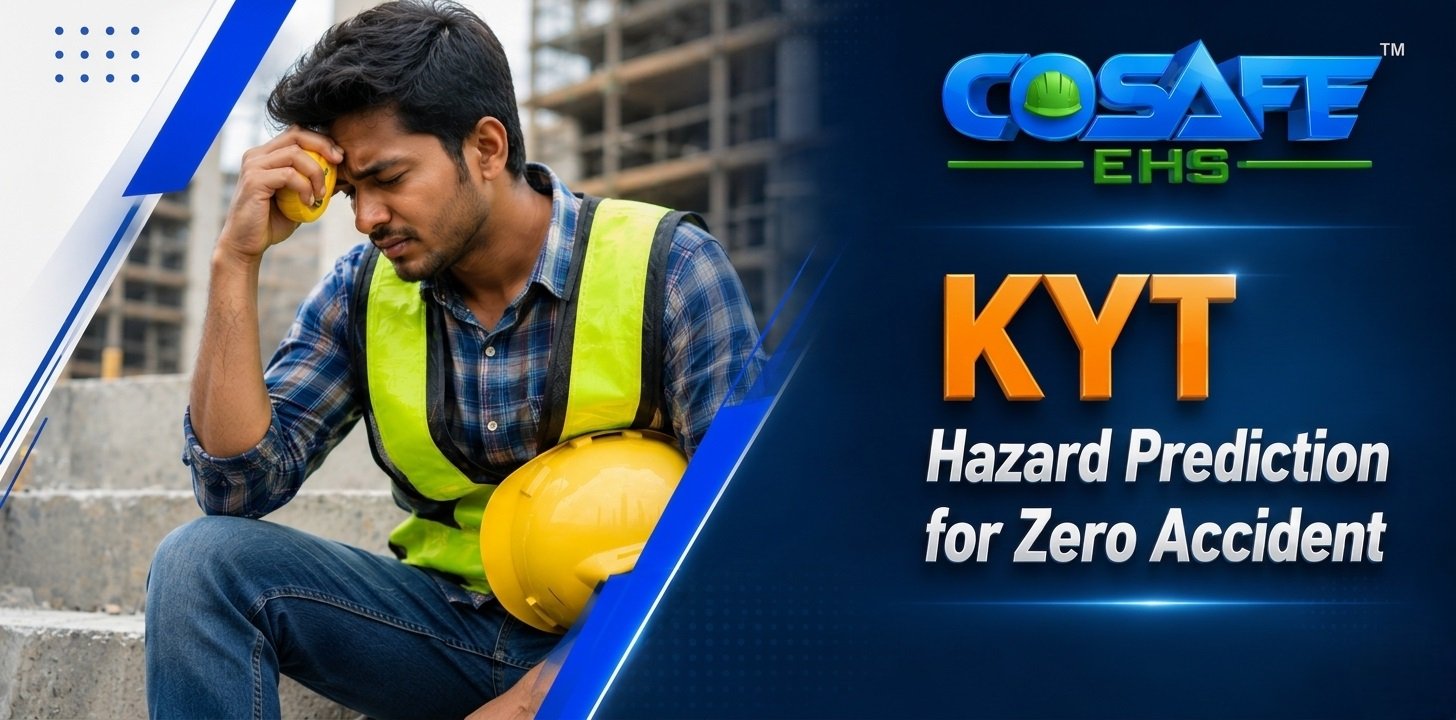
(KYT) Hazard Prediction Training

Flexible Delivery Options

As per your organizational needs

On-SiteClassroomOnline

Practical & Scenario-Based

Real-life examples, live demonstrations and workplace scenarios

Certificate Provided

Issued to every participant after successful completion of the training

(KYT) Hazard Prediction Training session

Overview

Hazard Prediction for Zero Accident (KYT) Training in Bangalore & Hyderabad

Professional KYT (Hazard Prediction Training) by Cosafe EHS Bangalore & Hyderabad

In every workplace, accidents rarely occur without warning signs. Unsafe conditions, unsafe acts, equipment defects, environmental hazards, procedural violations, and human errors often exist long before an incident occurs. The challenge is not whether hazards exist, but whether workers can recognize them before they lead to accidents.

KYT (Kiken Yochi Training), commonly known as Hazard Prediction Training, is a proactive safety technique developed in Japan as part of the Zero Accident Campaign. KYT focuses on identifying hidden dangers, predicting potential accidents, assessing risks, and implementing preventive actions before work begins. The methodology encourages workers to actively think about workplace hazards and take ownership of safety, making it one of the most effective behavioral safety tools used worldwide.

At Cosafe EHS Bangalore & Hyderabad, our KYT (Hazard Prediction Training) Program is designed to help organizations build a proactive safety culture where employees identify hazards before incidents occur. Through structured hazard prediction exercises, risk visualization techniques, team discussions, behavioral safety principles, and practical workplace applications, participants develop the ability to recognize risks and prevent accidents before they happen.

What is KYT (Hazard Prediction Training)?

KYT stands for:

  • K – Kiken (Hazard)

  • Y – Yochi (Prediction)

  • T – Training

The training involves analyzing workplace situations, identifying hidden hazards, discussing possible accident scenarios, determining critical danger points, and implementing preventive actions before work starts. KYT uses illustrations, workplace photographs, job scenarios, and actual site observations to improve hazard recognition capabilities.

Why KYT Training is Important

Traditional safety programs often react after incidents occur. KYT focuses on prevention by improving workers' ability to recognize hazards before they become accidents.

Organizations implementing KYT benefit from:

  • Reduced workplace accidents

  • Improved hazard awareness

  • Stronger safety culture

  • Better employee engagement

  • Enhanced teamwork

  • Improved risk perception

  • Increased safety compliance

  • Better near-miss reporting

  • Reduced unsafe behaviors

  • Higher operational reliability

Research on KYT has shown that hazard prediction ability can be improved through structured training and repeated practice, helping participants become more effective at recognizing workplace risks.

The Philosophy of Zero Accident Culture

KYT is based on the belief that:

  • Every accident is preventable.

  • Every hazard can be identified.

  • Every employee contributes to safety.

  • Safety is everyone's responsibility.

  • Prevention is more effective than correction.

The Zero Accident philosophy emphasizes respect for human life and proactive action to eliminate workplace risks.

Common Workplace Hazards Covered During KYT

Participants learn to predict and control:

  • Slip, trip, and fall hazards

  • Work at height risks

  • Electrical hazards

  • Fire hazards

  • Mechanical hazards

  • Material handling risks

  • Chemical exposure hazards

  • Vehicle movement risks

  • Confined space hazards

  • Ergonomic hazards

  • Unsafe work practices

  • Human error-related hazards


Objectives of KYT Training

The primary objectives include:

  • Developing hazard prediction skills

  • Improving safety observation abilities

  • Enhancing risk awareness

  • Strengthening proactive thinking

  • Reducing unsafe acts and conditions

  • Supporting behavioral safety initiatives

  • Improving communication among workers

  • Building a zero-accident mindset

  • Enhancing decision-making capabilities

  • Creating a culture of continuous safety improvement


Industries Benefiting from KYT Training

This program is highly valuable for:

  • Manufacturing Industries

  • Construction Projects

  • Oil & Gas Facilities

  • Chemical Plants

  • Warehousing Operations

  • Logistics Companies

  • Power Plants

  • Pharmaceutical Industries

  • Infrastructure Projects

  • Facility Management Companies

  • Food Processing Industries

  • Engineering Industries


Benefits of KYT Training

Organizations implementing KYT achieve:

  • Lower accident rates

  • Improved hazard identification

  • Better teamwork and communication

  • Enhanced employee participation

  • Reduced near misses

  • Stronger safety leadership

  • Increased workforce awareness

  • Better compliance performance

  • Improved operational efficiency

  • Sustainable safety culture development


Who Should Attend?

This training program is suitable for:

  • Safety Officers

  • EHS Professionals

  • Supervisors

  • Team Leaders

  • Engineers

  • Plant Operators

  • Maintenance Personnel

  • Contractors

  • Production Staff

  • Warehouse Personnel

  • Project Managers

  • All Employees

At Cosafe EHS Bangalore & Hyderabad, our KYT Training Program is customized according to industry risks, workplace operations, and organizational safety objectives.

Accidents rarely happen without warning signs. Most workplace incidents are preceded by unsafe conditions, unsafe acts, and hidden hazards that can be identified and controlled when workers are trained to recognize them. KYT (Hazard Prediction Training) empowers employees to think proactively, identify risks before work begins, and take preventive actions that support a Zero Accident Culture.

At Cosafe EHS Bangalore & Hyderabad, our KYT – Hazard Prediction Training Program equips employees, supervisors, safety professionals, and managers with the practical skills needed to recognize hazards, predict risks, develop preventive measures, and build a safer workplace. Through structured hazard prediction exercises, team discussions, visual learning techniques, and real-world applications, we help organizations create a proactive workforce committed to accident prevention.

Predict the Hazard. Prevent the Accident. Build a Zero Accident Culture. Choose Cosafe EHS for Professional KYT Hazard Prediction Training in Bangalore & Hyderabad.

Enquire Now

Get a customized (KYT) Hazard Prediction Training proposal for your organization.

Who Should Attend?

All Employees
Managers & Team Leaders
Safety Officers & HR Professionals
Emergency Response Teams
New Joinees
Leadership Teams

Training Modules

Our (KYT) Hazard Prediction Training program is structured to provide clear understanding, practical insights and real-world examples for better awareness and compliance.

01 History of KYT
02 Zero Accident Campaign
03 Importance of hazard prediction
04 Safety culture fundamentals
05 Worker participation in safety
06 Proactive versus reactive safety
07 Hazard identification concepts
08 Risk assessment basics
09 Unsafe acts
10 Unsafe conditions
11 Accident causation factors
12 Workplace risk recognition
13 Visual hazard recognition
14 Hazard prediction techniques
15 Risk anticipation methods
16 Critical danger point identification
17 Workplace observation skills
18 Risk visualization concepts
19 What hazards are present?
20 What can go wrong?
21 What unsafe conditions exist?
22 What accidents may occur?
23 Which hazards are most dangerous?
24 What are the consequences?
25 How can risks be eliminated?
26 What controls are required?
27 What preventive actions should be implemented?
28 Safety confirmation
29 Team commitment
30 Pointing and calling techniques
31 Hazard control implementation
32 Construction hazards
33 Manufacturing hazards
34 Warehouse hazards
35 Electrical hazards
36 Mechanical hazards
37 Environmental hazards
38 Human error concepts
39 Behavioral safety principles
40 Decision-making under pressure
41 Fatigue management
42 Communication failures
43 Situational awareness
44 Near miss reporting
45 Hazard observation techniques
46 Early intervention methods
47 Incident prevention strategies
48 Learning from near misses
49 Continuous improvement
50 Visual confirmation techniques
51 Verbal safety confirmation
52 Hazard awareness reinforcement
53 Error prevention methods
54 Safety communication practices
55 Maintenance activities
56 Material handling tasks
57 Equipment operation
58 Work at height
59 Electrical work
60 Contractor activities
61 HIRA fundamentals
62 Risk assessment integration
63 Job Safety Analysis (JSA)
64 Permit-to-Work systems
65 Safety planning
66 Control measure implementation
67 Hazard brainstorming
68 Team discussions
69 Risk prioritization
70 Countermeasure development
71 Action planning
72 Group presentations
73 Accident investigation reviews
74 Root cause analysis
75 Hazard recognition failures
76 Lessons learned
77 Prevention strategies
78 Safety improvement opportunities
79 Supervisor responsibilities
80 Safety leadership behaviors
81 Team motivation
82 Safety communication
83 Employee engagement
84 Continuous improvement practices
85 Hazard prediction sessions
86 Workplace observation exercises
87 Job-specific risk reviews
88 Countermeasure planning
89 Pointing and calling drills
90 Team-based KYT activities
91 Continuous hazard prediction activities
92 Daily KYT meetings
93 Safety observation programs
94 Employee participation strategies
95 Performance measurement
96 Sustainable safety culture development

Training Methodology

01
Multimedia presentations
02
Safety awareness workshops
03
Hazard prediction discussions
04
Industry case studies
05
Risk visualization exercises
06
Best-practice sharing
07
Workplace photographs
08
Safety illustrations
09
Incident scenarios
10
Site layouts
11
Equipment operations
12
Real workplace situations
13
Hazard identification
14
Risk evaluation
15
Countermeasure development
16
Action commitment exercises
17
Identify hidden hazards
18
Discuss potential consequences
19
Develop preventive actions
20
Share experiences
21
Improve safety awareness
22
Job-site hazard prediction
23
Safety observation exercises
24
Task-based risk analysis
25
Behavioral safety assessments
26
Hazard control planning
27
Hazard confirmation
28
Safety verification
29
Equipment checks
30
Worksite inspections
31
Verbal safety communication
32
Construction site hazards
33
Warehouse operations
34
Maintenance activities
35
Equipment operation risks
36
Electrical work scenarios
37
Emergency situations
38
Written assessments
39
Hazard prediction exercises
40
Group workshops
41
Practical demonstrations
42
Scenario analysis
43
Safety observation activities
44
Experienced EHS and behavioral safety trainers
45
Practical hazard prediction exercises
46
Industry-specific training programs
47
Real workplace safety scenarios
48
Interactive group learning methodology
49
Strong focus on Zero Accident Culture
50
Customized corporate training solutions
51
Competency-based assessments
52
Advanced behavioral safety techniques
53
Continuous improvement approach

Industries We Serve

Our (KYT) Hazard Prediction Training is relevant for organizations across all industries, including:

IT & ITES
Manufacturing
Healthcare
Education Institutions
Hospitality
Construction & Infrastructure
Logistics & Warehousing
Corporate Offices & All Other Sectors

Why Choose CoSafe EHS?

Experienced Trainers
Customized Training Programs
Practical & Interactive Approach
Flexible Delivery Modes
Industry-Focused Content

Frequently Asked Questions

View All FAQs
KYT stands for Kiken Yochi Training, meaning Hazard Prediction Training. It is a proactive safety technique that helps employees identify hidden workplace hazards, predict possible accidents, and implement preventive measures before work begins.
The primary objective is to develop employees’ hazard prediction and risk awareness skills, reduce unsafe acts and conditions, improve safety communication, and support a proactive Zero Accident Culture.
The KYT Four-Round Method involves four stages: identifying hazards, determining risk factors, developing countermeasures, and committing to safety actions. It helps teams systematically recognize and control workplace risks.
Training covers hazards such as slips and falls, work at height, electrical and fire hazards, mechanical risks, material handling, chemical exposure, vehicle movement, confined spaces, ergonomic hazards, unsafe practices, and human-error-related risks.
KYT Training is suitable for Safety Officers, EHS Professionals, Supervisors, Team Leaders, Engineers, Operators, Maintenance Personnel, Contractors, Production Staff, Warehouse Personnel, Project Managers, and other employees.
KYT develops proactive hazard recognition by encouraging workers to identify potential dangers and accident scenarios before starting a task. This supports early intervention, reduces unsafe behaviors, and strengthens workplace risk controls.
Yes. The program includes visual hazard recognition, workplace simulations, Four-Round KYT workshops, team discussions, job-specific hazard prediction, pointing and calling exercises, scenario-based learning, and practical safety observations.
KYT complements formal safety processes such as HIRA (Hazard Identification and Risk Assessment), JSA (Job Safety Analysis), and Permit-to-Work systems by strengthening workers’ ability to recognize and anticipate hazards during actual work activities.
Yes. Cosafe EHS can customize KYT Training for manufacturing, construction, oil & gas, chemical, warehousing, logistics, power, pharmaceutical, infrastructure, facility management, food processing, and engineering industries according to workplace risks.
Yes. Participants are assessed through written tests, hazard prediction exercises, practical demonstrations, scenario analysis, and group activities. Certificates are awarded upon successful completion of the KYT Training program.

Let's Create a Safer and More
Compliant Workplace Together

Contact us today to get a customized (KYT) Hazard Prediction Training proposal for your organization.