Chat with us 1
Practical Training Certified Trainers Safer Workplaces

STP & Sewage Rescue Mock Drill Training

Corporate Training in Bangalore, Hyderabad & Pan-India

Sewage Treatment Plants (STPs), Effluent Treatment Plants (ETPs), underground sewer networks, pumping stations, manholes, wet wells, sludge tanks, digesters, and underground chambers present some of the most hazardous working envi...
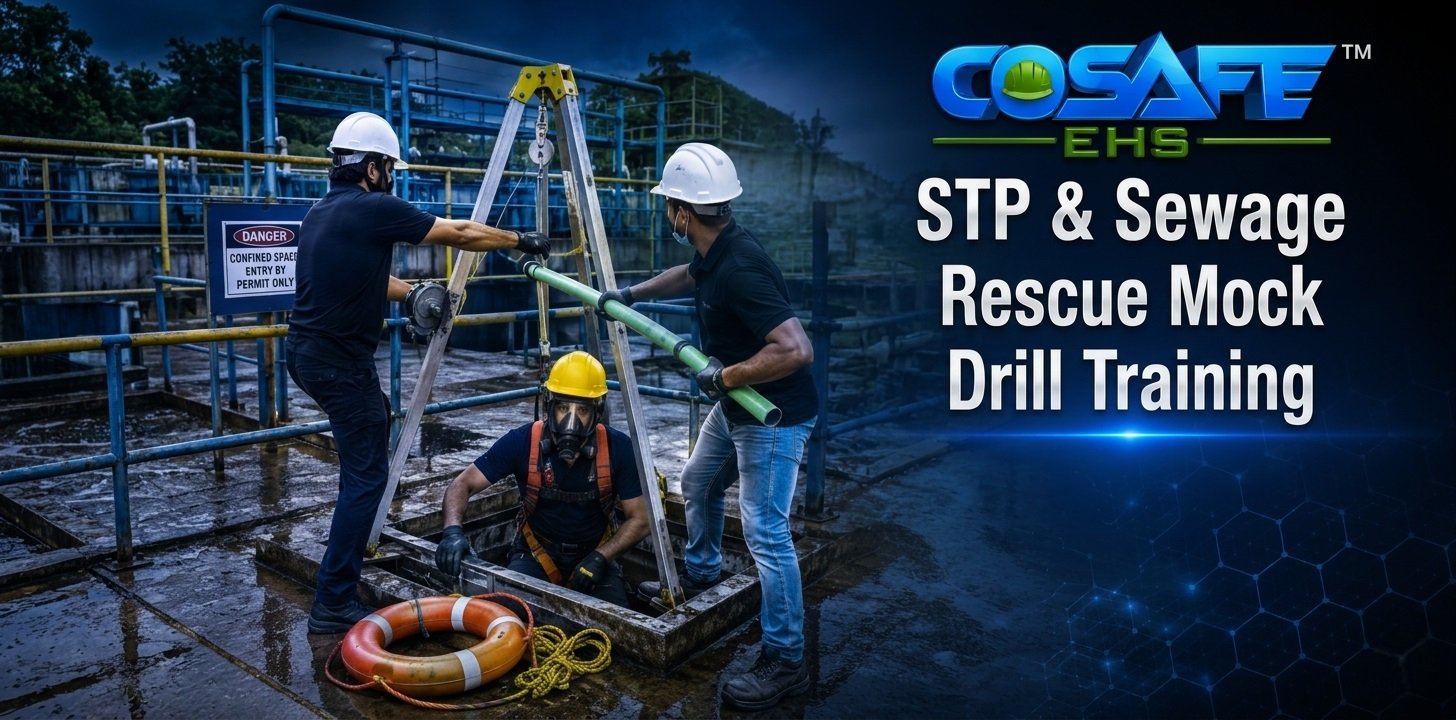
STP & Sewage Rescue Mock Drill Training

Flexible Delivery Options

As per your organizational needs

On-SiteClassroomOnline

Practical & Scenario-Based

Real-life examples, live demonstrations and workplace scenarios

Certificate Provided

Issued to every participant after successful completion of the training

STP & Sewage Rescue Mock Drill Training session

Overview

STP & Sewage Rescue Mock Drill Training in Bangalore & Hyderabad

Professional STP & Sewage Rescue Mock Drill Training by Cosafe EHS Bangalore & Hyderabad

Sewage Treatment Plants (STPs), Effluent Treatment Plants (ETPs), underground sewer networks, pumping stations, manholes, wet wells, sludge tanks, digesters, and underground chambers present some of the most hazardous working environments in industrial and municipal operations. These locations often qualify as confined spaces and expose workers to multiple life-threatening hazards including toxic gases, oxygen deficiency, biological contamination, engulfment risks, drowning hazards, mechanical equipment entrapment, and hazardous atmospheres.

One of the most serious dangers in sewage systems is the presence of toxic gases such as Hydrogen Sulfide (H₂S), Methane (CH₄), Carbon Monoxide (CO), Ammonia (NH₃), and oxygen-deficient atmospheres. These gases can quickly incapacitate workers, making rescue operations extremely challenging and time-sensitive. Wastewater and sewage facilities are specifically recognized for hazards involving toxic gases, oxygen deficiency, sludge engulfment, and difficult confined-space access.

At Cosafe EHS Bangalore & Hyderabad, our STP & Sewage Rescue Mock Drill Training Program is designed to prepare Emergency Response Teams (ERT), Safety Officers, Plant Operators, Maintenance Personnel, Supervisors, and Rescue Teams to safely manage confined space emergencies occurring in sewage treatment and wastewater facilities.

This comprehensive program combines confined space entry awareness, gas detection, emergency rescue procedures, retrieval systems, breathing apparatus operations, casualty management, permit-to-work systems, incident command structures, and realistic rescue simulations to ensure organizations can respond effectively during emergencies.

Why STP & Sewage Rescue Mock Drill Training is Important

Many confined space fatalities occur when untrained personnel attempt rescue without proper equipment or procedures. Studies and safety guidance consistently show that a significant number of confined space deaths involve would-be rescuers becoming victims themselves.

Regular STP & Sewage Rescue Mock Drills help organizations:

  • Test confined space rescue procedures

  • Improve emergency response readiness

  • Enhance rescue team competency

  • Reduce rescue response time

  • Verify equipment readiness

  • Improve communication systems

  • Strengthen permit-to-work compliance

  • Enhance gas monitoring capabilities

  • Improve casualty recovery techniques

  • Strengthen organizational safety culture


Common Hazards in STP & Sewage Facilities

Personnel may encounter:

  • Hydrogen Sulfide (H₂S) exposure

  • Methane accumulation

  • Oxygen-deficient atmospheres

  • Toxic gas inhalation

  • Biological contamination

  • Sludge engulfment hazards

  • Drowning risks

  • Mechanical equipment entrapment

  • Electrical hazards

  • Slip, trip, and fall hazards

  • Confined space emergencies

  • Chemical exposure incidents

These hazards require specialized rescue preparedness and continuous emergency response capability.

Objectives of STP & Sewage Rescue Mock Drills

The primary objectives include:

  • Testing confined space rescue plans

  • Evaluating rescue team readiness

  • Improving gas hazard awareness

  • Strengthening emergency communication

  • Enhancing rescue coordination

  • Improving casualty recovery procedures

  • Testing rescue equipment effectiveness

  • Strengthening incident command systems

  • Improving emergency decision-making

  • Building organizational resilience


Industries Requiring STP & Sewage Rescue Preparedness

This training is highly beneficial for:

  • Sewage Treatment Plants (STPs)

  • Wastewater Treatment Plants (WWTPs)

  • Effluent Treatment Plants (ETPs)

  • Municipal Water Authorities

  • Industrial Manufacturing Facilities

  • Pharmaceutical Industries

  • Food Processing Industries

  • Petrochemical Facilities

  • Oil & Gas Industries

  • Infrastructure Projects

  • Facility Management Companies

  • Utility Service Providers


Benefits of STP & Sewage Rescue Mock Drill Training

Organizations conducting regular rescue drills achieve:

  • Faster emergency response

  • Improved worker safety

  • Better confined space rescue capability

  • Enhanced compliance readiness

  • Reduced incident severity

  • Improved emergency preparedness

  • Better rescue coordination

  • Increased workforce confidence

  • Stronger ERT competency

  • Improved business continuity


Who Should Attend?

This training program is suitable for:

  • Emergency Response Team (ERT) Members

  • STP Operators

  • Sewage Plant Personnel

  • Maintenance Technicians

  • Safety Officers

  • EHS Professionals

  • Supervisors and Managers

  • Rescue Teams

  • Contractors

  • Engineers

  • Utility Personnel

  • Emergency Coordinators

At Cosafe EHS Bangalore & Hyderabad, our STP & Sewage Rescue Mock Drill Training is customized according to facility design, operational processes, confined space hazards, and industry-specific emergency response requirements.

STP and sewage treatment environments present unique and potentially fatal hazards, including toxic gases, oxygen-deficient atmospheres, biological contaminants, engulfment risks, and confined space emergencies. Without proper planning, rescue preparedness, trained personnel, and realistic mock drills, even routine maintenance activities can result in serious injuries or fatalities. Safety guidance consistently emphasizes regular rescue training, atmospheric monitoring, rescue planning, and competent rescue teams for wastewater and sewage operations.

At Cosafe EHS Bangalore & Hyderabad, our STP & Sewage Rescue Mock Drill Training Program equips Emergency Response Teams, safety professionals, plant operators, supervisors, and rescue personnel with the knowledge, practical skills, and confidence required to manage confined space and sewage-related emergencies safely and effectively. Through realistic rescue simulations, hands-on equipment training, and expert-led instruction, we help organizations strengthen emergency preparedness and protect lives.

Monitor the Atmosphere. Execute the Rescue. Save Lives. Choose Cosafe EHS for Professional STP & Sewage Rescue Mock Drill Training in Bangalore & Hyderabad.

Enquire Now

Get a customized STP & Sewage Rescue Mock Drill Training proposal for your organization.

Who Should Attend?

All Employees
Managers & Team Leaders
Safety Officers & HR Professionals
Emergency Response Teams
New Joinees
Leadership Teams

Training Modules

Our STP & Sewage Rescue Mock Drill Training program is structured to provide clear understanding, practical insights and real-world examples for better awareness and compliance.

01 STP operational hazards
02 Sewage system emergencies
03 Wastewater treatment risks
04 Rescue challenges
05 Emergency preparedness principles
06 Importance of mock drills
07 Definition of confined spaces
08 Permit-required confined spaces
09 Entry and exit challenges
10 Atmospheric hazards
11 Rescue limitations
12 Emergency response requirements
13 Hydrogen Sulfide (H₂S)
14 Methane (CH₄)
15 Carbon Monoxide (CO)
16 Ammonia (NH₃)
17 Oxygen deficiency hazards
18 Atmospheric testing procedures
19 Permit requirements
20 Entry authorization procedures
21 Hazard assessments
22 Isolation verification
23 Rescue readiness checks
24 Documentation requirements
25 Protective clothing
26 Respiratory protection
27 Chemical-resistant gloves
28 Eye protection
29 Safety harnesses
30 Protective footwear
31 SCBA components
32 Breathing apparatus procedures
33 Air management awareness
34 Emergency escape procedures
35 Respiratory protection limitations
36 Equipment inspection
37 Tripods
38 Winches
39 Retrieval systems
40 Rescue stretchers
41 Lifelines
42 Gas detectors
43 Communication devices
44 Rescue planning procedures
45 Emergency activation protocols
46 Resource allocation
47 Rescue route planning
48 Team coordination
49 Rescue readiness verification
50 Retrieval systems
51 Rescue winches
52 Lifeline recovery techniques
53 Casualty extraction methods
54 Emergency retrieval procedures
55 Entry rescue planning
56 Rescue team deployment
57 Hazard control measures
58 Rescue communication
59 Victim stabilization
60 Controlled extraction
61 Initial casualty assessment
62 Oxygen deficiency symptoms
63 H₂S exposure awareness
64 Trauma management
65 Patient stabilization
66 Emergency medical coordination
67 Incident Commander responsibilities
68 Team leadership
69 Resource management
70 Emergency communication
71 External agency coordination
72 Emergency reporting
73 Simulated confined space incidents
74 Toxic gas emergencies
75 Casualty retrieval operations
76 Rescue team deployment
77 Emergency communication exercises
78 Incident command activation
79 Manhole rescue operations
80 Wet well rescue scenarios
81 Sludge tank emergencies
82 Pump station incidents
83 Gas exposure emergencies
84 Multi-casualty rescue situations
85 Response time analysis
86 Rescue effectiveness evaluation
87 Equipment readiness review
88 Communication assessment
89 Corrective action planning
90 Lessons learned documentation

Training Methodology

01
Multimedia presentations
02
Industry case studies
03
Incident investigation reviews
04
Rescue planning workshops
05
Hazard recognition exercises
06
Best-practice discussions
07
STP hazard assessments
08
Confined space evaluations
09
Atmospheric risk reviews
10
Rescue feasibility studies
11
Equipment inspections
12
Emergency preparedness assessments
13
Gas detectors
14
SCBA systems
15
Tripods and winches
16
Rescue retrieval systems
17
Harnesses and lifelines
18
Communication equipment
19
Oxygen monitoring
20
H₂S detection
21
Methane monitoring
22
Atmospheric testing procedures
23
Hazard assessment exercises
24
Continuous monitoring practices
25
Non-entry rescue drills
26
Retrieval system operations
27
Casualty extraction exercises
28
Rescue team coordination
29
Emergency communication drills
30
Incident command simulations
31
Confined space rescue operations
32
Toxic gas emergency response
33
Casualty recovery exercises
34
SCBA deployment drills
35
Rescue team activation
36
Emergency evacuation exercises
37
H₂S exposure emergencies
38
Manhole rescue operations
39
Wet well incidents
40
Sludge tank emergencies
41
Pump station rescue scenarios
42
Multiple casualty rescue exercises
43
Performance feedback
44
Response time analysis
45
Rescue effectiveness reviews
46
Equipment assessments
47
Improvement recommendations
48
Lessons learned discussions
49
Written assessments
50
Gas detection exercises
51
Rescue simulations
52
Equipment operation evaluations
53
Team performance reviews
54
Practical competency demonstrations
55
Experienced confined space rescue instructors
56
Practical and hands-on training methodology
57
Realistic rescue simulations
58
Advanced gas monitoring exercises
59
SCBA and respiratory protection training
60
Site-specific emergency planning support
61
Competency-based assessments
62
Emergency Response Team development programs
63
Detailed post-drill evaluation reports
64
Customized corporate training solutions

Program Details

Details InformationTraining Duration

- 1 Day / 2 DaysMode of Training:- Classroom + PracticalCertification:- Certificate ProvidedCertificate Validity:- 1–2 YearsTraining Location:- Onsite / Training CenterLanguages Available:- Kannada / Hindi / English / Telugu

STP & Sewage Rescue Mock Drill Training program
Customizable for your organization

Industries We Serve

Our STP & Sewage Rescue Mock Drill Training is relevant for organizations across all industries, including:

IT & ITES
Manufacturing
Healthcare
Education Institutions
Hospitality
Construction & Infrastructure
Logistics & Warehousing
Corporate Offices & All Other Sectors

Why Choose CoSafe EHS?

Experienced Trainers
Customized Training Programs
Practical & Interactive Approach
Flexible Delivery Modes
Industry-Focused Content

Frequently Asked Questions

View All FAQs
It is practical emergency response training designed to prepare teams for confined space, toxic gas, sewage, and wastewater-related rescue emergencies.
Regular mock drills help organizations test rescue procedures, improve emergency readiness, strengthen rescue competency, reduce response time, and verify rescue equipment readiness.
Training addresses H₂S exposure, methane accumulation, oxygen deficiency, toxic gases, biological contamination, sludge engulfment, drowning, mechanical entrapment, electrical hazards, chemical exposure, and confined space emergencies.
The program is suitable for ERT members, STP operators, sewage plant personnel, maintenance technicians, safety officers, EHS professionals, supervisors, rescue teams, contractors, engineers, utility personnel, and emergency coordinators.
Yes. Participants learn about H₂S, methane, carbon monoxide, ammonia, oxygen deficiency, atmospheric testing, gas detection, and continuous monitoring practices.
The program includes practical familiarization with tripods, winches, retrieval systems, rescue stretchers, lifelines, gas detectors, communication devices, SCBA systems, and related rescue equipment.
Yes. Participants learn non-entry rescue methods such as retrieval systems and rescue winches, as well as trained entry rescue operations involving team deployment, hazard control, communication, victim stabilization, and controlled extraction.
Scenarios can include manhole rescue, wet well incidents, sludge tank emergencies, pump station incidents, H₂S or toxic gas exposure, confined space emergencies, and multiple-casualty rescue situations.
Cosafe EHS follows a practical, hands-on, competency-based methodology involving classroom sessions, site-specific hazard assessments, equipment demonstrations, gas monitoring exercises, confined space rescue exercises, full-scale simulations, and post-drill evaluation.
Yes. Participants are evaluated through written assessments, gas detection exercises, rescue simulations, equipment operation evaluations, team performance reviews, and practical competency demonstrations, with certificates issued upon successful completion.

Let's Create a Safer and More
Compliant Workplace Together

Contact us today to get a customized STP & Sewage Rescue Mock Drill Training proposal for your organization.