Bangalore Office
Warehouse No 4, Survey No 198/6, Janatha Colony, Dommsandra Bangalore Karnataka 562125



Warehouse No 4, Survey No 198/6, Janatha Colony, Dommsandra Bangalore Karnataka 562125
Godown No 3/C, Survey No. 217, Beside ORR, Shamshabad, R.R. District, Hyderabad, Telangana - 501218
+91 7892978960
corporate@cosafe.in
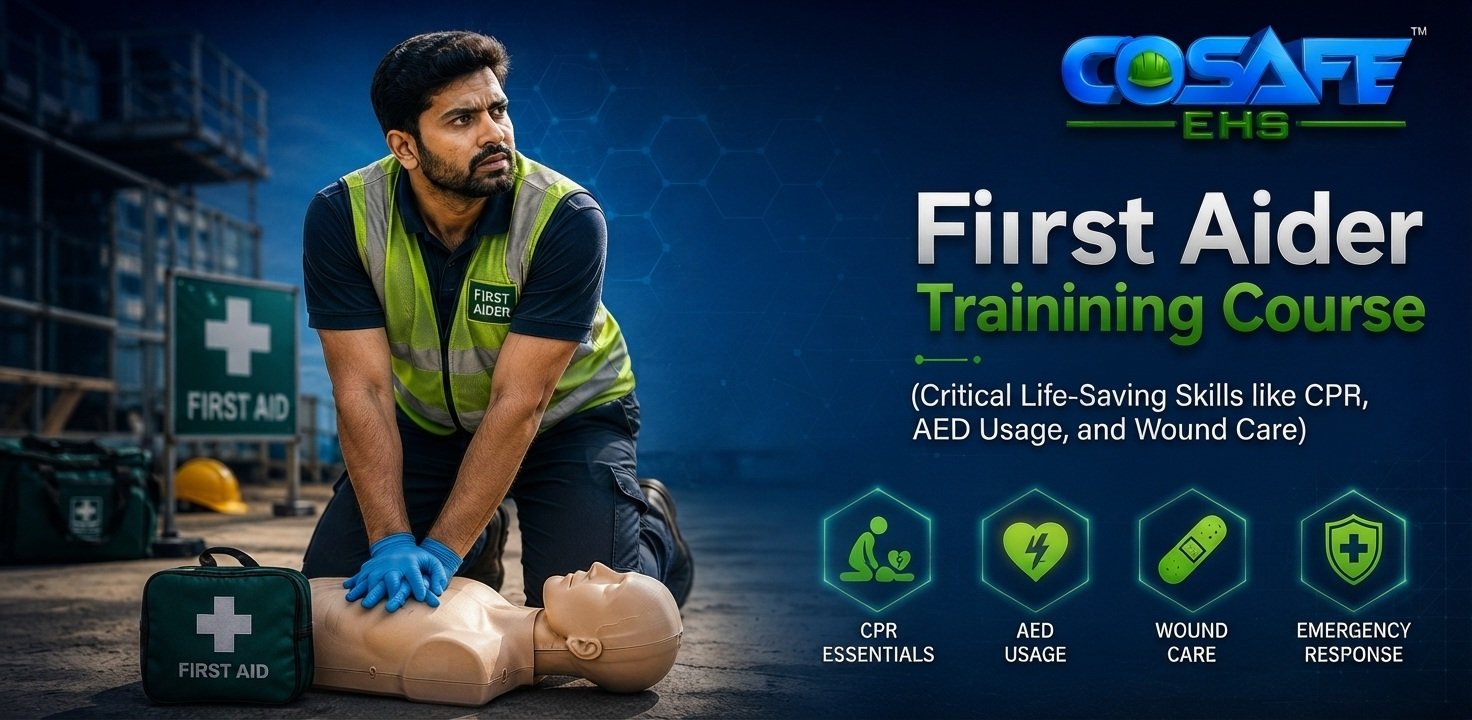
Medical emergencies can occur at any time and in any workplace, including factories, construction sites, warehouses, offices, hospitals, schools, hotels, shopping malls, logistics facilities, and industrial plants. Cardiac arrest, choking, severe bleeding, fractures, burns, electric shock, chemical exposure, heat stress, and traumatic injuries require immediate first aid before professional medical services arrive. A trained First Aider can make the difference between life and death by providing timely, safe, and effective emergency care.
The Professional First Aider Course by Cosafe EHS Bangalore & Hyderabad is a comprehensive, competency-based training program that equips participants with life-saving knowledge, practical emergency response skills, and the confidence to provide immediate assistance during workplace and public emergencies. The course emphasizes hands-on learning through practical demonstrations, CPR practice, AED familiarization, casualty assessment, trauma management, and emergency simulations.
Participants learn internationally accepted first aid principles, including patient assessment, scene safety, Basic Life Support (BLS), Cardiopulmonary Resuscitation (CPR), Automated External Defibrillator (AED) awareness, bleeding control, fracture management, burn treatment, choking response, recovery position, and emergency communication. The program prepares individuals to respond confidently while waiting for professional medical assistance.
A First Aider is a trained individual who provides immediate medical assistance to an injured or suddenly ill person until qualified healthcare professionals arrive. Their responsibilities include assessing the emergency scene, protecting themselves and others, providing first aid treatment, performing CPR when required, controlling bleeding, treating injuries, monitoring casualties, and coordinating emergency medical services.
This course is ideal for:
Participants learn:
• Principles of First Aid
• Objectives of Emergency Care
• Responsibilities of a First Aider
• Chain of Survival
• Scene Safety
• Infection Prevention
• Consent and Patient Care Ethics
Topics include:
• Scene Assessment
• Personal Safety
• Primary Survey (DRABC/DRSABCD)
• Secondary Assessment
• Vital Signs
• Patient Monitoring
• Emergency Communication
• Calling Emergency Services
Module 3 – Basic Life Support (BLS)
Participants learn:
• Adult BLS
• Child BLS
• Infant BLS
• Recognition of Cardiac Arrest
• Rescue Breathing
• Chest Compressions
• Compression-to-Ventilation Ratios
• Team-Based CPR
Hands-on practical training includes:
• Adult CPR
• Child CPR
• Infant CPR
• AED Components
• Safe AED Operation
• Pad Placement
• Shock Delivery Awareness
• Post-Resuscitation Care
Training covers:
• Airway Management
• Recovery Position
• Choking Recognition
• Adult Choking Response
• Child Choking Response
• Infant Choking Response
• Foreign Body Airway Obstruction (FBAO)
Module 6 – Bleeding & Wound Management
Participants practice:
• External Bleeding Control
• Pressure Bandaging
• Severe Bleeding Management
• Wound Cleaning
• Dressing Techniques
• Amputation Awareness
• Nosebleeds
Topics include:
• Bone Fractures
• Dislocations
• Sprains
• Strains
• Splinting Techniques
• Immobilization
• Casualty Movement
• Spinal Injury Precautions
Module 8 – Burns & Medical Emergencies
Participants learn:
• Thermal Burns
• Chemical Burns
• Electrical Burns
• Heat Stroke
• Heat Exhaustion
• Hypothermia
• Shock Management
• Poisoning Awareness
• Seizures
• Stroke Recognition
• Diabetic Emergencies
• Asthma Attacks
Training includes:
• Industrial Medical Emergencies
• Incident Reporting
• Emergency Action Plans
• Casualty Evacuation
• Team Coordination
• Communication During Emergencies
Hands-on activities include:
• CPR Practice
• AED Demonstration
• Bleeding Control
• Bandaging
• Splinting
• Recovery Position
• Casualty Assessment
• Emergency Simulations
• Team-Based Rescue Exercises
Participants complete:
• Written Examination
• CPR Practical Assessment
• AED Practical Evaluation
• Casualty Assessment Test
• Emergency Response Demonstration
• Competency Evaluation
• Certification upon Successful Completion
 Mr. S P Mahadev
Participants receive extensive practical experience through CPR manikins, AED demonstrations, bandaging exercises, casualty handling, emergency simulations, and realistic workplace scenarios that build confidence for real emergencies.
Training is delivered by experienced EHS professionals and emergency response instructors with practical knowledge in occupational health, workplace safety, and industrial emergency management.
Participants gain practical competency in:
• CPR
• AED Operation
• Airway Management
• Bleeding Control
• Burn Treatment
• Fracture Management
• Choking Response
• Medical Emergency Care
The course enables organizations to:
• Improve emergency response capability
• Reduce injury severity
• Increase employee confidence
• Improve business continuity
• Strengthen workplace safety culture
• Support regulatory compliance
Successful participants can enhance opportunities as:
• Certified First Aider
• Safety Officer
• HSE Officer
• Emergency Response Team Member
• Fire Marshal
• Site Supervisor
• Facility Coordinator
• Industrial Safety Professional
• Construction Safety Personnel
• Workplace Emergency Coordinator
Organizations benefit through:
• Faster emergency response
• Reduced medical incident severity
• Better employee protection
• Improved emergency preparedness
• Increased workforce competency
• Stronger safety compliance
• Reduced operational disruption
• Enhanced organizational resilience
Cosafe EHS follows a competency-based, highly practical training methodology designed to develop confident and capable workplace First Aiders through interactive learning, live demonstrations, and realistic emergency simulations.
Participants complete course registration and an initial assessment to evaluate their understanding of emergency response, workplace hazards, and basic first aid principles.
Expert instructors provide comprehensive training covering:
• First Aid Principles
• Human Anatomy Basics
• CPR
• AED
• Medical Emergencies
• Trauma Care
• Emergency Communication
• Workplace Emergency Procedures
Participants observe demonstrations on:
• CPR Techniques
• AED Operation
• Recovery Position
• Bandaging
• Splinting
• Bleeding Control
• Airway Management
• Casualty Handling
Participants actively perform:
• Adult CPR
• Child CPR
• Infant CPR
• AED Practice
• Choking Management
• Wound Dressing
• Fracture Immobilization
• Emergency Patient Assessment
• Casualty Transportation
Participants practice realistic scenarios involving:
• Cardiac Arrest
• Severe Bleeding
• Burns
• Choking
• Stroke
• Seizures
• Workplace Trauma
• Electrical Injuries
• Heat-Related Illnesses
• Team-Based Emergency Response
Participants complete:
• Written Examination
• CPR Practical Assessment
• AED Evaluation
• Casualty Assessment
• Emergency Response Demonstration
• Final Competency Assessment
Participants who successfully complete the program receive a Professional First Aider Course Certificate from Cosafe EHS, demonstrating competency in First Aid, CPR, AED awareness, emergency casualty management, workplace medical emergency response, and life-saving techniques. The certification enhances professional credibility and helps organizations build safer, more prepared workplaces.
Get trained by industry experts and become a certified professional.