Chat with us 1
Practical Training Certified Trainers Safer Workplaces

Green Code Mock Drill Training

Corporate Training in Bangalore, Hyderabad & Pan-India

An Evacuation Emergency can occur at any workplace without warning due to fire, bomb threats, gas leaks, chemical releases, structural instability, earthquakes, flooding, severe weather, utility failures, security threats, or othe...
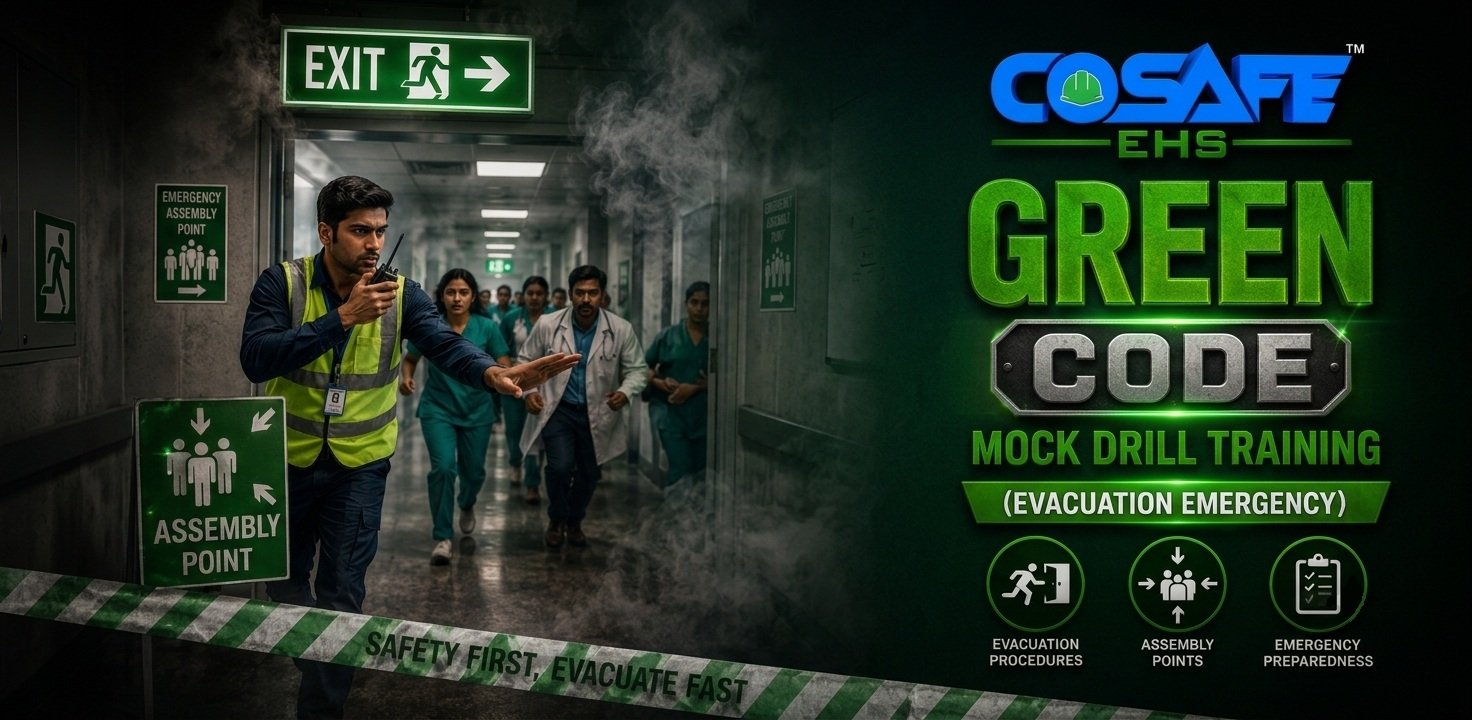
Green Code Mock Drill Training

Flexible Delivery Options

As per your organizational needs

On-SiteClassroomOnline

Practical & Scenario-Based

Real-life examples, live demonstrations and workplace scenarios

Certificate Provided

Issued to every participant after successful completion of the training

Green Code Mock Drill Training session

Overview

Professional Green Code Mock Drill Training (Evacuation Emergency) by Cosafe EHS Bangalore & Hyderabad

An Evacuation Emergency can occur at any workplace without warning due to fire, bomb threats, gas leaks, chemical releases, structural instability, earthquakes, flooding, severe weather, utility failures, security threats, or other hazardous situations. A safe and well-coordinated evacuation is essential to protect lives, minimize injuries, reduce panic, and ensure business continuity.

At Cosafe EHS Bangalore & Hyderabad, our Green Code Mock Drill Training (Evacuation Emergency) is designed to prepare organizations with the knowledge, practical skills, and confidence required to execute safe, organized, and efficient evacuations during emergencies. Through realistic scenario-based simulations, evacuation exercises, Incident Command System (ICS) implementation, emergency communication drills, and full-scale mock exercises, participants develop the competencies required to respond quickly while safeguarding employees, visitors, contractors, and critical assets.

Our training integrates internationally recognized emergency preparedness principles, evacuation planning, fire and life safety practices, business continuity concepts, and organizational emergency management to help organizations build a resilient safety culture.

What is a Green Code?

A Green Code is an emergency notification that commonly indicates a partial or full evacuation of a facility because remaining inside has become unsafe. Evacuation may be required due to an internal or external emergency such as fire, bomb threats, hazardous material releases, structural damage, or other dangerous conditions. It is important to note that Green Code meanings are not globally standardized, and some organizations assign different meanings to the colour. Every organization should therefore follow its own approved Emergency Response Plan (ERP).

A Green Code may be activated due to:

  • Fire emergency

  • Bomb threat

  • Suspicious package

  • Chemical spill

  • Toxic gas release

  • LPG or gas leakage

  • Structural damage

  • Earthquake

  • Flooding

  • Severe weather

  • Utility failure

  • Smoke infiltration

  • External security threat

  • Industrial accident

Any condition requiring immediate evacuation

The primary objective of a Green Code is to move occupants safely from danger, account for everyone at designated assembly areas, coordinate emergency responders, and resume operations only when authorities declare the area safe.

Countries Where Green Code (Evacuation Emergency) Systems Are Commonly Applied

Emergency colour-code systems that include Green Code for Evacuation are widely used in healthcare facilities and many organizations across:

  • India (organization-specific emergency code systems)

  • Canada

  • United States (selected organizations)

  • Australia (selected organizations)

  • New Zealand

  • Singapore

  • Malaysia

  • United Arab Emirates (UAE)

  • Saudi Arabia

  • Qatar

  • Oman

  • South Africa

  • Ireland

  • Hong Kong

In Canada, Green Code is widely standardized in many healthcare organizations to indicate Evacuation. In the United States and several other countries, the meaning may vary depending on the facility or employer, making organization-specific training essential.

Why Green Code Mock Drills are Important

An evacuation is successful only when it is well-planned, well-practiced, and executed without confusion. Poor emergency preparedness may result in:

  • Delayed evacuation

  • Panic among occupants

  • Congested exit routes

  • Incomplete personnel accountability

  • Communication failures

  • Injuries during evacuation

  • Business interruption

  • Property damage

  • Regulatory non-compliance

  • Increased emergency response time

Regular Green Code Mock Drills help organizations:

  • Improve evacuation preparedness

  • Strengthen emergency communication

  • Validate evacuation procedures

  • Improve employee confidence

  • Enhance emergency leadership

  • Improve assembly point management

  • Strengthen accountability procedures

  • Improve coordination with emergency services

  • Support regulatory compliance

  • Enhance organizational resilience

Objectives of Green Code Mock Drill Training

The program aims to:

  • Understand Green Code activation procedures

  • Develop effective evacuation strategies

  • Improve emergency communication

  • Strengthen emergency leadership

  • Enhance occupant accountability

  • Improve evacuation route management

  • Implement Incident Command System (ICS)

  • Coordinate with emergency agencies

  • Validate emergency response plans

  • Build a proactive safety culture

Key Benefits of Green Code Mock Drill Training

Organizations conducting regular Green Code drills benefit through:

  • Faster evacuation response

  • Improved employee safety

  • Better emergency coordination

  • Reduced panic during emergencies

  • Enhanced communication efficiency

  • Improved compliance readiness

  • Stronger business continuity

  • Better leadership performance

  • Increased emergency preparedness

  • Greater organizational resilience

Who Should Attend?

This training is suitable for:

  • EHS Managers

  • Safety Officers

  • Fire & Safety Officers

  • Emergency Response Teams (ERT)

  • Fire Wardens

  • Floor Wardens

  • Security Personnel

  • Facility Managers

  • Operations Managers

  • HR Managers

  • Administration Teams

  • Engineering & Maintenance Personnel

  • Manufacturing Employees

  • Warehouse Personnel

  • Logistics Teams

  • Corporate Office Employees

  • Educational Institution Staff

  • Hotel & Hospitality Personnel

  • Healthcare Support Staff

  • Industrial Workers

A Green Code (Evacuation Emergency) requires rapid decision-making, clear communication, disciplined evacuation, and effective coordination to protect lives during emergencies. Regular Green Code Mock Drills enable organizations to validate emergency procedures, strengthen preparedness, improve evacuation efficiency, and enhance resilience against a wide range of internal and external threats.

At Cosafe EHS Bangalore & Hyderabad, our Green Code Mock Drill Training (Evacuation Emergency) equips organizations with the knowledge, practical skills, and confidence needed to conduct safe and effective evacuations. Through realistic simulations, structured evaluations, and internationally aligned emergency management practices, we help organizations create safer workplaces, stronger emergency response capabilities, and resilient business operations.

Prepare. Evacuate. Protect. Recover. Choose Cosafe EHS for Professional Green Code Mock Drill Training (Evacuation Emergency) in Bangalore & Hyderabad.

Enquire Now

Get a customized Green Code Mock Drill Training proposal for your organization.

Who Should Attend?

All Employees
Managers & Team Leaders
Safety Officers & HR Professionals
Emergency Response Teams
New Joinees
Leadership Teams

Training Modules

Our Green Code Mock Drill Training program is structured to provide clear understanding, practical insights and real-world examples for better awareness and compliance.

01 Emergency preparedness
02 Evacuation management
03 Green Code principles
04 Organizational resilience
05 Business continuity
06 Life safety priorities
07 Green Code activation
08 Emergency notification
09 Partial evacuation
10 Full evacuation
11 Shelter-to-evacuation transition
12 Organizational emergency response plans
13 Hazard recognition
14 Workplace risk assessment
15 Vulnerability analysis
16 Evacuation trigger identification
17 Preventive controls
18 Emergency planning
19 Alarm systems
20 Public address systems
21 Emergency notifications
22 Communication hierarchy
23 Crisis communication
24 Reporting procedures
25 Evacuation routes
26 Emergency exits
27 Safe assembly areas
28 Alternative escape routes
29 Evacuation priorities
30 Mobility assistance planning
31 ICS principles
32 Emergency leadership
33 Command structure
34 Resource coordination
35 Decision-making
36 Documentation
37 Incident Controller
38 Emergency Coordinator
39 Fire Wardens
40 Floor Wardens
41 Search Teams
42 Security Personnel
43 First Aid Responders
44 Assembly Area Coordinators
45 Headcount procedures
46 Attendance verification
47 Visitor accountability
48 Contractor tracking
49 Missing person reporting
50 Re-entry authorization
51 Calm evacuation procedures
52 Stairwell safety
53 Crowd management
54 Exit discipline
55 Assistance for persons with disabilities
56 Hazard avoidance
57 Fire & Rescue Services
58 Police
59 Emergency Medical Services
60 Disaster Management Authorities
61 Civil Defence
62 Local Emergency Authorities
63 Critical operations protection
64 Emergency recovery planning
65 Damage assessment
66 Resource restoration
67 Operational continuity
68 Recovery coordination
69 Crisis leadership
70 Decision-making
71 Team coordination
72 Communication under pressure
73 Situation assessment
74 Resource management
75 Incident documentation
76 Timeline recording
77 Emergency reports
78 Lessons learned
79 Corrective actions
80 Continuous improvement
81 Green Code activation
82 Emergency notification
83 Evacuation procedures
84 Occupant accountability
85 Assembly point management
86 Incident Command activation
87 Emergency coordination
88 Recovery procedures
89 Performance evaluation
90 Response time analysis
91 Evacuation assessment
92 Communication review
93 Gap identification
94 Corrective action planning
95 Emergency response improvement

Training Methodology

01
Emergency preparedness presentations
02
Evacuation management workshops
03
Interactive discussions
04
Emergency case studies
05
Safety awareness sessions
06
Group learning activities
07
Hazard identification
08
Evacuation route analysis
09
Assembly point planning
10
Exit capacity evaluation
11
Occupancy risk assessment
12
Emergency planning workshops
13
Fire emergencies
14
Bomb threats
15
Gas leaks
16
Chemical releases
17
Structural instability
18
Severe weather events
19
Utility failures
20
Multi-floor evacuations
21
Alarm activation
22
Evacuation route management
23
Safe exit procedures
24
Assembly point organization
25
Accountability procedures
26
Communication protocols
27
Green Code activation
28
Emergency communication
29
Building evacuation
30
Occupant accountability
31
Incident Command implementation
32
Emergency coordination
33
Recovery planning
34
Re-entry management
35
Management Teams
36
Emergency Response Teams
37
Fire Wardens
38
Floor Wardens
39
Security Personnel
40
Engineering Departments
41
Maintenance Teams
42
HR Departments
43
Operations Personnel
44
Response times are measured
45
Evacuation efficiency is evaluated
46
Communication effectiveness is reviewed
47
Accountability procedures are assessed
48
Operational gaps are identified
49
Corrective action plans are developed
50
Written assessments
51
Practical evacuation exercises
52
Scenario-based simulations
53
Team performance
54
Mock drill participation
55
Emergency response competency evaluations
56
Experienced emergency preparedness consultants
57
Practical, scenario-based evacuation simulations
58
Industry-specific emergency planning
59
Incident Command System (ICS) integration
60
Comprehensive evacuation and accountability training
61
Customized on-site mock drills
62
Detailed post-drill evaluation reports
63
Compliance and audit readiness support
64
Continuous improvement recommendations
65
Strong commitment to life safety, emergency preparedness, and business continuity

Industries We Serve

Our Green Code Mock Drill Training is relevant for organizations across all industries, including:

IT & ITES
Manufacturing
Healthcare
Education Institutions
Hospitality
Construction & Infrastructure
Logistics & Warehousing
Corporate Offices & All Other Sectors

Why Choose CoSafe EHS?

Experienced Trainers
Customized Training Programs
Practical & Interactive Approach
Flexible Delivery Modes
Industry-Focused Content

Frequently Asked Questions

View All FAQs
Green Code Mock Drill Training prepares organizations to conduct safe, organized, and efficient evacuations during emergencies through practical simulations, evacuation exercises, emergency communication, and Incident Command System (ICS) implementation.
Green Code commonly indicates a partial or full facility evacuation when remaining inside becomes unsafe due to internal or external emergencies.
Green Code may be activated for fire, bomb threats, suspicious packages, chemical spills, toxic gas releases, LPG or gas leaks, structural damage, earthquakes, flooding, severe weather, utility failures, and security threats.
Regular drills help improve evacuation preparedness, emergency communication, occupant accountability, assembly point management, emergency leadership, coordination with emergency services, and organizational resilience.
The training is suitable for EHS Managers, Safety Officers, Fire Wardens, Floor Wardens, ERT members, Security Personnel, Facility Managers, HR and Administration teams, engineering and maintenance personnel, warehouse and logistics teams, and other relevant employees.
Training covers Green Code procedures, hazard identification, evacuation planning, emergency communication, ICS, roles and responsibilities, occupant accountability, safe evacuation techniques, emergency services coordination, business continuity, and emergency leadership.
Yes. Participants practice alarm activation, evacuation route management, safe exit procedures, assembly point organization, accountability procedures, communication protocols, and realistic evacuation scenarios.
Tabletop and full-scale simulations may include fire emergencies, bomb threats, gas leaks, chemical releases, structural instability, severe weather, utility failures, and multi-floor evacuation scenarios.
Yes. Cosafe EHS provides industry-specific emergency planning, customized on-site mock drills, evacuation and accountability training, ICS integration, and detailed post-drill evaluation.
Yes. Participants are assessed through written evaluations, practical evacuation exercises, scenario-based simulations, team performance, mock drill participation, and emergency response competency evaluations. Certificates are awarded upon successful completion.

Let's Create a Safer and More
Compliant Workplace Together

Contact us today to get a customized Green Code Mock Drill Training proposal for your organization.