Bangalore Office
Warehouse No 4, Survey No 198/6, Janatha Colony, Dommsandra Bangalore Karnataka 562125

Warehouse No 4, Survey No 198/6, Janatha Colony, Dommsandra Bangalore Karnataka 562125
Godown No 3/C, Survey No. 217, Beside ORR, Shamshabad, R.R. District, Hyderabad, Telangana - 501218
+91 7892978960
corporate@cosafe.in
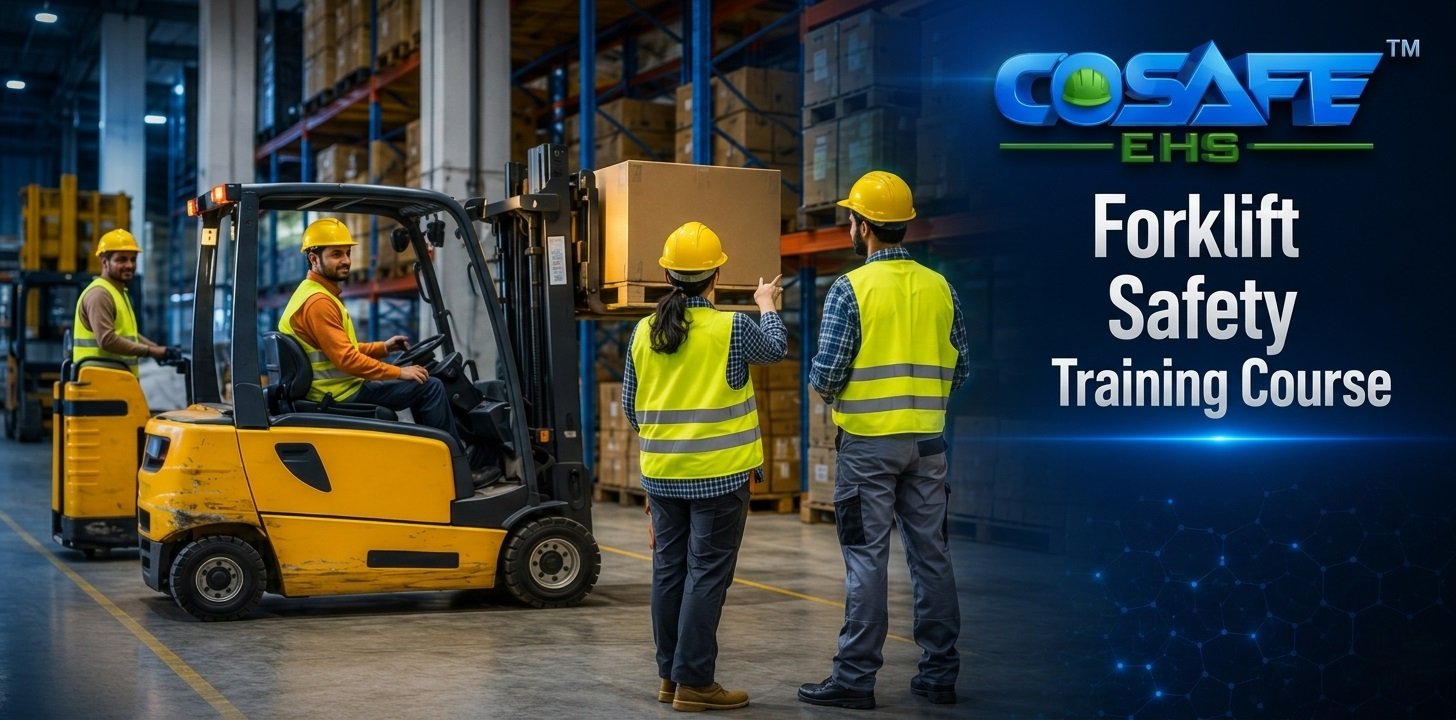
Forklifts, also known as Powered Industrial Trucks (PITs), are essential material handling equipment used across warehouses, manufacturing units, logistics centers, construction projects, ports, and industrial facilities. While forklifts significantly improve operational efficiency, improper operation can result in serious workplace accidents, equipment damage, product loss, and even fatalities.
Forklift Safety Training by Cosafe EHS Bangalore & Hyderabad is designed to equip operators, supervisors, warehouse personnel, and safety professionals with the knowledge and practical skills required to operate forklifts safely, efficiently, and in compliance with industry best practices. International safety standards emphasize that forklift operators must receive formal instruction, practical training, and competency evaluation before operating equipment independently.
At Cosafe EHS Bangalore & Hyderabad, Forklift Safety Training is positioned as a practical way for organizations to reduce accidents, improve productivity, and meet legal compliance expectations. The training is built around real workplace hazards, site conditions, and operator behavior, so teams learn how to work safely in the same environments where forklifts are actually used.
Forklift incidents most often involve tip-overs, collisions with pedestrians or objects, load instability, and poor visibility during maneuvering. OSHA’s guidance specifically warns operators to watch for pedestrians, keep clear visibility, sound the horn at cross aisles and obstructed areas, maintain safe distance from edges, and never use forks to lift people. OSHA also notes that forklifts are used for picking up, transporting, stacking, and unstacking loads, which makes safe load handling a core part of any training program.
This training is designed for forklift operators, warehouse staff, supervisors, logistics teams, maintenance personnel, and safety professionals who need a structured, compliance-oriented, and hands-on program that improves day-to-day safe operation.
Forklift-related incidents continue to be a major workplace safety concern globally, with many accidents linked to inadequate training, poor load handling practices, and unsafe operating behavior. Proper training significantly reduces these risks.
This Forklift Safety Training Course is ideal for:
Key Learning Outcomes
After completing the training, participants will be able to:
The final stage is competency review and feedback, so supervisors and organizations understand where additional coaching may be needed. This makes the training useful not only for certification, but also for building a stronger warehouse safety culture, reducing downtime, and improving overall operational reliability.
Forklift Safety Training at Cosafe EHS Bangalore & Hyderabad is designed to help organizations build safer operators, safer workplaces, and safer material handling systems.
Topics Covered
Learning Objective
Participants gain foundational knowledge of forklift operations and safety requirements.
Topics Covered
Practical Understanding
Operators learn how each component influences safe operation and equipment performance.
Topics Covered
Learning Objective
Understand the science behind forklift balance and accident prevention. Stability and load handling are among the most critical aspects of operator training programs.
Topics Covered
Practical Session
Hands-on forklift inspection before operation.
Topics Covered
Learning Objective
Develop safe driving habits that reduce operational risks.
Topics Covered
Practical Exercise
Real-time material handling simulations.
Proper load manipulation, stacking, and unstacking are essential competencies recommended within structured forklift training programs.
Topics Covered
Learning Objective
Recognize and control workplace hazards before incidents occur.
Industry guidance highlights pedestrian traffic, ramps, narrow aisles, and hazardous environments as critical training elements for forklift operators.
Topics Covered
Practical Scenario-Based Learning
Participants practice emergency response procedures in controlled environments.
Topics Covered
Learning Objective
Create safer interaction between forklifts and pedestrians.
Practical exercises and workplace evaluations are essential components of effective forklift operator training.
Assessment Areas
Certification Requirements
Participants are assessed to verify competence in safe forklift operations before certification. Competency evaluation is a core requirement of recognized forklift training frameworks.
At Cosafe EHS Bangalore & Hyderabad, the Forklift Safety Training methodology is built around a formal-and-practical learning model that mirrors OSHA’s performance-oriented approach. That means participants do not just hear about safe forklift operation; they practice the skills, demonstrate competence, and are evaluated in conditions that reflect their real workplace hazards
The program typically begins with interactive classroom sessions using presentations, discussions, and case examples to explain forklift hazards, operator responsibilities, load stability, pedestrian safety, visibility limitations, and workplace traffic control. This is followed by live demonstrations and supervised practical exercises covering inspection, start-up, steering, turning, load handling, parking, and safe shutdown procedures.
Instructor-Led Classroom Training
Our expert trainers deliver engaging classroom sessions using:
Participants gain a strong understanding of forklift safety principles before entering practical sessions.
Practical Hands-On Training
The practical component focuses on real-world forklift operations.
Activities Include
Hands-on training helps operators develop muscle memory, confidence, and safe operating behaviors.
Hazard Identification Workshops
Participants learn how to identify:
Real workplace scenarios are used to improve hazard recognition skills.
Scenario-Based Learning
Training incorporates realistic situations such as:
This approach improves decision-making and risk awareness.
Competency Evaluation
Each participant undergoes:
Training effectiveness is measured through competency-based evaluation methods aligned with industry best practices.
Certification
Upon successful completion, participants receive a Forklift Safety Training Certificate from Cosafe EHS Bangalore & Hyderabad.
Next, participants are taken through scenario-based exercises that reflect common warehouse and industrial risks such as blind corners, narrow aisles, ramp movement, obstructed visibility, load instability, pedestrian interaction, and emergency stopping. These exercises help operators build habit-based safety skills, which is important because many forklift incidents are linked to routine behaviors that become unsafe when attention drops or site conditions change.
Duration: Half Day (3–4 Hours) / Full Day (5–6 Hours)
Certification: Certificate will be provided after successful completion
Validity: 1–2 Years
Languages: Kannada / Hindi / English / Telugu