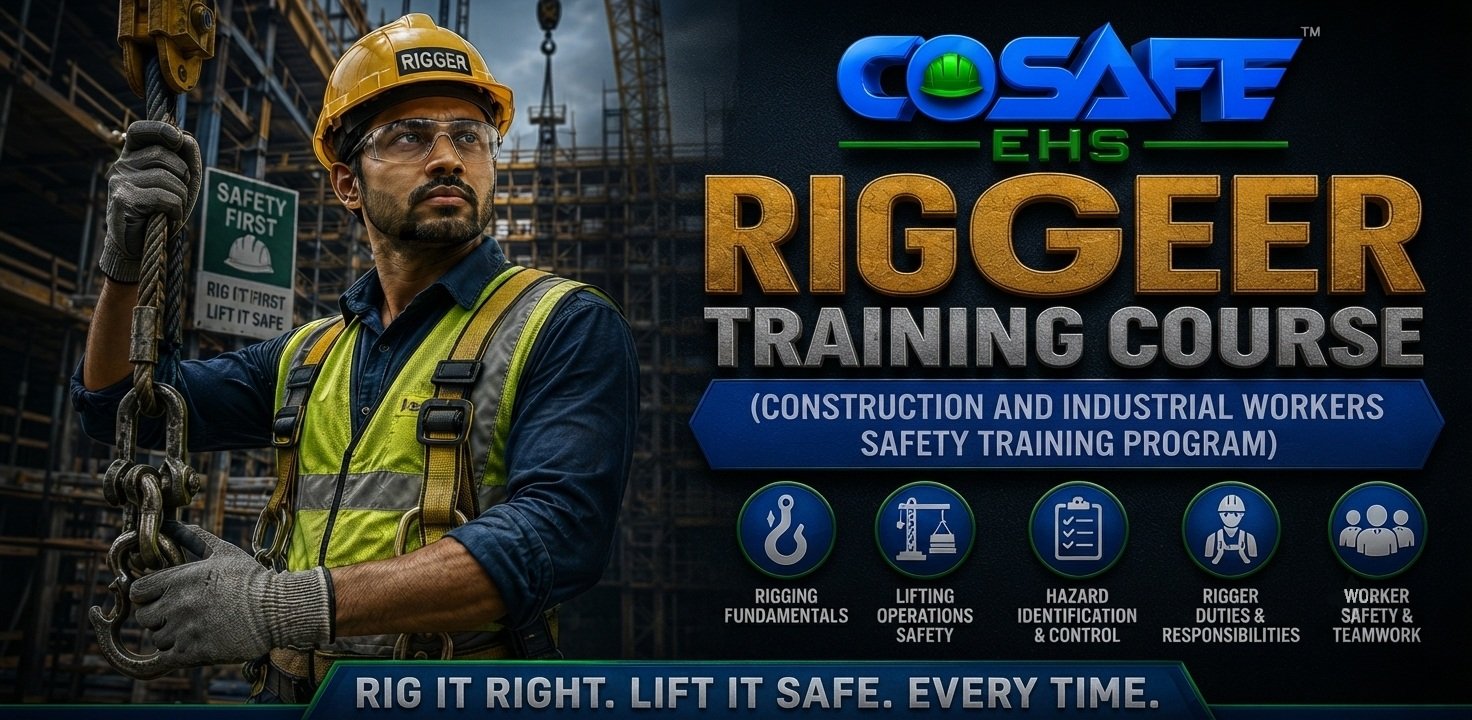
Rigger Training Course

Duration
3, 6, 12 months
Mode
Online/Offline
Placement
100% assistance
Language
Kannada/Hindi/English

Course Details

Professional Rigger Training Course in Bangalore

Advanced Rigging & Safe Lifting Operations Training for Industrial Professionals

Rigging operations are among the most safety-critical activities in industries involving heavy lifting, material handling, crane operations, construction, oil & gas, petrochemical plants, power generation, shipbuilding, manufacturing, mining, infrastructure, and logistics. Improper rigging practices can lead to dropped loads, equipment failures, structural damage, serious injuries, fatalities, project delays, and significant financial losses. A professionally trained Rigger plays a vital role in ensuring every lifting operation is planned, executed, and supervised safely.

The Rigger Training Course by Cosafe EHS Bangalore is a comprehensive, competency-based occupational health and safety program designed to equip participants with the technical knowledge, practical skills, and confidence required to perform safe rigging and lifting operations in accordance with international industry standards and best practices.

The course combines interactive classroom sessions, lifting equipment demonstrations, sling inspection, load calculation exercises, practical rigging techniques, crane communication, lifting plan workshops, hazard identification, and live lifting simulations. Participants develop the ability to inspect rigging equipment, select appropriate lifting gear, calculate safe working loads, direct crane operations using standard hand signals, and execute lifting tasks safely and efficiently.

This training reflects internationally recognized lifting and rigging principles widely applied across India, UAE, Saudi Arabia, Qatar, Oman, Kuwait, Bahrain, Singapore, Malaysia, Australia, the United Kingdom, Canada, and Europe, where competent riggers are essential for safe heavy lifting operations.
What is a Rigger?

A Rigger is a trained professional responsible for preparing, attaching, securing, and guiding loads for lifting and moving using cranes, hoists, winches, and other lifting equipment. Riggers inspect lifting accessories, determine the correct rigging method, calculate load weights, ensure equipment suitability, communicate with crane operators, and maintain complete control of lifting activities to prevent accidents.
Importance of Rigger Training

Safe rigging requires more than attaching slings to a load. Every lifting operation demands proper planning, hazard assessment, equipment inspection, communication, and load control.

Professional Rigger Training helps organizations:

  • Prevent dropped loads and lifting accidents

  • Improve lifting operation safety

  • Reduce equipment damage and downtime

  • Ensure compliance with lifting procedures

  • Improve communication between riggers and crane operators

  • Strengthen hazard identification and risk control

  • Increase operational efficiency

  • Protect personnel, equipment, and surrounding assets

  • Build a proactive workplace safety culture

Who Should Attend?

This course is ideal for:

  • Riggers

  • Banksmen / Signalmen

  • Crane Operators

  • Lifting Supervisors

  • Construction Supervisors

  • Mechanical Technicians

  • Maintenance Personnel

  • Fabricators

  • Welders

  • Pipe Fitters

  • Steel Erectors

  • Site Engineers

  • Project Engineers

  • Shutdown & Turnaround Personnel

  • Safety Officers

  • HSE Engineers

  • Warehouse Personnel

  • Logistics Teams

  • Marine & Shipyard Workers

  • Oil & Gas Professionals

  • Industries Covered

The course is applicable across:

  • Construction

  • Oil & Gas

  • Petrochemical Plants

  • Refineries

  • Manufacturing

  • Heavy Engineering

  • Steel Plants

  • Cement Plants

  • Mining

  • Infrastructure Projects

  • Marine & Shipbuilding

  • Ports & Harbours

  • Power Plants

  • Renewable Energy Projects

  • Warehousing & Logistics

  • Aviation

  • Railways

  • Facility Management

  • Industrial Maintenance

What you'll learn

  • Understand the roles, responsibilities, and safety requirements of a professional Rigger in construction, industrial, and heavy lifting operations.
  • Identify workplace hazards and perform effective Hazard Identification (HAZID), Risk Assessment (RA), and Job Safety Analysis (JSA) before conducting lifting activities.
  • Inspect, select, and safely use rigging equipment and lifting accessories, including slings, shackles, hooks, turnbuckles, spreader beams, and lifting clamps.
  • Calculate load weight, determine the Centre of Gravity (COG), and apply Safe Working Load (SWL) and Working Load Limit (WLL) principles for safe lifting operations.
  • Demonstrate correct rigging techniques using vertical, choker, basket, and multi-leg sling configurations for different types of loads.
  • Communicate effectively with crane operators using internationally recognized hand signals, radio communication, and standard lifting procedures.
  • Plan and execute routine, critical, and complex lifting operations while maintaining load stability, exclusion zones, and safe work practices.
  • Apply appropriate Personal Protective Equipment (PPE), lifting safety procedures, and emergency response measures to prevent lifting-related incidents and dropped loads.
  • Conduct pre-use inspections, identify defects, maintain rigging equipment, and ensure compliance with industry standards and workplace lifting procedures.
  • Develop the practical skills and competency required to perform safe, efficient, and compliant rigging operations, enhancing workplace safety, operational productivity, and career opportunities in construction, oil & gas, manufacturing, marine, and heavy engineering industries.