Confined Space Entry

Duration
3, 6, 12 months
Mode
Online/Offline
Placement
100% assistance
Language
Kannada/Hindi/English

Course Details

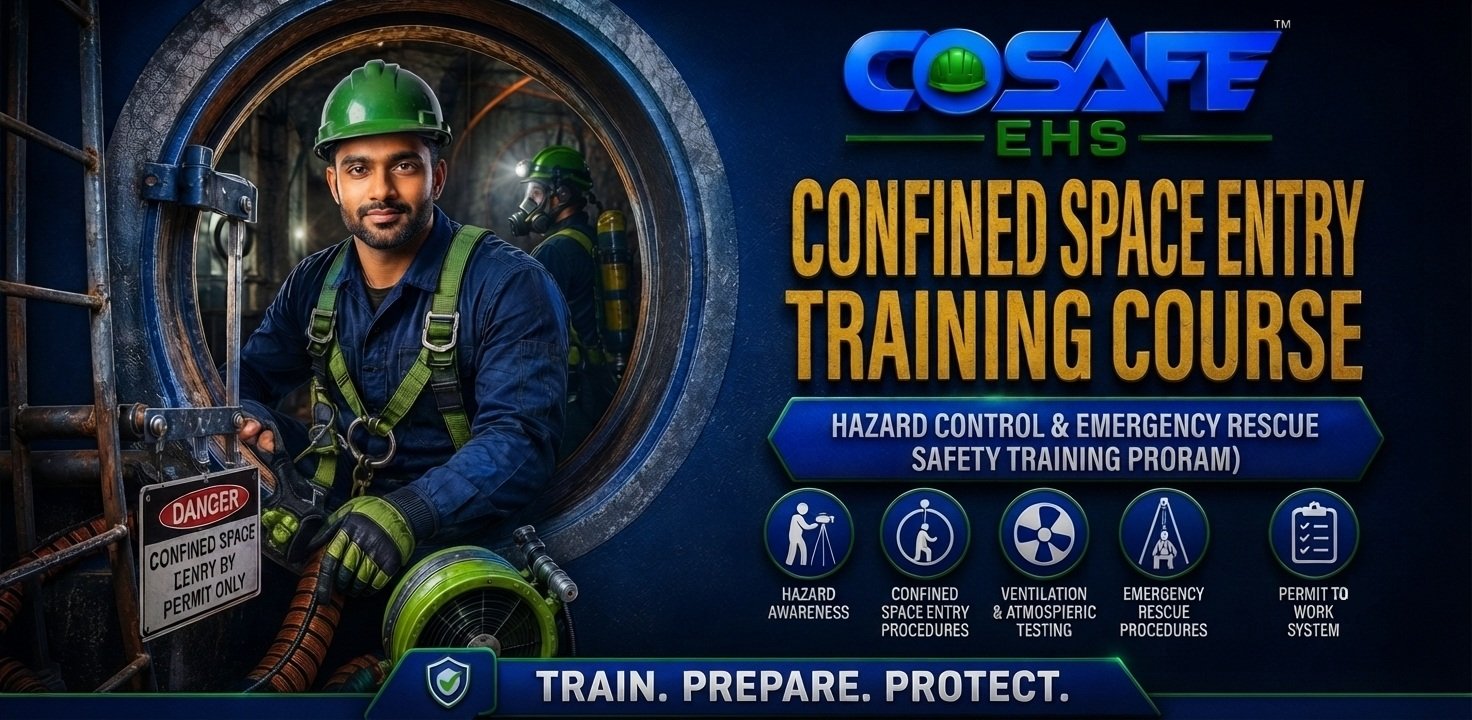
Confined Space Entry Training Course in Bangalore


Professional Confined Space Safety Training for Safe Entry, Hazard Control & Emergency Rescue

Confined spaces are among the most hazardous work environments in industrial operations. Tanks, silos, storage vessels, manholes, pipelines, sewers, boilers, vaults, pits, tunnels, reactors, sumps, and underground chambers often contain invisible dangers such as oxygen deficiency, toxic gases, flammable atmospheres, engulfment hazards, restricted access, and limited ventilation. Without proper planning, atmospheric testing, permit control, and emergency rescue preparedness, confined space work can rapidly result in serious injuries or fatalities.

The Confined Space Entry Training Course by Cosafe EHS Bangalore is a comprehensive, competency-based occupational health and safety program designed to equip participants with the knowledge, practical skills, and confidence required to safely enter, work within, supervise, and support confined space operations in accordance with recognized industry best practices.

The program combines instructor-led classroom sessions, practical demonstrations, gas detector training, atmospheric monitoring, Permit to Work (PTW) exercises, Lockout/Tagout (LOTO) demonstrations, ventilation techniques, emergency rescue simulations, and realistic confined space entry scenarios. Participants develop the competency to identify confined space hazards, implement effective control measures, conduct atmospheric testing, manage entry permits, use appropriate PPE, and respond effectively during emergencies.

The course reflects internationally accepted confined space entry principles widely adopted across India, UAE, Saudi Arabia, Qatar, Oman, Kuwait, Bahrain, Singapore, Malaysia, Australia, the United Kingdom, Canada, and Europe, making it valuable for professionals working in construction, oil & gas, petrochemical, manufacturing, utilities, marine, and infrastructure industries.

What is a Confined Space?

A confined space is an enclosed or partially enclosed area that is large enough for a worker to enter, has limited means of entry or exit, and is not designed for continuous human occupancy. Examples include tanks, vessels, silos, manholes, pipelines, tunnels, pits, boilers, and storage tanks. Some confined spaces are classified as Permit-Required Confined Spaces (PRCS) because they contain or have the potential to contain hazardous atmospheres, engulfment risks, or other serious hazards.

Why Confined Space Entry Training is Essential

Effective confined space training enables organizations to:

  • Prevent fatalities caused by oxygen deficiency and toxic gases

  • Identify atmospheric, mechanical, electrical, and engulfment hazards

  • Ensure compliance with Permit to Work (PTW) systems

  • Improve gas testing and atmospheric monitoring competency

  • Strengthen emergency preparedness and rescue planning

  • Reduce operational downtime and incident-related losses

  • Improve communication between entrants, attendants, and supervisors

  • Build a proactive workplace safety culture

  • Support compliance with industry and client safety requirements


Who Should Attend?

This course is suitable for:

  • Confined Space Entrants

  • Attendants (Hole Watchers)

  • Entry Supervisors

  • Safety Officers

  • HSE Engineers

  • Permit Receivers

  • Permit Issuers

  • Maintenance Engineers

  • Mechanical Technicians

  • Electrical Technicians

  • Instrumentation Technicians

  • Welders

  • Fabricators

  • Pipe Fitters

  • Shutdown & Turnaround Personnel

  • Construction Supervisors

  • Facility Management Teams

  • Emergency Response Teams (ERT)

  • Contractors

  • Industrial Workers


Industries Covered

  • Oil & Gas

  • Petrochemical

  • Chemical Processing

  • Refineries

  • Power Plants

  • Manufacturing

  • Construction

  • Mining

  • Marine & Shipbuilding

  • Water & Wastewater Treatment

  • Pharmaceuticals

  • Food Processing

  • Cement Plants

  • Steel Industries

  • Utilities

  • Infrastructure Projects

  • Warehousing & Logistics


What you'll learn

  • Understand the principles, classifications, hazards, and legal requirements associated with confined space entry operations in industrial workplaces.
  • Identify confined space hazards, including oxygen deficiency, toxic gases, flammable atmospheres, engulfment, mechanical, electrical, and environmental risks before entry.
  • Conduct effective Hazard Identification (HAZID), Risk Assessment (RA), and Job Safety Analysis (JSA) to implement appropriate control measures for confined space work.
  • Apply Permit to Work (PTW) procedures by interpreting, verifying, and complying with confined space entry permits, authorization requirements, and safe work practices.
  • Perform atmospheric testing using multi-gas detectors to monitor oxygen levels, flammable gases (LEL), and toxic gases such as Hydrogen Sulphide (H₂S) and Carbon Monoxide (CO).
  • Demonstrate the correct use of isolation procedures, Lockout/Tagout (LOTO), ventilation systems, retrieval equipment, and Personal Protective Equipment (PPE) for safe confined space entry.
  • Understand the roles and responsibilities of Authorized Entrants, Attendants, Entry Supervisors, Permit Issuers, and Emergency Rescue Teams during confined space operations.
  • Implement effective communication, continuous atmospheric monitoring, emergency response, evacuation procedures, and non-entry rescue techniques to manage confined space emergencies safely.
  • Conduct pre-entry inspections, equipment checks, permit verification, documentation, and post-entry procedures in compliance with industry best practices and organizational safety standards.
  • Develop the practical competency and confidence to safely perform confined space entry operations, reduce workplace risks, ensure regulatory compliance, and enhance safety performance across construction, manufacturing, oil & gas, petrochemical, utilities, and infrastructure industries.