Bangalore Office
Warehouse No 4, Survey No 198/6, Janatha Colony, Dommsandra Bangalore Karnataka 562125

Warehouse No 4, Survey No 198/6, Janatha Colony, Dommsandra Bangalore Karnataka 562125
Godown No 3/C, Survey No. 217, Beside ORR, Shamshabad, R.R. District, Hyderabad, Telangana - 501218
+91 7892978960
corporate@cosafe.in
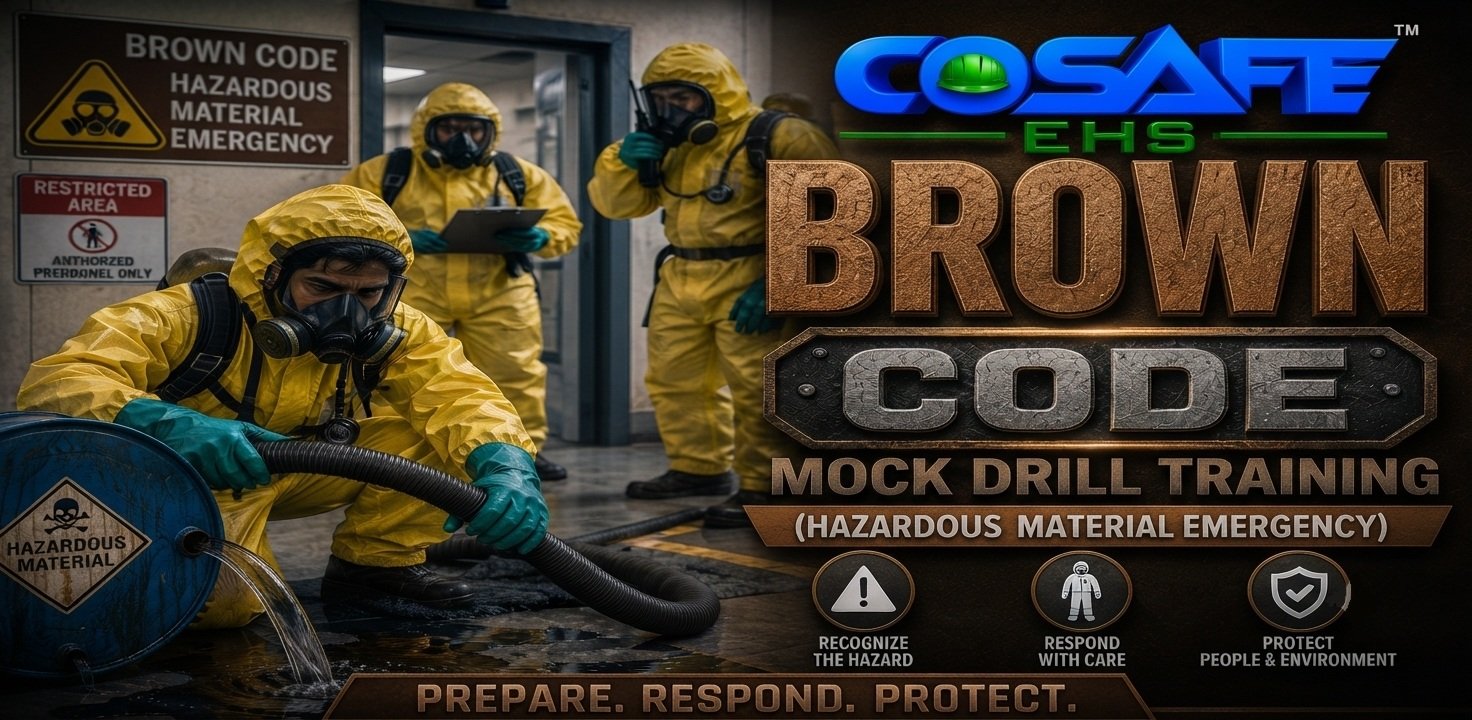
Hazardous material (HazMat) emergencies are among the most dangerous incidents that can occur in hospitals, manufacturing facilities, laboratories, chemical industries, oil & gas plants, pharmaceutical facilities, logistics centers, research institutions, and public infrastructure. Chemical spills, toxic gas leaks, corrosive substance exposure, radioactive contamination, biological hazards, and hazardous material transportation accidents can threaten human life, damage property, disrupt operations, and impact the environment if not managed effectively.
At Cosafe EHS Bangalore, our Brown Code Mock Drill Training (Hazardous Material Emergency) is designed to prepare organizations to effectively respond to hazardous material incidents through structured emergency planning, practical simulations, emergency communication, Incident Command System (ICS), spill containment awareness, decontamination procedures, evacuation planning, and coordinated emergency response exercises.
Our competency-based training enables Emergency Response Teams (ERT), safety professionals, healthcare workers, security personnel, facility managers, and operational teams to confidently manage hazardous material emergencies while minimizing injuries, environmental impact, operational downtime, and regulatory risks.
The program integrates globally recognized emergency preparedness principles, hazardous materials management practices, occupational health and safety standards, emergency response planning, environmental protection, and business continuity concepts to build resilient organizations capable of managing high-risk HazMat incidents.
A Brown Code (Code Brown) is an emergency notification used by many healthcare organizations and industrial facilities to indicate a Hazardous Material (HazMat) Emergency involving the release, spill, leakage, contamination, or exposure to dangerous chemical, biological, or hazardous substances requiring immediate emergency response.
Depending on the organization, Brown Code may be activated for:
The primary objective of Brown Code is to activate emergency response procedures, isolate the affected area, protect personnel, contain hazardous materials, coordinate with emergency responders, and minimize harm to people, property, and the environment.
Emergency colour-code systems differ between countries and organizations. Brown Code for hazardous material emergencies is commonly implemented in healthcare facilities, industrial organizations, and emergency management systems across:
Important Note: Emergency colour codes are not internationally standardized. Many Canadian healthcare facilities use Code Brown for hazardous material emergencies, while some organizations in other countries may assign different meanings. Every organization should follow its approved Emergency Response Plan (ERP), Hazardous Materials Management Plan, Disaster Management Plan (DMP), and local regulatory requirements.
Hazardous material emergencies can escalate rapidly, exposing employees, patients, visitors, responders, and surrounding communities to toxic substances. Without proper planning and regular emergency exercises, organizations may experience delayed response, uncontrolled chemical releases, environmental damage, injuries, regulatory violations, and operational shutdowns.
Regular Brown Code Mock Drill Training enables organizations to:
The training program aims to:
Organizations conducting regular Brown Code drills benefit through:
This training is highly suitable for:
This training is recommended for:
Hazardous material emergencies demand immediate recognition, rapid communication, effective containment, disciplined teamwork, and structured emergency response procedures. Regular Brown Code Mock Drill Training enables organizations to validate hazardous material emergency plans, improve response efficiency, strengthen environmental protection, and enhance workforce safety.
At Cosafe EHS Bangalore, our Brown Code Mock Drill Training (Hazardous Material Emergency) equips organizations with internationally aligned hazardous material emergency management practices, realistic emergency simulations, and competency-based learning to effectively manage chemical spills, toxic releases, and other HazMat incidents. Through practical mock drills, expert guidance, and continuous improvement, we help organizations build safer workplaces, stronger emergency response systems, regulatory compliance, and a culture of operational excellence and environmental responsibility.
Overview of hazardous material emergencies, emergency preparedness, legal responsibilities, environmental protection, and organizational emergency response systems.
Classification of hazardous substances, chemical hazards, toxic materials, corrosives, flammable substances, oxidizers, compressed gases, biological hazards, and radioactive materials.
Emergency notification systems, activation criteria, communication hierarchy, emergency announcements, documentation, escalation procedures, and emergency reporting.
Hazard identification techniques, chemical compatibility, exposure pathways, consequence analysis, workplace risk assessment, and preventive measures.
Chemical spill control principles, spill containment methods, leak isolation, absorbent materials, spill kits, containment barriers, and emergency response priorities.
Selection, inspection, limitations, proper use, maintenance, and emergency application of PPE suitable for hazardous material incidents.
Personnel decontamination, equipment decontamination, contaminated waste handling, isolation procedures, environmental protection, and safe disposal practices.
Emergency leadership, Incident Command structure, resource management, documentation, emergency decision-making, and coordination during hazardous material incidents.
Evacuation planning, exclusion zones, shelter-in-place procedures, emergency assembly, accountability systems, coordination with Fire Services, HazMat Teams, Pollution Control Authorities, and emergency medical services.
Participants conduct realistic hazardous material emergency simulations involving Brown Code activation, spill containment, emergency communication, evacuation, Incident Command implementation, PPE deployment, coordination with emergency agencies, decontamination awareness, documentation, and post-drill evaluation.