Bangalore Office
Warehouse No 4, Survey No 198/6, Janatha Colony, Dommsandra Bangalore Karnataka 562125

Warehouse No 4, Survey No 198/6, Janatha Colony, Dommsandra Bangalore Karnataka 562125
Godown No 3/C, Survey No. 217, Beside ORR, Shamshabad, R.R. District, Hyderabad, Telangana - 501218
+91 7892978960
corporate@cosafe.in
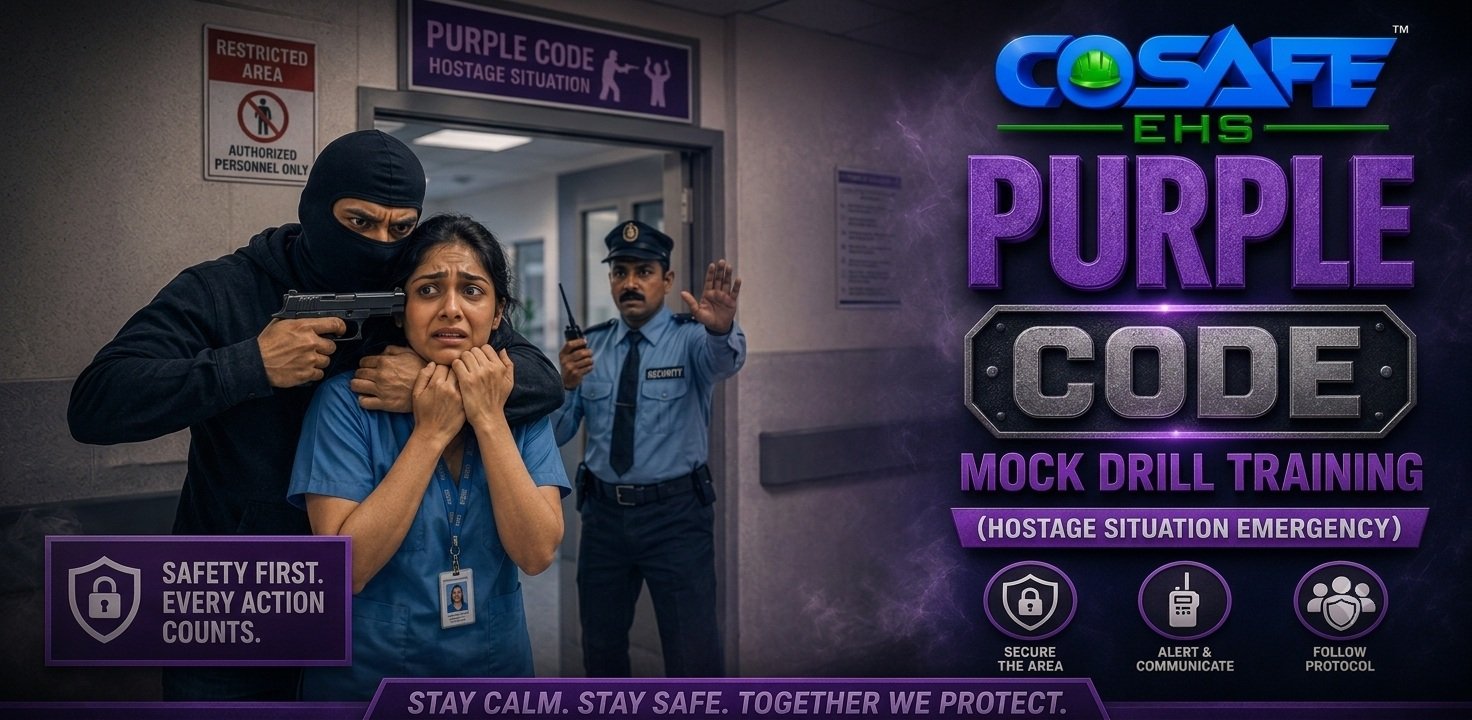
Hostage situations are among the most complex and high-risk emergencies that organizations may encounter. Whether caused by workplace violence, armed intrusions, criminal activities, domestic disputes, terrorism, or civil unrest, these incidents demand an immediate, coordinated, and highly disciplined response. Every decision made during a hostage emergency directly affects the safety of hostages, employees, visitors, emergency responders, and organizational assets.
Cosafe EHS Bangalore offers comprehensive Purple Code Mock Drill Training (Hostage Situation Emergency) designed to strengthen organizational preparedness through realistic emergency simulations, crisis communication, emergency command systems, lockdown procedures, coordination with law enforcement agencies, evacuation decision-making, and structured post-incident recovery planning.
Our scenario-based training prepares organizations to respond calmly, safely, and effectively during hostage emergencies while minimizing panic, protecting lives, supporting law enforcement operations, and maintaining business continuity. Participants gain practical experience through realistic mock drills, tabletop exercises, emergency communication practices, and coordinated response simulations.
The training follows internationally recognized emergency management principles, workplace violence prevention strategies, crisis management frameworks, occupational health and safety practices, and business continuity concepts to develop resilient organizations capable of managing high-risk security emergencies.
A Purple Code is an emergency notification used by some healthcare organizations, institutions, and corporate facilities to indicate a Hostage Situation Emergency requiring immediate activation of emergency response procedures, lockdown protocols, crisis management teams, and coordination with law enforcement authorities.
Depending on the organization, Purple Code may be activated during:
The objective of Purple Code is to rapidly secure the facility, protect occupants, activate emergency communication systems, coordinate with police and emergency responders, preserve life, and support safe resolution of the incident.
Emergency colour-code systems vary significantly across countries and organizations. Purple Code for hostage or security-related emergencies is implemented by selected healthcare institutions, government facilities, educational organizations, and corporate organizations in:
Important Note: Emergency colour codes are not internationally standardized. Some hospitals and organizations use Purple Code for hostage situations, while others may assign different meanings such as violent persons, bomb threats, or child protection incidents. Organizations should always follow their approved Emergency Response Plan (ERP), Security Management Plan, Crisis Management Plan, and applicable local regulations.
Hostage emergencies are unpredictable and can escalate within minutes. Organizations that conduct regular Purple Code Mock Drills are better prepared to protect lives, coordinate emergency actions, and support law enforcement during critical incidents.
Without regular preparedness exercises, organizations may face:
The training program aims to:
This training is recommended for:
Hostage situations require calm leadership, structured communication, disciplined emergency response, and close coordination with law enforcement agencies. Regular Purple Code Mock Drill Training enables organizations to validate security procedures, improve emergency readiness, strengthen crisis leadership, and protect employees, visitors, and critical assets during high-risk incidents.
At Cosafe EHS Bangalore, our Purple Code Mock Drill Training (Hostage Situation Emergency) equips organizations with internationally aligned security preparedness practices, realistic emergency simulations, and competency-based learning that prepare teams to respond effectively during hostage incidents. Through practical mock drills, continuous evaluation, and expert guidance, we help organizations build safer workplaces, stronger security systems, and resilient emergency response capabilities.
Understanding hostage situations, workplace violence, security threats, emergency preparedness principles, legal responsibilities, and organizational security management.
Identification of potential hostage scenarios, behavioural indicators, workplace vulnerabilities, threat assessment techniques, and preventive security measures.
Emergency notification systems, communication hierarchy, emergency announcements, activation protocols, escalation procedures, and emergency documentation.
Planning and implementation of lockdown procedures, access control, secure zones, shelter-in-place strategies, movement restrictions, and occupant accountability.
Internal communication, emergency messaging, communication with law enforcement, family communication, media awareness, and information management during hostage situations.
Emergency command structure, leadership roles, resource management, emergency coordination, documentation, and decision-making during security emergencies.
Understanding police response procedures, incident command integration, evidence preservation, perimeter management, emergency medical coordination, and mutual aid.
Safe behaviour during hostage situations, situational awareness, emergency instructions, shelter strategies, evacuation decision-making, and survival awareness.
Operational continuity planning, damage assessment, recovery planning, employee assistance, psychological support, and restoration of normal operations.
Participants conduct realistic simulations involving hostage emergency activation, lockdown implementation, emergency communication, law enforcement coordination, Incident Command activation, emergency decision-making, accountability procedures, and structured post-drill evaluation.