Bangalore Office
Warehouse No 4, Survey No 198/6, Janatha Colony, Dommsandra Bangalore Karnataka 562125

Warehouse No 4, Survey No 198/6, Janatha Colony, Dommsandra Bangalore Karnataka 562125
Godown No 3/C, Survey No. 217, Beside ORR, Shamshabad, R.R. District, Hyderabad, Telangana - 501218
+91 7892978960
corporate@cosafe.in
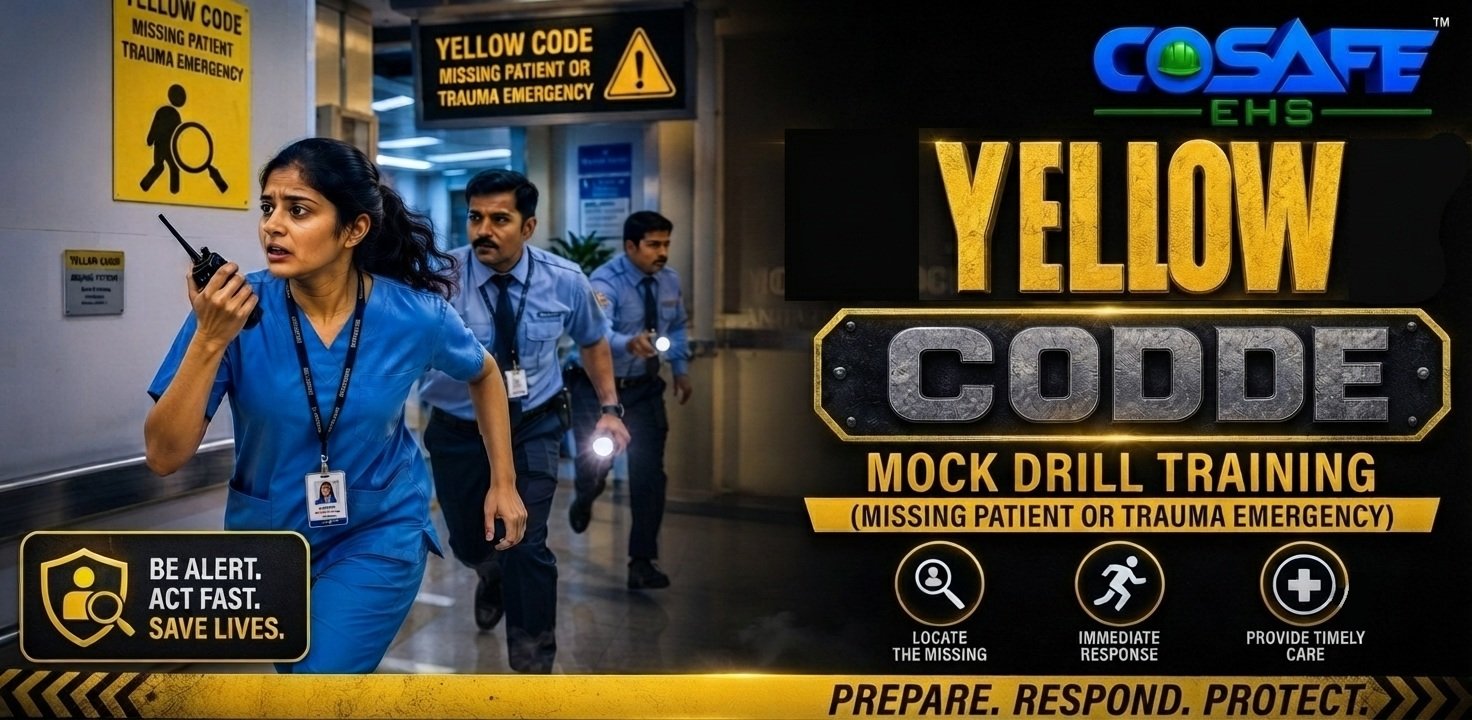
Healthcare facilities, hospitals, rehabilitation centers, nursing homes, and emergency care institutions frequently encounter situations where a patient goes missing or a major trauma emergency requires immediate, coordinated action. Such incidents demand rapid communication, systematic search procedures, multidisciplinary teamwork, emergency medical intervention, and effective coordination with security personnel and external emergency agencies. Delays or poor coordination can place patients at significant risk, compromise patient safety, and disrupt hospital operations.
Cosafe EHS Bangalore offers comprehensive Yellow Code Mock Drill Training (Missing Patient or Trauma Emergency) designed to prepare healthcare organizations and emergency response teams for managing critical situations through structured emergency planning, realistic simulations, incident command implementation, emergency communication, coordinated search operations, trauma response awareness, and post-incident evaluation.
Our competency-based program enables healthcare professionals, security teams, emergency response personnel, and hospital administrators to develop the knowledge, practical skills, and confidence required to respond effectively during Yellow Code emergencies while ensuring patient safety, regulatory compliance, and organizational resilience.
A Yellow Code (Code Yellow) is an emergency notification used by many hospitals and healthcare organizations to indicate a Missing Patient, Trauma Emergency, or another organization-specific emergency requiring immediate coordinated action. Because emergency colour codes are not internationally standardized, the meaning of Yellow Code varies between hospitals and countries.
Depending on the organization's emergency response policy, a Yellow Code may be activated for:
The primary objective of Yellow Code is to ensure immediate activation of emergency procedures, rapid communication, coordinated search operations or trauma response, patient protection, and timely restoration of normal healthcare services.
Emergency colour-code systems differ across healthcare organizations. Yellow Code is commonly used in healthcare facilities and institutions across:
Important Note: In many Canadian healthcare facilities, Code Yellow commonly refers to a Missing Patient. Some hospitals in other countries may use Yellow Code for Trauma Emergencies, Disaster Response, or other organization-specific situations. Every organization should follow its approved Hospital Emergency Response Plan (HERP), Emergency Response Plan (ERP), and applicable national healthcare regulations.
A missing patient or trauma emergency can rapidly escalate into a life-threatening situation if immediate action is not taken. Patients with cognitive impairment, psychiatric conditions, pediatric patients, or critically injured trauma victims require timely intervention to prevent serious consequences.
Regular Yellow Code Mock Drill Training helps organizations:
The program is designed to:
Organizations conducting regular Yellow Code drills gain several operational and safety advantages, including:
This program is highly beneficial for:
This training is recommended for:
Missing patient incidents and trauma emergencies require immediate recognition, rapid communication, effective teamwork, and structured emergency response procedures. Regular Yellow Code Mock Drill Training enables healthcare organizations to validate emergency protocols, improve response times, strengthen patient protection, and enhance multidisciplinary coordination.
At Cosafe EHS Bangalore, our Yellow Code Mock Drill Training (Missing Patient or Trauma Emergency) equips healthcare professionals, emergency responders, and hospital management teams with the knowledge, practical skills, and confidence required to respond effectively during critical incidents. Through realistic simulations, structured evaluations, and internationally aligned emergency preparedness practices, we help organizations build safer healthcare environments, stronger emergency response systems, and a culture of continuous patient safety improvement.
Overview of Yellow Code systems, emergency preparedness principles, patient safety standards, legal responsibilities, and emergency response policies.
Understanding patient elopement, high-risk patient categories, missing patient response procedures, search planning, reporting systems, and patient recovery strategies.
Recognition of trauma emergencies, trauma activation criteria, emergency stabilization principles, multidisciplinary coordination, and emergency response priorities.
Hospital emergency communication protocols, public announcement systems, emergency notification, documentation, reporting procedures, and communication hierarchy.
Hospital Incident Command System (HICS), emergency leadership, role allocation, resource management, emergency documentation, and operational coordination.
Organized search planning, zone allocation, access control, CCTV coordination, visitor management, patient tracking systems, and communication with security teams.
Coordination between emergency physicians, trauma surgeons, nursing staff, laboratory services, blood bank, radiology, pharmacy, ambulance services, and administration.
Hospital security management, restricted area control, visitor management, emergency access procedures, perimeter security, and coordination with law enforcement when required.
Patient identification systems, vulnerable patient monitoring, preventive measures, environmental safety, documentation, and quality improvement initiatives.
Participants conduct realistic simulations involving Yellow Code activation, emergency communication, missing patient search operations, trauma response coordination, Incident Command implementation, documentation, and post-drill evaluation.