






Overview
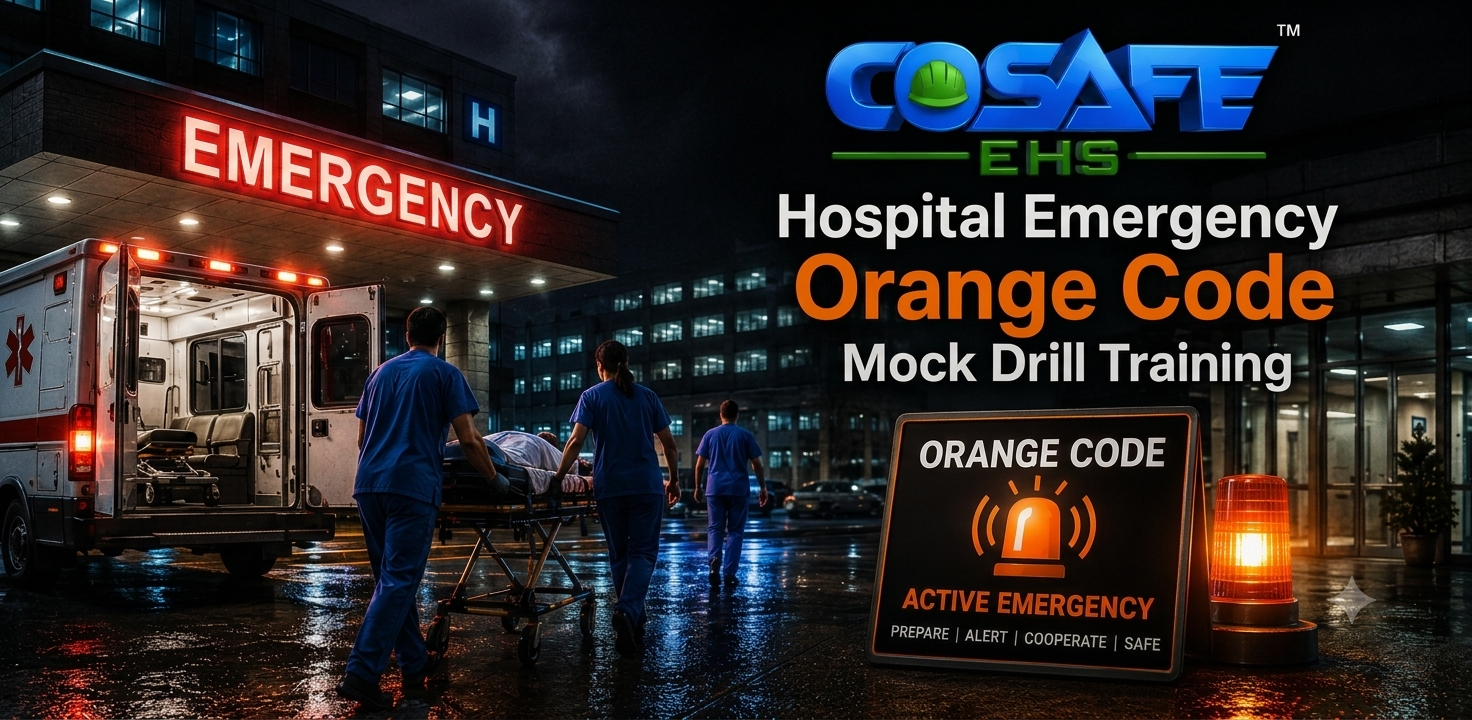
Hospital Emergency Orange Code Mock Drill Training in Bangalore
Professional Hospital Emergency Orange Code Mock Drill Training by Cosafe EHS Bangalore
Healthcare facilities must be prepared to respond rapidly and effectively to large-scale emergencies that can overwhelm normal hospital operations. Among the most critical emergency situations faced by hospitals are mass casualty incidents (MCIs), external disasters, multiple trauma events, transportation accidents, industrial disasters, explosions, natural calamities, and community-wide emergencies. In many healthcare systems worldwide, these situations are managed through the activation of Hospital Emergency Orange Code protocols.
At Cosafe EHS Bangalore, our Hospital Emergency Orange Code Mock Drill Training Program is designed to strengthen hospital disaster preparedness, emergency response coordination, mass casualty management, patient surge handling, triage operations, and incident command capabilities. The program helps healthcare facilities test their emergency plans, identify operational gaps, improve interdepartmental coordination, and ensure readiness for large-scale emergencies.
Through realistic simulations, scenario-based exercises, tabletop drills, and full-scale mock drill execution, participants develop the competence and confidence required to manage complex emergency situations while maintaining patient care and operational continuity.
What is Hospital Emergency Orange Code?
Hospital Emergency Orange Code is commonly used in many healthcare organizations to indicate a Mass Casualty Incident (MCI), External Disaster, Community Emergency, or Large-Scale Patient Surge Situation requiring immediate activation of emergency response systems.
Depending on the country, healthcare authority, and hospital emergency code policy, Orange Code may be activated during:
Road traffic accidents involving multiple casualties
Industrial accidents
Chemical plant incidents
Building collapses
Train accidents
Aircraft emergencies
Natural disasters
Earthquakes
Floods
Cyclones and storms
Terrorist incidents
Community disasters
Public health emergencies
The exact definition of Orange Code may vary by jurisdiction, but its primary objective remains the coordinated management of large-scale emergencies requiring extraordinary healthcare resources.
Countries Where Hospital Orange Code Systems Are Commonly Used
Hospital emergency color code systems, including Orange Code, are widely implemented across healthcare facilities in:
India
United States
Canada
Australia
New Zealand
United Kingdom
Ireland
Singapore
Malaysia
United Arab Emirates (UAE)
Saudi Arabia
Qatar
Oman
South Africa
Hong Kong
While the terminology and emergency code assignments may differ slightly between countries and healthcare organizations, Orange Code is frequently associated with disaster response, mass casualty management, or external emergency incidents requiring hospital-wide coordination.
Why Hospital Orange Code Mock Drills are Important
Hospitals face significant challenges when dealing with large numbers of casualties arriving within a short period.
Without proper preparedness, hospitals may experience:
Resource shortages
Delayed patient treatment
Communication failures
Emergency department overcrowding
Operational disruption
Patient safety risks
Staff confusion
Inadequate triage management
Poor coordination with external agencies
Increased mortality and morbidity
Regular Orange Code Mock Drills help hospitals validate emergency plans, strengthen preparedness, and ensure efficient emergency response during actual disasters.
Objectives of Hospital Emergency Orange Code Mock Drill Training
The key objectives include:
Understanding Orange Code activation procedures
Strengthening mass casualty preparedness
Improving disaster management capabilities
Enhancing triage effectiveness
Strengthening emergency communication systems
Improving surge capacity management
Enhancing incident command operations
Coordinating with external emergency agencies
Testing hospital disaster response plans
Building organizational resilience
Key Benefits of Orange Code Mock Drills
Healthcare facilities conducting regular Orange Code drills benefit through:
-
Improved disaster preparedness
Faster emergency activation
Better triage efficiency
Enhanced patient management
Stronger resource coordination
Improved communication systems
Better interdepartmental collaboration
Increased staff confidence
Enhanced business continuity
Improved regulatory readiness
Who Should Attend?
This training is ideal for:
Hospital Administrators
Medical Superintendents
Emergency Physicians
Nursing Leaders
Emergency Department Teams
Trauma Teams
Disaster Management Committees
Hospital Incident Command Teams
Security Personnel
Ambulance Coordinators
Safety Officers
EHS Professionals
Mass casualty incidents, external disasters, and community emergencies can occur without warning, placing extraordinary demands on healthcare facilities. Hospitals must be prepared to rapidly activate emergency response systems, manage patient surges, coordinate resources, and maintain critical healthcare operations. Regular Hospital Emergency Orange Code Mock Drills are essential for validating preparedness, strengthening response capabilities, and ensuring effective disaster management.
At Cosafe EHS Bangalore, our Hospital Emergency Orange Code Mock Drill Training Program equips healthcare professionals with the knowledge, practical skills, and confidence required to manage complex disaster situations efficiently. Through realistic simulations, structured evaluations, and continuous improvement methodologies, we help hospitals build safer, stronger, and more resilient healthcare systems.
Prepare for Disasters. Strengthen Response. Save More Lives. Choose Cosafe EHS Bangalore for Professional Hospital Emergency Orange Code Mock Drill Training in Bangalore.
Training Modules
Module 1: Introduction to Hospital Disaster Management
Participants gain a strong understanding of disaster preparedness principles.
Topics include:
- Hospital disaster management fundamentals
- Emergency preparedness frameworks
- Disaster response systems
- Hospital emergency planning
- Healthcare resilience
- Emergency coordination structures
Module 2: Understanding Hospital Emergency Orange Code
This module focuses on Orange Code concepts and activation procedures.
Training includes:
- Definition of Orange Code
- Disaster classifications
- Mass casualty incidents
- External emergencies
- Hospital surge events
- Emergency activation criteria
Participants learn when and how Orange Code should be activated.
Module 3: Mass Casualty Incident (MCI) Management
Participants understand the challenges associated with managing multiple casualties.
Topics include:
- MCI principles
- Casualty flow management
- Patient prioritization
- Resource allocation
- Emergency department expansion
- Surge response planning
Module 4: Hospital Incident Command System (HICS)
Effective disaster response requires structured leadership.
Training includes:
- Hospital Incident Command System
- Incident Commander roles
- Command structure development
- Emergency operations center activation
- Resource coordination
- Incident documentation
Participants learn organized disaster response management.
Module 5: Triage Management During Disasters
Triage is critical during mass casualty incidents.
Topics include:
- Disaster triage principles
- START triage system
- Patient categorization
- Priority treatment decisions
- Triage area setup
- Continuous reassessment
Participants practice rapid patient prioritization techniques.
Module 6: Emergency Communication and Information Management
Communication plays a vital role during disaster situations.
Training includes:
- Emergency notifications
- Communication hierarchy
- Internal communication systems
- External agency communication
- Media management
- Situation reporting
Participants learn effective emergency communication practices.
Module 7: Surge Capacity and Resource Management
Hospitals must be prepared to manage sudden increases in patient volume.
Topics include:
- Surge capacity planning
- Bed management strategies
- Resource mobilization
- Staffing contingency plans
- Equipment allocation
- Emergency logistics
Participants learn how to optimize available resources during disasters.
Module 8: Patient Flow and Emergency Department Management
Managing patient movement efficiently is essential.
Training includes:
- Patient reception procedures
- Casualty distribution
- Treatment area management
- Overflow planning
- Emergency routing
- Patient tracking systems
Module 9: Coordination with External Emergency Services
Successful disaster response requires multi-agency collaboration.
Topics include:
- Ambulance services coordination
- Fire department interaction
- Police coordination
- Disaster management authorities
- Public health agencies
- Mutual aid agreements
Participants understand inter-agency emergency coordination.
Module 10: Emergency Medical Response and Trauma Management
Participants gain awareness of emergency medical response principles.
Training includes:
- Trauma management coordination
- Critical patient stabilization
- Emergency medical support
- Casualty handling procedures
- Treatment prioritization
- Patient transfer coordination
Module 11: Hospital Security and Access Control During Disasters
Disaster situations require enhanced security management.
Topics include:
- Crowd control
- Visitor management
- Emergency access routes
- Restricted area management
- Security coordination
- Facility protection measures
Participants learn how to maintain order during large-scale emergencies.
Module 12: Evacuation and Shelter-in-Place Procedures
Some disasters may require partial or full evacuation.
Training includes:
- Evacuation decision-making
- Patient evacuation planning
- Shelter-in-place strategies
- Area isolation
- Occupant accountability
- Emergency relocation procedures
Module 13: Business Continuity and Recovery Planning
Hospitals must continue critical services during emergencies.
Topics include:
- Continuity planning
- Essential service protection
- Recovery operations
- Infrastructure resilience
- Emergency recovery teams
- Operational restoration
Participants learn strategies for maintaining healthcare operations.
Module 14: Full-Scale Hospital Orange Code Mock Drill Simulation
Participants engage in realistic emergency scenarios involving:
- Mass casualty incidents
- Multi-vehicle accidents
- Industrial disaster simulations
- Disaster triage operations
- Surge capacity activation
- Emergency coordination exercises
- Incident command deployment
- Resource mobilization activities
These drills simulate real-world disaster response conditions.
Module 15: Post-Drill Evaluation and Improvement Planning
Continuous improvement strengthens emergency preparedness.
Training includes:
- Drill performance assessment
- Response gap analysis
- Corrective action planning
- Lessons learned reviews
- Emergency plan updates
- Future preparedness enhancements
Training Methodology
At Cosafe EHS Bangalore, our Hospital Emergency Orange Code Mock Drill Training follows a practical, simulation-based, and healthcare-focused methodology designed to prepare hospitals for large-scale emergencies and mass casualty incidents.
Interactive Classroom Sessions
Participants receive expert instruction through:
- Disaster management presentations
- Emergency preparedness workshops
- Hospital emergency planning discussions
- Case study reviews
- Incident command training
- Interactive Q&A sessions
This provides a strong foundation in disaster response principles.
Disaster Risk Assessment Workshops
Participants engage in:
- Hazard identification exercises
- Disaster vulnerability assessments
- Emergency planning reviews
- Resource gap analysis
- Surge capacity evaluations
- Preparedness planning activities
These workshops strengthen organizational resilience.
Tabletop Disaster Simulations
Participants work through realistic disaster scenarios involving:
- Mass casualty events
- Natural disasters
- Industrial accidents
- Community emergencies
- Public health incidents
- Transportation disasters
These exercises improve strategic decision-making and coordination.
Triage and Casualty Management Practical Sessions
Hands-on exercises include:
- Patient triage simulations
- Casualty categorization
- Emergency treatment prioritization
- Patient flow management
- Resource allocation exercises
- Emergency department surge management
Participants develop practical disaster response skills.
Incident Command System Exercises
Participants practice:
- Command center activation
- Leadership coordination
- Emergency communications
- Resource deployment
- Situation reporting
- Multi-agency collaboration
These exercises strengthen command and control capabilities.
Full-Scale Orange Code Mock Drill Execution
Participants actively perform:
- Orange Code activation
- Disaster response deployment
- Triage operations
- Casualty management
- Surge capacity activation
- Emergency communication
- Incident command operations
- Inter-agency coordination
These drills simulate realistic hospital disaster scenarios.
Multi-Department Coordination Exercises
Training involves:
- Emergency Departments
- Trauma Teams
- Nursing Services
- Hospital Administration
- Security Personnel
- Ambulance Services
- Engineering Departments
- Disaster Management Teams
This ensures hospital-wide preparedness.
Post-Drill Debriefing and Evaluation
Following every mock drill:
- Response effectiveness is assessed
- Triage performance is reviewed
- Communication efficiency is evaluated
- Operational gaps are identified
- Corrective actions are recommended
- Improvement plans are developed
This supports continuous preparedness improvement.
Competency Assessment and Certification
Participants are evaluated through:
- Written assessments
- Disaster response exercises
- Triage simulations
- Incident command evaluations
- Team participation
- Mock drill performance reviews
Certificates are awarded upon successful completion of the program.
Why Choose Cosafe EHS Bangalore for Hospital Emergency Orange Code Mock Drill Training?
- Specialized healthcare disaster management expertise
- Experienced emergency preparedness consultants
- Realistic mass casualty simulations
- Hospital-specific emergency planning solutions
- Incident Command System integration
- Practical triage and surge management exercises
- Multi-agency coordination expertise
- Regulatory and accreditation support
- Comprehensive post-drill evaluation reports
- Strong focus on patient safety and operational continuity