Bangalore Office
Warehouse No 4, Survey No 198/6, Janatha Colony, Dommsandra Bangalore Karnataka 562125

Warehouse No 4, Survey No 198/6, Janatha Colony, Dommsandra Bangalore Karnataka 562125
First Floor, Santhosh Reddy Complex, 23-171/1, Madhura Nagar, Shamshabad, Hyderabad, Telangana 501218
+91 7892978960
corporate@cosafe.in
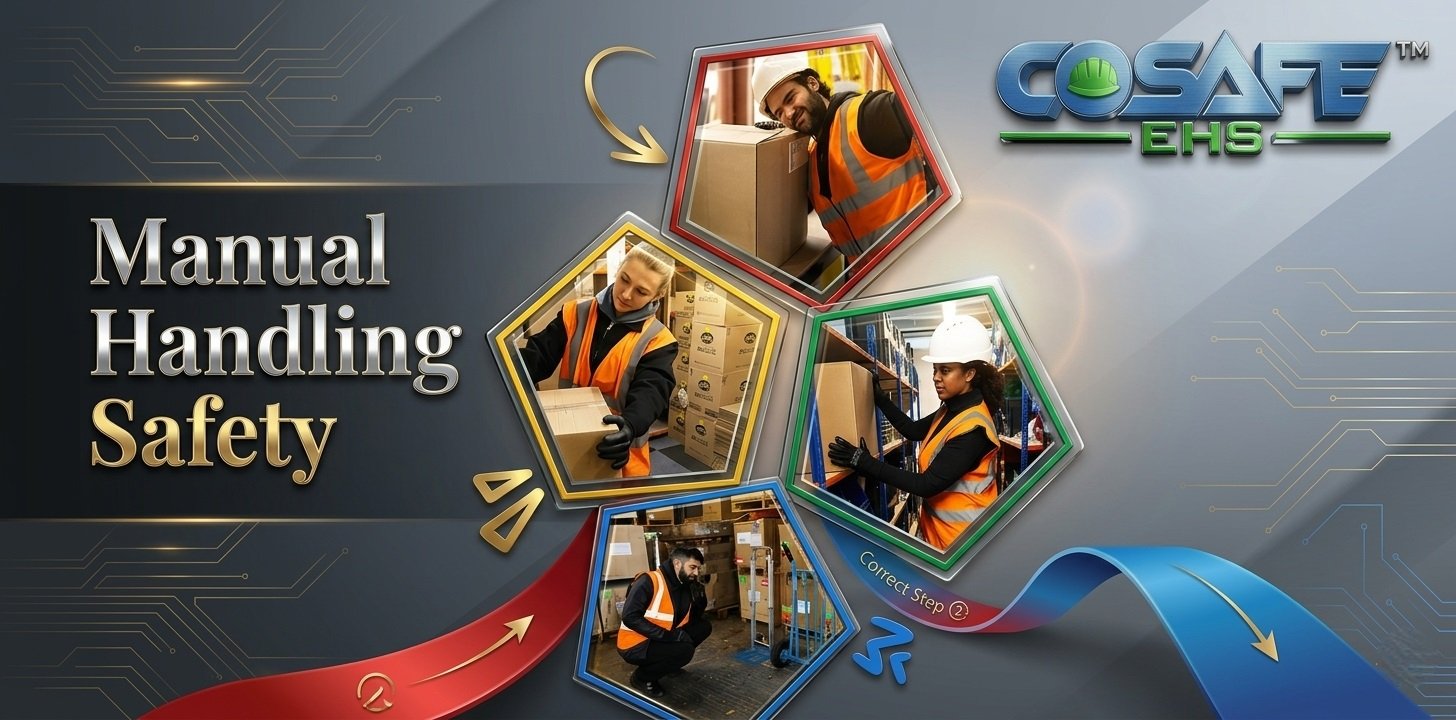
Manual handling activities are performed daily across virtually every industry, including manufacturing, warehousing, logistics, construction, healthcare, retail, hospitality, pharmaceuticals, food processing, and office environments. Tasks such as lifting, carrying, pushing, pulling, lowering, holding, stacking, moving, and transporting materials are often considered routine; however, they remain one of the leading causes of workplace injuries worldwide.
Poor manual handling practices can result in musculoskeletal disorders (MSDs), back injuries, strains, sprains, shoulder injuries, slips, trips, falls, and long-term occupational health problems. These injuries not only affect employee well-being but also contribute to absenteeism, reduced productivity, increased compensation claims, and operational disruptions.
At Cosafe EHS Bangalore, our Manual Handling Safety Training Program is designed to provide employees, supervisors, warehouse personnel, healthcare workers, logistics teams, and industrial workers with the knowledge and practical skills required to perform manual handling tasks safely and efficiently. The training focuses on hazard identification, ergonomic principles, risk assessment, body mechanics, safe lifting techniques, and injury prevention strategies.
Our comprehensive training program helps organizations create safer workplaces by promoting proper manual handling techniques, reducing workplace injuries, and improving employee awareness regarding physical risk factors.
Many workplace injuries occur because workers underestimate the risks associated with lifting and moving loads. Factors such as awkward postures, repetitive movements, excessive force, poor workplace design, and inadequate training can significantly increase injury risks.
Improve employee confidence during material handling tasks
Organizations that invest in professional Manual Handling Safety Training benefit from:
Who Should Attend?
This training program is ideal for:
At Cosafe EHS Bangalore, our Manual Handling Safety Training combines practical workplace applications with ergonomic best practices to ensure employees can perform tasks safely and effectively.
Manual handling injuries are preventable when workers are properly trained, workplace risks are controlled, and ergonomic principles are applied consistently. Investing in Manual Handling Safety Training is one of the most effective ways to improve employee well-being, reduce workplace injuries, and increase operational efficiency.
At Cosafe EHS Bangalore, our Manual Handling Safety Training Program equips employees, supervisors, and organizations with the knowledge, practical skills, and confidence required to perform manual handling tasks safely and effectively. Through comprehensive instruction, practical demonstrations, and workplace-focused learning, participants develop the competencies necessary to prevent injuries and create safer working environments.
Lift Smart. Move Safely. Prevent Injuries. Choose Cosafe EHS Bangalore for Professional Manual Handling Safety Training.
This module introduces participants to the fundamentals of manual handling and workplace injury prevention.
Topics include:
Participants develop a strong understanding of why safe manual handling is critical.
Musculoskeletal injuries are among the most common consequences of improper manual handling.
Topics include:
Participants learn how improper handling techniques contribute to workplace injuries.
Identifying risks before performing a task is essential for injury prevention.
Training includes:
Participants learn how to recognize and control manual handling hazards.
Proper body mechanics significantly reduce injury risks.
Topics include:
Participants understand how ergonomics improves workplace safety and comfort.
Correct lifting techniques are fundamental to injury prevention.
Training includes:
Participants practice proven lifting methods that minimize strain.
Manual handling extends beyond lifting activities.
Topics include:
Participants learn safer methods for moving materials in the workplace.
Some loads require assistance from multiple workers.
Training includes:
Participants learn how teamwork reduces manual handling risks.
Using appropriate equipment can significantly reduce physical strain.
Topics include:
Participants understand when and how to use handling aids effectively.
Workplace design plays a major role in manual handling safety.
Topics include:
Participants learn how workplace improvements can reduce injury risks.
Different industries face unique manual handling challenges.
Topics include:
Participants gain industry-specific safety knowledge.
PPE supports manual handling safety when used appropriately.
Training includes:
Participants learn how PPE complements safe handling practices.
Workers must know how to respond to handling-related incidents.
Topics include:
Participants improve their understanding of injury response and prevention.
Learning from incidents helps improve workplace safety performance.
Topics include:
Participants understand how incident reviews contribute to safer workplaces.
Practical activities reinforce classroom learning.
Activities include:
At Cosafe EHS Bangalore, we follow a practical, interactive, and competency-based training methodology designed to ensure participants can confidently apply manual handling principles in real workplace situations.
Interactive Classroom Sessions
Participants receive structured instruction through:
This approach builds a strong foundation of knowledge.
Practical Demonstrations
Our trainers conduct hands-on demonstrations covering:
Participants observe and practice safe techniques under expert guidance.
Scenario-Based Learning
Realistic workplace scenarios help participants understand practical challenges.
Exercises include:
This method improves decision-making and workplace awareness.
Group Activities and Workshops
Participants engage in:
These activities strengthen collaboration and safety culture.
Practical Competency Assessment
Participants are evaluated through:
Certificates are awarded upon successful completion of the training program.
Duration: Half Day (3–4 Hours) / Full Day (5–6 Hours)
Certification: Certificate will be provided after successful completion
Validity: 1–2 Years
Languages: Kannada / Hindi / English / Telugu