






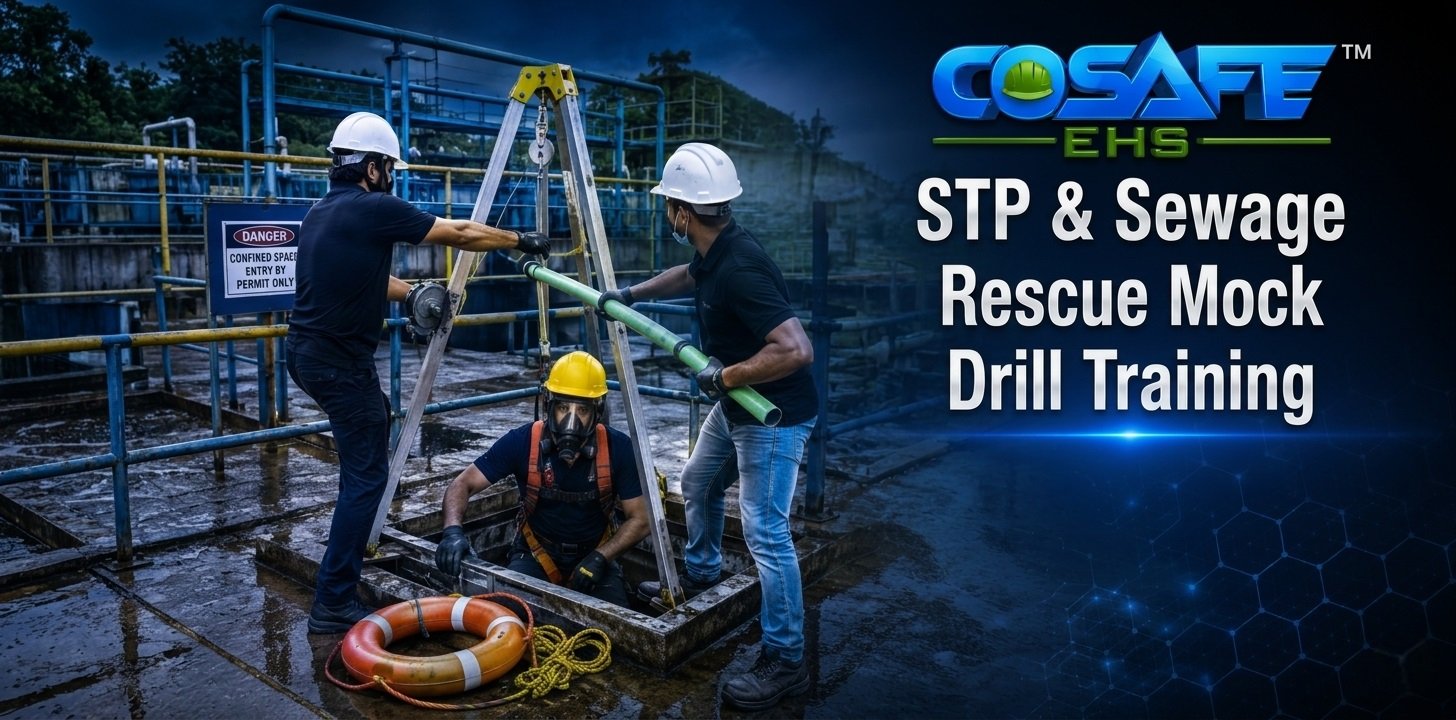
Overview
STP & Sewage Rescue Mock Drill Training in Bangalore
Professional STP & Sewage Rescue Mock Drill Training by Cosafe EHS Bangalore
Sewage Treatment Plants (STPs), Effluent Treatment Plants (ETPs), underground sewer networks, pumping stations, manholes, wet wells, sludge tanks, digesters, and underground chambers present some of the most hazardous working environments in industrial and municipal operations. These locations often qualify as confined spaces and expose workers to multiple life-threatening hazards including toxic gases, oxygen deficiency, biological contamination, engulfment risks, drowning hazards, mechanical equipment entrapment, and hazardous atmospheres.
One of the most serious dangers in sewage systems is the presence of toxic gases such as Hydrogen Sulfide (H₂S), Methane (CH₄), Carbon Monoxide (CO), Ammonia (NH₃), and oxygen-deficient atmospheres. These gases can quickly incapacitate workers, making rescue operations extremely challenging and time-sensitive. Wastewater and sewage facilities are specifically recognized for hazards involving toxic gases, oxygen deficiency, sludge engulfment, and difficult confined-space access.
At Cosafe EHS Bangalore, our STP & Sewage Rescue Mock Drill Training Program is designed to prepare Emergency Response Teams (ERT), Safety Officers, Plant Operators, Maintenance Personnel, Supervisors, and Rescue Teams to safely manage confined space emergencies occurring in sewage treatment and wastewater facilities.
This comprehensive program combines confined space entry awareness, gas detection, emergency rescue procedures, retrieval systems, breathing apparatus operations, casualty management, permit-to-work systems, incident command structures, and realistic rescue simulations to ensure organizations can respond effectively during emergencies.
Why STP & Sewage Rescue Mock Drill Training is Important
Many confined space fatalities occur when untrained personnel attempt rescue without proper equipment or procedures. Studies and safety guidance consistently show that a significant number of confined space deaths involve would-be rescuers becoming victims themselves.
Regular STP & Sewage Rescue Mock Drills help organizations:
Test confined space rescue procedures
Improve emergency response readiness
Enhance rescue team competency
Reduce rescue response time
Verify equipment readiness
Improve communication systems
Strengthen permit-to-work compliance
Enhance gas monitoring capabilities
Improve casualty recovery techniques
Strengthen organizational safety culture
Common Hazards in STP & Sewage Facilities
Personnel may encounter:
Hydrogen Sulfide (H₂S) exposure
Methane accumulation
Oxygen-deficient atmospheres
Toxic gas inhalation
Biological contamination
Sludge engulfment hazards
Drowning risks
Mechanical equipment entrapment
Electrical hazards
Slip, trip, and fall hazards
Confined space emergencies
Chemical exposure incidents
These hazards require specialized rescue preparedness and continuous emergency response capability.
Objectives of STP & Sewage Rescue Mock Drills
The primary objectives include:
Testing confined space rescue plans
Evaluating rescue team readiness
Improving gas hazard awareness
Strengthening emergency communication
Enhancing rescue coordination
Improving casualty recovery procedures
Testing rescue equipment effectiveness
Strengthening incident command systems
Improving emergency decision-making
Building organizational resilience
Industries Requiring STP & Sewage Rescue Preparedness
This training is highly beneficial for:
Sewage Treatment Plants (STPs)
Wastewater Treatment Plants (WWTPs)
Effluent Treatment Plants (ETPs)
Municipal Water Authorities
Industrial Manufacturing Facilities
Pharmaceutical Industries
Food Processing Industries
Petrochemical Facilities
Oil & Gas Industries
Infrastructure Projects
Facility Management Companies
Utility Service Providers
Benefits of STP & Sewage Rescue Mock Drill Training
Organizations conducting regular rescue drills achieve:
Faster emergency response
Improved worker safety
Better confined space rescue capability
Enhanced compliance readiness
Reduced incident severity
Improved emergency preparedness
Better rescue coordination
Increased workforce confidence
Stronger ERT competency
Improved business continuity
Who Should Attend?
This training program is suitable for:
Emergency Response Team (ERT) Members
STP Operators
Sewage Plant Personnel
Maintenance Technicians
Safety Officers
EHS Professionals
Supervisors and Managers
Rescue Teams
Contractors
Engineers
Utility Personnel
Emergency Coordinators
At Cosafe EHS Bangalore, our STP & Sewage Rescue Mock Drill Training is customized according to facility design, operational processes, confined space hazards, and industry-specific emergency response requirements.
STP and sewage treatment environments present unique and potentially fatal hazards, including toxic gases, oxygen-deficient atmospheres, biological contaminants, engulfment risks, and confined space emergencies. Without proper planning, rescue preparedness, trained personnel, and realistic mock drills, even routine maintenance activities can result in serious injuries or fatalities. Safety guidance consistently emphasizes regular rescue training, atmospheric monitoring, rescue planning, and competent rescue teams for wastewater and sewage operations.
At Cosafe EHS Bangalore, our STP & Sewage Rescue Mock Drill Training Program equips Emergency Response Teams, safety professionals, plant operators, supervisors, and rescue personnel with the knowledge, practical skills, and confidence required to manage confined space and sewage-related emergencies safely and effectively. Through realistic rescue simulations, hands-on equipment training, and expert-led instruction, we help organizations strengthen emergency preparedness and protect lives.
Monitor the Atmosphere. Execute the Rescue. Save Lives. Choose Cosafe EHS Bangalore for Professional STP & Sewage Rescue Mock Drill Training in Bangalore.
Training Modules
Module 1: Introduction to STP & Sewage Emergency Response
Participants receive a comprehensive understanding of sewage-related emergencies and rescue requirements.
Topics include:
- STP operational hazards
- Sewage system emergencies
- Wastewater treatment risks
- Rescue challenges
- Emergency preparedness principles
- Importance of mock drills
Participants gain a strong foundation in sewage rescue operations.
Module 2: Confined Space Hazard Awareness
Most STP rescue incidents occur within confined spaces.
Training includes:
- Definition of confined spaces
- Permit-required confined spaces
- Entry and exit challenges
- Atmospheric hazards
- Rescue limitations
- Emergency response requirements
Participants understand the unique hazards associated with confined space environments.
Module 3: Toxic Gas Awareness and Monitoring
Gas monitoring is critical for worker and rescuer safety.
Topics include:
- Hydrogen Sulfide (H₂S)
- Methane (CH₄)
- Carbon Monoxide (CO)
- Ammonia (NH₃)
- Oxygen deficiency hazards
- Atmospheric testing procedures
Participants learn how toxic gases impact rescue operations.
Module 4: Permit-to-Work System for STP Operations
Safe entry begins with proper authorization.
Training includes:
- Permit requirements
- Entry authorization procedures
- Hazard assessments
- Isolation verification
- Rescue readiness checks
- Documentation requirements
Participants understand how permit systems support safe operations.
Module 5: Personal Protective Equipment (PPE)
Proper PPE is essential for sewage rescue operations.
Topics include:
- Protective clothing
- Respiratory protection
- Chemical-resistant gloves
- Eye protection
- Safety harnesses
- Protective footwear
Participants learn proper PPE selection and usage.
Module 6: SCBA and Respiratory Protection
Some rescue situations require breathing apparatus.
Training includes:
- SCBA components
- Breathing apparatus procedures
- Air management awareness
- Emergency escape procedures
- Respiratory protection limitations
- Equipment inspection
Participants develop confidence in respiratory protection equipment.
Module 7: Rescue Equipment Familiarization
Participants receive practical exposure to rescue equipment.
Topics include:
- Tripods
- Winches
- Retrieval systems
- Rescue stretchers
- Lifelines
- Gas detectors
- Communication devices
Participants become familiar with critical rescue tools.
Module 8: Rescue Planning and Emergency Preparedness
Every confined space entry requires a rescue plan.
Training includes:
- Rescue planning procedures
- Emergency activation protocols
- Resource allocation
- Rescue route planning
- Team coordination
- Rescue readiness verification
Participants learn how rescue plans support emergency operations.
Module 9: Non-Entry Rescue Techniques
Non-entry rescue is the preferred rescue option whenever possible.
Topics include:
- Retrieval systems
- Rescue winches
- Lifeline recovery techniques
- Casualty extraction methods
- Emergency retrieval procedures
Participants learn safer rescue alternatives before considering entry rescue.
Module 10: Entry Rescue Operations
Some emergencies require trained rescuers to enter the space.
Training includes:
- Entry rescue planning
- Rescue team deployment
- Hazard control measures
- Rescue communication
- Victim stabilization
- Controlled extraction
Participants learn advanced confined space rescue principles.
Module 11: Casualty Management and First Aid
Proper casualty handling improves survival outcomes.
Topics include:
- Initial casualty assessment
- Oxygen deficiency symptoms
- H₂S exposure awareness
- Trauma management
- Patient stabilization
- Emergency medical coordination
Participants strengthen medical emergency response capabilities.
Module 12: Incident Command System (ICS)
Effective leadership improves emergency outcomes.
Training includes:
- Incident Commander responsibilities
- Team leadership
- Resource management
- Emergency communication
- External agency coordination
- Emergency reporting
Participants improve emergency leadership skills.
Module 13: STP & Sewage Rescue Mock Drill Execution
Participants engage in realistic emergency simulations.
Activities include:
- Simulated confined space incidents
- Toxic gas emergencies
- Casualty retrieval operations
- Rescue team deployment
- Emergency communication exercises
- Incident command activation
Participants gain practical emergency response experience.
Module 14: Scenario-Based Emergency Simulations
Different emergency scenarios are introduced.
Exercises include:
- Manhole rescue operations
- Wet well rescue scenarios
- Sludge tank emergencies
- Pump station incidents
- Gas exposure emergencies
- Multi-casualty rescue situations
Participants improve adaptability and problem-solving skills.
Module 15: Post-Drill Evaluation and Continuous Improvement
Continuous improvement strengthens preparedness.
Topics include:
- Response time analysis
- Rescue effectiveness evaluation
- Equipment readiness review
- Communication assessment
- Corrective action planning
- Lessons learned documentation
Participants learn how organizations improve rescue readiness through regular drills.
Training Methodology
At Cosafe EHS Bangalore, our STP & Sewage Rescue Mock Drill Training follows a practical, hands-on, and competency-based methodology designed to replicate real confined space emergencies encountered in wastewater and sewage treatment facilities.
Interactive Classroom Sessions
Participants receive structured instruction through:
- Multimedia presentations
- Industry case studies
- Incident investigation reviews
- Rescue planning workshops
- Hazard recognition exercises
- Best-practice discussions
This establishes a strong theoretical foundation.
Site-Specific Hazard Assessment
Before practical drills, our experts conduct:
- STP hazard assessments
- Confined space evaluations
- Atmospheric risk reviews
- Rescue feasibility studies
- Equipment inspections
- Emergency preparedness assessments
This ensures realistic and site-specific training.
Practical Equipment Demonstrations
Participants receive demonstrations covering:
- Gas detectors
- SCBA systems
- Tripods and winches
- Rescue retrieval systems
- Harnesses and lifelines
- Communication equipment
Hands-on demonstrations improve equipment competency.
Gas Monitoring and Atmospheric Testing Exercises
Participants perform:
- Oxygen monitoring
- H₂S detection
- Methane monitoring
- Atmospheric testing procedures
- Hazard assessment exercises
- Continuous monitoring practices
These exercises strengthen hazard recognition capabilities.
Confined Space Rescue Exercises
Participants engage in:
- Non-entry rescue drills
- Retrieval system operations
- Casualty extraction exercises
- Rescue team coordination
- Emergency communication drills
- Incident command simulations
Practical exercises improve rescue effectiveness.
Full-Scale STP & Sewage Rescue Mock Drills
The core of the training involves realistic emergency simulations.
Activities include:
- Confined space rescue operations
- Toxic gas emergency response
- Casualty recovery exercises
- SCBA deployment drills
- Rescue team activation
- Emergency evacuation exercises
Participants practice under realistic emergency conditions.
Scenario-Based Emergency Learning
Real-world simulations improve decision-making capabilities.
Exercises include:
- H₂S exposure emergencies
- Manhole rescue operations
- Wet well incidents
- Sludge tank emergencies
- Pump station rescue scenarios
- Multiple casualty rescue exercises
This approach develops practical emergency response skills.
Post-Drill Debriefing and Performance Evaluation
Following each exercise, participants receive:
- Performance feedback
- Response time analysis
- Rescue effectiveness reviews
- Equipment assessments
- Improvement recommendations
- Lessons learned discussions
This process supports continuous improvement.
Competency Assessment and Certification
Participants are evaluated through:
- Written assessments
- Gas detection exercises
- Rescue simulations
- Equipment operation evaluations
- Team performance reviews
- Practical competency demonstrations
Certificates are issued upon successful completion of the training program.
Why Choose Cosafe EHS Bangalore for STP & Sewage Rescue Mock Drill Training?
- Experienced confined space rescue instructors
- Practical and hands-on training methodology
- Realistic rescue simulations
- Advanced gas monitoring exercises
- SCBA and respiratory protection training
- Site-specific emergency planning support
- Competency-based assessments
- Emergency Response Team development programs
- Detailed post-drill evaluation reports
- Customized corporate training solutions
Program Details
Details Information
Training Duration:- 1 Day / 2 Days
Mode of Training:- Classroom + Practical
Certification:- Certificate Provided
Certificate Validity:- 1–2 Years
Training Location:- Onsite / Training Center
Languages Available:- Kannada / Hindi / English / Telugu