






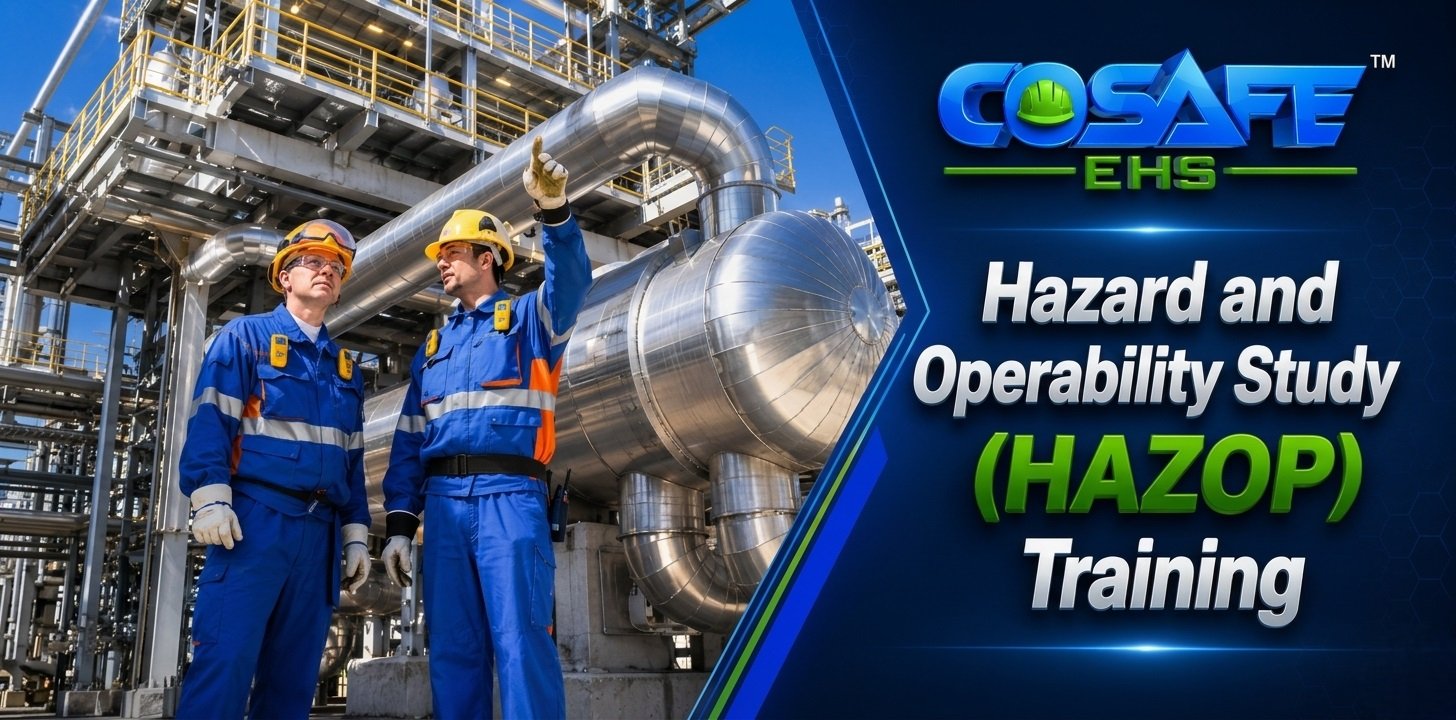
Overview
Hazard and Operability Study (HAZOP) Training in Bangalore
Professional HAZOP Risk Training Program by Cosafe EHS Bangalore
In high-risk industries such as oil & gas, chemical processing, pharmaceuticals, petrochemicals, power generation, food processing, water treatment, manufacturing, and process industries, even a small deviation in operating parameters can result in catastrophic consequences. Equipment failures, human errors, process deviations, control system malfunctions, chemical releases, fires, explosions, environmental incidents, and production losses can occur if process hazards are not identified and controlled effectively.
HAZOP (Hazard and Operability Study) is one of the most widely recognized and systematic risk assessment techniques used globally to identify potential hazards, operational problems, and process deviations before they lead to incidents. HAZOP helps organizations evaluate process safety risks, improve operational reliability, enhance compliance, and protect people, assets, and the environment.
At Cosafe EHS Bangalore, our HAZOP Risk Training Program is designed to provide engineers, safety professionals, plant managers, supervisors, process operators, project teams, and risk management personnel with comprehensive knowledge of HAZOP methodology, risk identification techniques, process hazard analysis, and practical risk control strategies. The program combines international best practices with real-world industrial applications to help organizations strengthen process safety management systems.
What is HAZOP?
HAZOP (Hazard and Operability Study) is a structured and systematic team-based risk assessment methodology used to identify hazards and operability issues in industrial processes. It examines process deviations from design intent using guide words and evaluates their potential causes, consequences, existing safeguards, and recommendations for improvement.
The HAZOP technique is extensively used throughout the lifecycle of industrial facilities, including:
Process design reviews
New plant commissioning
Plant modifications
Process optimization projects
Safety management reviews
Regulatory compliance assessments
Operational risk assessments
HAZOP helps organizations proactively identify weaknesses before incidents occur.
Why HAZOP Training is Important
Many major industrial disasters have been linked to unrecognized process hazards, inadequate risk assessments, and operational deviations. HAZOP provides a structured framework to identify these risks before they escalate into serious incidents.
Organizations benefit from HAZOP by:
Identifying hidden process hazards
Preventing fires and explosions
Reducing chemical release incidents
Improving process reliability
Enhancing operational efficiency
Supporting process safety management (PSM)
Strengthening regulatory compliance
Reducing downtime and losses
Improving emergency preparedness
Protecting personnel, assets, and the environment
Key Objectives of HAZOP Training
The primary objectives of the training include:
Understanding HAZOP principles and methodology
Learning systematic hazard identification techniques
Conducting process deviation analysis
Identifying causes and consequences of deviations
Evaluating process safeguards
Developing risk reduction recommendations
Strengthening process safety management systems
Improving multidisciplinary team participation
Supporting compliance and audit requirements
Enhancing organizational risk management capabilities
Industries Benefiting from HAZOP Training
This training program is highly beneficial for:
Oil & Gas Industries
Petrochemical Plants
Chemical Manufacturing Units
Pharmaceutical Industries
Fertilizer Plants
Power Generation Facilities
Food Processing Industries
Water Treatment Plants
LNG & LPG Facilities
Refineries
Engineering and EPC Companies
Process Manufacturing Industries
Benefits of HAZOP Risk Training
Organizations implementing HAZOP effectively achieve:
Improved process safety performance
Reduced operational risks
Enhanced regulatory compliance
Better process design integrity
Improved plant reliability
Lower incident rates
Reduced maintenance costs
Stronger risk management systems
Enhanced team collaboration
Increased operational confidence
Who Should Attend?
This program is ideal for:
Process Engineers
Chemical Engineers
Plant Managers
Operations Managers
Safety Officers
HSE Professionals
Project Engineers
Design Engineers
Maintenance Engineers
Production Supervisors
Risk Assessment Teams
Process Safety Professionals
At Cosafe EHS Bangalore, our HAZOP Training Program is customized to suit the operational requirements, process complexities, and risk profiles of different industries.
Process industries operate in complex environments where even minor deviations can lead to major consequences. Effective hazard identification, risk assessment, and process safety management are essential for preventing incidents, protecting personnel, ensuring operational reliability, and maintaining regulatory compliance.
At Cosafe EHS Bangalore, our HAZOP (Hazard and Operability Study) Risk Training Program equips engineers, safety professionals, operators, managers, and project teams with the practical knowledge and technical expertise required to conduct systematic HAZOP studies and improve process safety performance. Through hands-on workshops, real-world case studies, deviation analysis exercises, and multidisciplinary team learning, we help organizations identify risks before they become incidents.
Identify the Hazard. Analyze the Deviation. Strengthen Process Safety. Choose Cosafe EHS Bangalore for Professional HAZOP Risk Training in Bangalore.
Training Modules
Module 1: Introduction to HAZOP and Process Safety
Participants gain a comprehensive understanding of HAZOP fundamentals and process safety principles.
Topics include:
- Introduction to process safety
- Importance of hazard identification
- Evolution of HAZOP studies
- Process safety incidents and lessons learned
- Risk management principles
- HAZOP applications across industries
Participants develop a strong foundation in process hazard analysis.
Module 2: Fundamentals of Hazard Identification and Risk Assessment
This module introduces key risk management concepts.
Training includes:
- Hazard identification techniques
- Risk assessment methodologies
- Risk ranking systems
- Process safety hazards
- Operational risks
- Human factor considerations
Participants learn the relationship between HAZOP and risk management.
Module 3: HAZOP Methodology and Study Structure
Participants learn the systematic HAZOP approach.
Topics include:
- HAZOP objectives
- Team-based study process
- Structured brainstorming techniques
- Node selection
- Process parameter identification
- Documentation requirements
This module provides the framework for conducting effective HAZOP studies.
Module 4: Understanding Process Design Intent
A successful HAZOP begins with understanding how the process is intended to operate.
Training includes:
- Process flow diagrams (PFDs)
- Piping and Instrumentation Diagrams (P&IDs)
- Equipment specifications
- Process descriptions
- Operating conditions
- Design parameters
Participants learn how to interpret process information effectively.
Module 5: HAZOP Guide Words and Process Parameters
Guide words form the core of HAZOP analysis.
Topics include:
Common Guide Words
- No / Not
- More
- Less
- Reverse
- As Well As
- Other Than
- Part Of
- Early
- Late
Process Parameters
- Flow
- Pressure
- Temperature
- Level
- Composition
- Velocity
- Concentration
Participants learn how guide words are applied to identify deviations.
Module 6: Process Deviation Analysis
This module focuses on identifying process deviations.
Training includes:
- Causes of deviations
- Equipment failures
- Human errors
- Instrumentation failures
- Utility failures
- Process upsets
Participants learn systematic deviation analysis techniques.
Module 7: Consequence Analysis
Understanding consequences is essential for risk evaluation.
Topics include:
- Fire scenarios
- Explosion risks
- Toxic releases
- Environmental impacts
- Equipment damage
- Production interruptions
Participants learn to assess the severity of process deviations.
Module 8: Safeguard Identification and Evaluation
Participants learn how to evaluate existing protective measures.
Training includes:
- Engineering controls
- Safety instrumented systems
- Alarms and interlocks
- Pressure relief systems
- Emergency shutdown systems
- Administrative controls
This module strengthens risk reduction planning.
Module 9: HAZOP Team Roles and Responsibilities
Effective HAZOP studies require multidisciplinary collaboration.
Topics include:
- HAZOP Leader
- Scribe/Recorder
- Process Engineers
- Operations Personnel
- Maintenance Teams
- Safety Professionals
Participants learn team roles and communication strategies.
Module 10: Risk Ranking and Prioritization
Not all risks require the same level of attention.
Training includes:
- Risk matrices
- Likelihood assessment
- Consequence assessment
- Risk categorization
- Prioritization methods
- Action planning
Participants learn effective risk prioritization techniques.
Module 11: HAZOP Recommendations and Action Tracking
Recommendations are critical to improving safety.
Topics include:
- Developing corrective actions
- Engineering recommendations
- Procedural improvements
- Human factor controls
- Action ownership
- Tracking and closure systems
Participants learn how to convert findings into practical improvements.
Module 12: Human Factors and Operational Risks
Human performance can significantly influence process safety.
Training includes:
- Operator errors
- Communication breakdowns
- Fatigue management
- Competency issues
- Shift handover risks
- Behavioral considerations
Participants understand the impact of human factors on process safety.
Module 13: HAZOP Documentation and Reporting
Proper documentation ensures traceability and compliance.
Topics include:
- HAZOP worksheets
- Study reports
- Recommendation registers
- Action tracking systems
- Compliance documentation
- Audit preparation
Participants learn professional reporting practices.
Module 14: HAZOP Case Studies and Industrial Applications
Real-world examples strengthen learning outcomes.
Case studies include:
- Chemical process incidents
- Refinery accidents
- Pharmaceutical manufacturing deviations
- Utility system failures
- Storage tank hazards
- Process upset scenarios
Participants gain practical insights from actual industry events.
Module 15: Practical HAZOP Workshop
Participants conduct a complete HAZOP exercise.
Activities include:
- Node selection
- Guide word application
- Deviation analysis
- Consequence assessment
- Safeguard evaluation
- Recommendation development
This workshop develops real-world HAZOP competency
Training Methodology
At Cosafe EHS Bangalore, our HAZOP Risk Training Program follows a practical, interactive, and industry-focused learning approach designed to build strong process safety competencies.
Interactive Classroom Learning
Participants receive structured instruction through:
- Expert-led presentations
- Process safety discussions
- Industry examples
- HAZOP methodology workshops
- Best-practice reviews
- Knowledge-sharing sessions
This creates a strong theoretical foundation.
Process Flow Diagram (PFD) and P&ID Workshops
Participants learn through:
- Diagram interpretation exercises
- Process mapping activities
- System understanding workshops
- Equipment identification exercises
- Process parameter reviews
- Design intent analysis
These activities improve technical understanding.
Practical HAZOP Team Exercises
Participants work in multidisciplinary groups to:
- Analyze process systems
- Apply guide words
- Identify deviations
- Evaluate risks
- Recommend safeguards
- Present findings
This simulates actual industrial HAZOP studies.
Industry-Specific Case Studies
Participants analyze real incidents involving:
- Chemical releases
- Refinery process deviations
- Utility failures
- Equipment malfunctions
- Human error incidents
- Process safety failures
Case studies help participants understand real-world applications.
Risk Assessment and Consequence Analysis Workshops
Participants perform:
- Hazard identification
- Risk ranking
- Consequence evaluation
- Safeguard assessment
- Action planning
- Risk mitigation exercises
These activities strengthen analytical capabilities.
Group Discussions and Brainstorming Sessions
Collaborative learning activities include:
- Hazard identification discussions
- Deviation analysis workshops
- Team problem-solving exercises
- Recommendation development
- Lessons learned reviews
This improves communication and teamwork skills.
Scenario-Based Learning
Participants evaluate realistic process scenarios involving:
- High-pressure systems
- Chemical processing units
- Storage facilities
- Utility operations
- Emergency conditions
- Operational deviations
This develops practical decision-making capabilities.
Competency Assessment and Certification
Participants are assessed through:
- Written evaluations
- HAZOP exercises
- Case study analysis
- Group presentations
- Practical workshops
- Knowledge assessments
Certificates are awarded upon successful completion of the training program.
Why Choose Cosafe EHS Bangalore for HAZOP Risk Training?
- Experienced process safety and HSE professionals
- Industry-focused training methodology
- Practical HAZOP workshops
- Real-world process safety case studies
- Customized corporate training programs
- Competency-based assessments
- Process-specific learning modules
- Interactive team exercises
- Strong focus on risk reduction
- Comprehensive training materials