






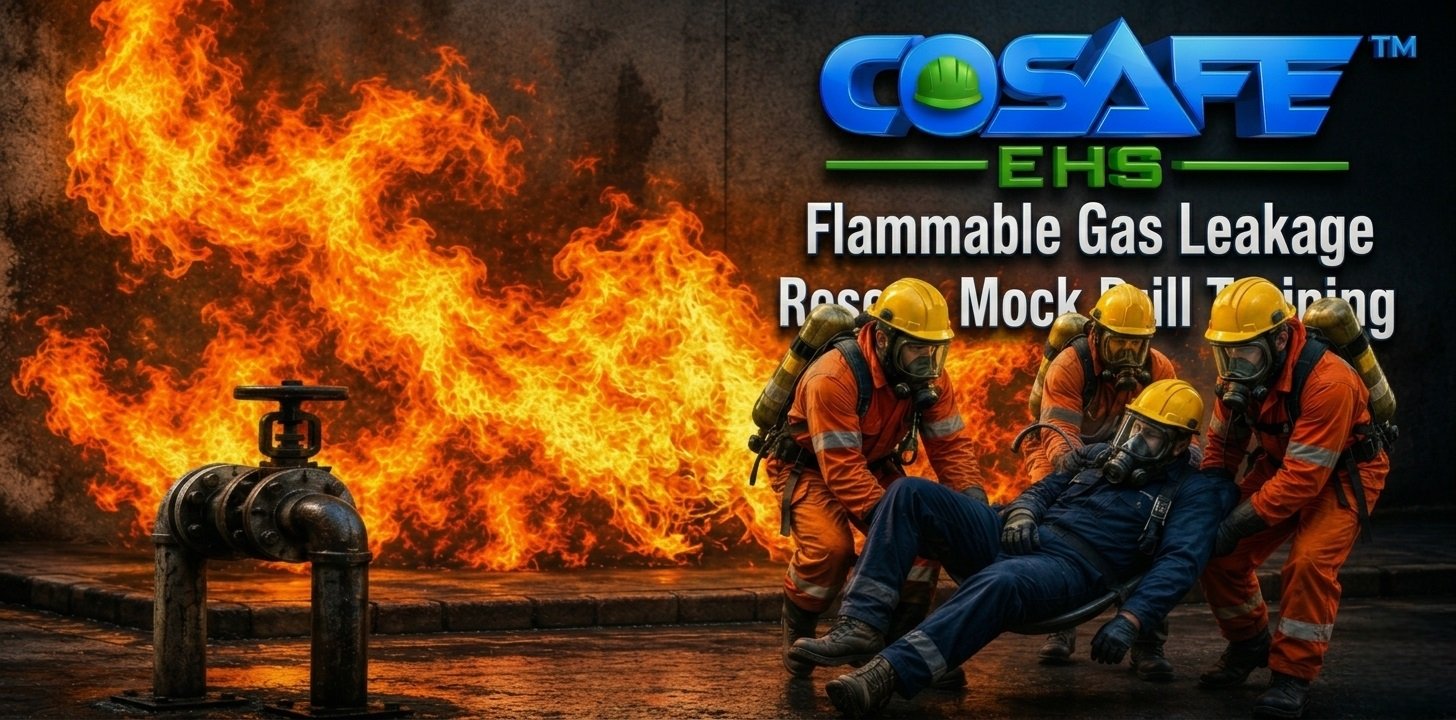
Overview
Flammable Gas Leakage Rescue Mock Drill Training in Bangalore
Professional Flammable Gas Leakage Rescue Mock Drill Training by Cosafe EHS Bangalore
Flammable gas leaks are among the most dangerous industrial emergencies, posing immediate risks of fire, explosion, toxic exposure, property damage, environmental impact, and multiple casualties. Industries handling Liquefied Petroleum Gas (LPG), Natural Gas, Methane, Propane, Butane, Hydrogen, Acetylene, Ethylene, and other combustible gases must be prepared to respond effectively to gas leakage incidents before they escalate into catastrophic events.
A small gas leak can quickly develop into a major emergency if not identified, controlled, and managed promptly. Flammable gases can accumulate in confined or poorly ventilated areas, forming explosive atmospheres that may ignite from a spark, hot surface, electrical equipment, static discharge, or open flame. Historical industrial incidents around the world have demonstrated that inadequate emergency preparedness, delayed response, poor communication, and lack of rescue planning significantly increase the severity of gas-related emergencies.
At Cosafe EHS Bangalore, our Flammable Gas Leakage Rescue Mock Drill Training Program is designed to prepare Emergency Response Teams (ERT), Fire & Safety Personnel, Plant Operators, Supervisors, Maintenance Teams, and Emergency Coordinators to effectively manage gas leakage emergencies. The program combines hazard recognition, gas detection, emergency isolation, rescue planning, firefighting coordination, evacuation procedures, incident command systems, and realistic emergency simulations to build a highly competent emergency response capability.
Our training focuses on improving emergency preparedness, strengthening rescue competencies, reducing response times, enhancing coordination, and ensuring that personnel can safely respond to flammable gas incidents without exposing themselves to unnecessary risks.
Why Flammable Gas Leakage Rescue Mock Drill Training is Important
Flammable gas incidents often develop rapidly and leave little time for decision-making. Organizations must be capable of:
Detecting gas leaks quickly
Activating emergency response plans
Isolating ignition sources
Conducting safe evacuations
Deploying emergency response teams
Rescuing affected personnel
Coordinating firefighting operations
Managing emergency communications
Preventing escalation to fire or explosion
Restoring safe operations
Regular mock drills help organizations verify that emergency procedures work effectively under realistic conditions.
Common Flammable Gas Hazards
Organizations may encounter:
-
LPG leaks
Natural gas leaks
Hydrogen releases
Acetylene leaks
Methane accumulation
Propane leakage
Butane release incidents
Compressed gas cylinder failures
Pipeline leak emergencies
Process gas release incidents
Objectives of Flammable Gas Leakage Rescue Mock Drills
The key objectives include:
Testing emergency response plans
Evaluating rescue readiness
Improving gas detection competency
Strengthening evacuation procedures
Enhancing firefighting preparedness
Reducing emergency response time
Improving communication systems
Testing incident command effectiveness
Evaluating equipment readiness
Building organizational resilience
Industries Requiring Gas Leak Emergency Preparedness
This training is highly beneficial for:
Oil & Gas Industries
Petrochemical Facilities
LPG Bottling Plants
Refineries
Chemical Manufacturing Plants
Power Generation Facilities
Pharmaceutical Industries
Food Processing Industries
Manufacturing Facilities
Steel and Metal Industries
Warehousing Operations
Infrastructure Projects
Benefits of Flammable Gas Leakage Rescue Mock Drill Training
Organizations conducting regular drills achieve:
-
Faster emergency response
Improved rescue capability
Reduced incident severity
Better evacuation efficiency
Enhanced worker confidence
Improved emergency coordination
Stronger compliance performance
Better equipment readiness
Reduced operational downtime
Stronger safety culture
Who Should Attend?
This program is ideal for:
Emergency Response Team (ERT) Members
Fire & Rescue Teams
Safety Officers
EHS Professionals
Plant Operators
Maintenance Personnel
Supervisors and Managers
Contractors
Utility Personnel
Incident Commanders
Facility Managers
Emergency Coordinators
At Cosafe EHS Bangalore, our Flammable Gas Leakage Rescue Mock Drill Training is customized according to site-specific hazards, gas inventories, operational processes, and industry requirements.
Flammable gas leakage incidents can escalate within seconds, resulting in fires, explosions, injuries, fatalities, and major business disruptions. Organizations that rely solely on written procedures without conducting regular rescue mock drills often discover critical gaps only when an actual emergency occurs. Effective emergency preparedness requires trained personnel, tested procedures, competent rescue teams, reliable equipment, and realistic emergency simulations.
At Cosafe EHS Bangalore, our Flammable Gas Leakage Rescue Mock Drill Training Program equips Emergency Response Teams, safety professionals, supervisors, operators, and emergency coordinators with the knowledge, practical skills, and confidence required to respond effectively during gas leak emergencies. Through realistic rescue scenarios, hands-on emergency exercises, and expert guidance, we help organizations strengthen preparedness, improve response capabilities, and protect lives, assets, and business continuity.
Detect the Leak. Control the Hazard. Execute the Rescue. Choose Cosafe EHS Bangalore for Professional Flammable Gas Leakage Rescue Mock Drill Training in Bangalore.
Training Modules
Module 1: Introduction to Flammable Gas Emergencies
Participants receive a comprehensive understanding of gas leakage emergencies and rescue operations.
Topics include:
- Flammable gas hazards
- Industrial gas leak incidents
- Fire and explosion risks
- Emergency response principles
- Rescue challenges
- Importance of emergency preparedness
Participants gain a strong foundation in flammable gas emergency management.
Module 2: Properties of Flammable Gases
Understanding gas behavior is essential for safe emergency response.
Topics include:
- Physical and chemical properties
- Flammability characteristics
- Lower Explosive Limit (LEL)
- Upper Explosive Limit (UEL)
- Vapor density concepts
- Ignition sources
- Gas dispersion behavior
Participants learn how gases behave under different environmental conditions.
Module 3: Hazard Identification and Risk Assessment
Proper hazard assessment improves emergency preparedness.
Training includes:
- Gas leak risk assessment
- Hazard identification techniques
- Vulnerability analysis
- Consequence assessment
- Control measures
- Emergency planning considerations
Participants develop hazard recognition and risk management skills.
Module 4: Gas Detection and Monitoring Systems
Early detection is critical for preventing escalation.
Topics include:
- Portable gas detectors
- Fixed gas monitoring systems
- LEL monitoring
- Alarm systems
- Detector calibration awareness
- Atmospheric monitoring procedures
Participants learn how gas detection systems support emergency response.
Module 5: Emergency Isolation and Leak Control
Immediate control measures reduce incident severity.
Training includes:
- Emergency shutdown procedures
- Valve isolation techniques
- Utility isolation
- Leak containment principles
- Source control methods
- Safe intervention procedures
Participants understand the importance of rapid incident stabilization.
Module 6: Fire and Explosion Prevention Measures
Preventing ignition is the highest priority during a gas leak emergency.
Topics include:
- Ignition source control
- Hot work restrictions
- Static electricity awareness
- Electrical safety precautions
- Safe area management
- Explosion prevention strategies
Participants learn how to minimize ignition risks.
Module 7: Emergency Response Team (ERT) Operations
Well-organized ERT operations improve emergency outcomes.
Training includes:
- ERT structure
- Roles and responsibilities
- Team deployment procedures
- Communication systems
- Rescue coordination
- Emergency leadership
Participants understand effective emergency response organization.
Module 8: Rescue Planning and Emergency Response
Every gas emergency requires a structured rescue strategy.
Topics include:
- Rescue planning procedures
- Resource allocation
- Rescue route planning
- Emergency activation
- Victim recovery planning
- Rescue safety considerations
Participants learn how to prepare for safe rescue operations.
Module 9: Casualty Search and Rescue Operations
Gas leak incidents may require immediate rescue intervention.
Training includes:
- Casualty location techniques
- Rescue prioritization
- Victim extraction methods
- Rescue team safety
- Medical coordination
- Incident stabilization
Participants develop practical rescue skills.
Module 10: Emergency Evacuation and Accountability
Efficient evacuation reduces exposure and injury risks.
Topics include:
- Emergency alarms
- Evacuation procedures
- Assembly point management
- Personnel accountability
- Crowd management
- Emergency communication
Participants strengthen evacuation management capabilities.
Module 11: Firefighting Coordination During Gas Emergencies
Gas leaks may escalate into fire emergencies.
Training includes:
- Gas fire awareness
- Firefighting support procedures
- Fire protection systems
- Water spray applications
- Cooling operations
- Coordination with fire services
Participants understand the interaction between gas leak response and firefighting operations.
Module 12: Incident Command System (ICS)
Effective leadership is critical during major emergencies.
Topics include:
- Incident Commander responsibilities
- Emergency decision-making
- Resource management
- Communication flow
- External agency coordination
- Emergency documentation
Participants strengthen emergency leadership skills.
Module 13: Flammable Gas Leakage Rescue Mock Drill Execution
Participants engage in realistic emergency simulations.
Activities include:
- Simulated gas leak incidents
- Emergency alarm activation
- Gas detection exercises
- ERT deployment
- Rescue operations
- Emergency evacuations
Participants gain practical emergency response experience.
Module 14: Scenario-Based Emergency Simulations
Different emergency situations are introduced to improve competency.
Exercises include:
- LPG leakage scenarios
- Hydrogen leak incidents
- Gas cylinder emergencies
- Process plant gas releases
- Pipeline leak simulations
- Multi-casualty emergency events
Participants improve adaptability and emergency decision-making skills.
Module 15: Post-Drill Evaluation and Continuous Improvement
Continuous improvement strengthens emergency preparedness.
Topics include:
- Response time evaluation
- Rescue performance review
- Equipment assessment
- Communication effectiveness analysis
- Corrective action planning
- Lessons learned documentation
Participants understand how organizations improve emergency readiness through regular drills
Training Methodology
At Cosafe EHS Bangalore, our Flammable Gas Leakage Rescue Mock Drill Training follows a practical, competency-based, and scenario-driven learning approach designed to replicate real industrial emergency conditions.
Interactive Classroom Sessions
Participants receive structured instruction through:
- Multimedia presentations
- Industrial case studies
- Emergency response workshops
- Hazard identification exercises
- Group discussions
- Industry best-practice reviews
This creates a strong theoretical foundation.
Site Hazard Assessment
Before practical exercises, our experts conduct:
- Gas inventory reviews
- Hazard assessments
- Emergency preparedness evaluations
- Rescue capability assessments
- Equipment inspections
- Response plan reviews
This ensures realistic and site-specific training.
Practical Equipment Demonstrations
Participants receive hands-on demonstrations covering:
- Gas detectors
- Emergency shutdown systems
- Fire protection equipment
- Communication devices
- Rescue equipment
- Emergency response resources
Practical demonstrations improve operational competency.
Gas Detection and Monitoring Exercises
Participants engage in:
- Gas monitoring activities
- Alarm response exercises
- LEL monitoring practices
- Hazard zone establishment
- Atmospheric testing procedures
- Emergency communication drills
These exercises strengthen hazard recognition skills.
Full-Scale Flammable Gas Leakage Rescue Mock Drills
The core of the training involves realistic emergency simulations.
Activities include:
- Simulated gas releases
- Emergency response activation
- Rescue team deployment
- Casualty recovery operations
- Fire response coordination
- Evacuation exercises
Participants practice under realistic emergency conditions.
Scenario-Based Emergency Learning
Real-world scenarios improve problem-solving capabilities.
Exercises include:
- LPG storage facility emergencies
- Hydrogen release incidents
- Gas pipeline failures
- Manufacturing plant gas leaks
- Multi-casualty rescue situations
- Escalating emergency scenarios
This approach develops practical decision-making skills.
Post-Drill Debriefing and Performance Evaluation
After every exercise, participants receive:
- Performance feedback
- Response time analysis
- Strength identification
- Improvement recommendations
- Equipment assessments
- Lessons learned discussions
This process supports continuous improvement.
Competency Assessment and Certification
Participants are evaluated through:
- Written assessments
- Gas detection exercises
- Emergency response simulations
- Rescue performance evaluations
- Team coordination assessments
- Practical competency demonstrations
Certificates are awarded upon successful completion of the training program.
Why Choose Cosafe EHS Bangalore for Flammable Gas Leakage Rescue Mock Drill Training?
- Experienced industrial emergency response trainers
- Practical and hands-on training methodology
- Realistic gas leak emergency simulations
- Site-specific rescue planning support
- Advanced gas detection training
- Emergency Response Team development programs
- Competency-based assessments
- Detailed post-drill evaluation reports
- Customized corporate training solutions
- Industry-focused safety and emergency preparedness expertise
Program Details
Details Information
Training Duration:- 1 Day / 2 Days
Mode of Training:- Classroom + Practical
Certification:- Certificate Provided
Certificate Validity:- 1–2 Years
Training Location:- Onsite / Training Center
Languages Available:- Kannada / Hindi / English / Telugu