






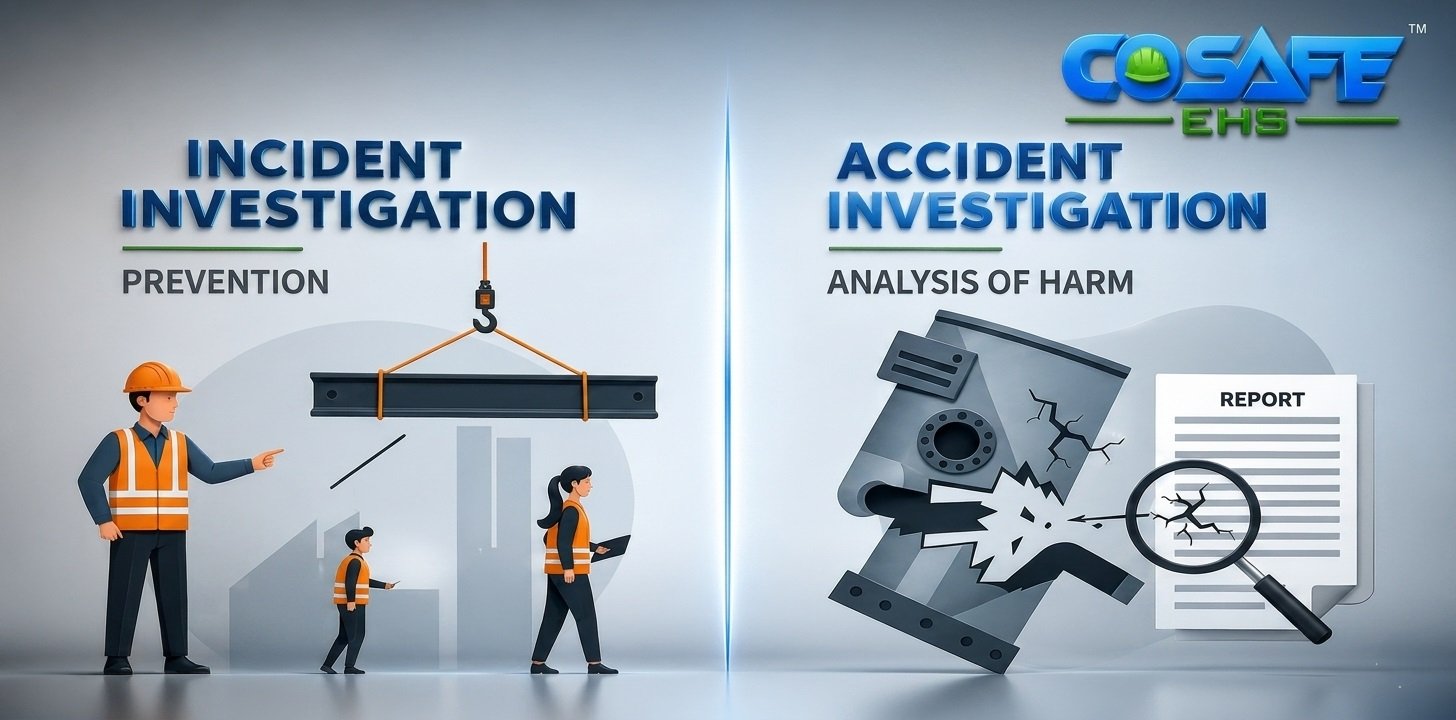
Overview
Accident Investigation & Analysis Training in Bangalore
Professional Accident Investigation & Analysis Training by Cosafe EHS Bangalore
Every workplace incident, near miss, unsafe act, property damage event, occupational illness, environmental release, or serious injury provides valuable lessons that can help prevent future occurrences. However, organizations often focus on identifying who was involved rather than understanding why the incident occurred. Effective Accident Investigation & Analysis goes beyond assigning blame—it identifies root causes, system failures, human factors, organizational weaknesses, and process gaps that contribute to incidents.
Across industries such as manufacturing, construction, oil & gas, logistics, warehousing, healthcare, power generation, pharmaceuticals, infrastructure projects, and facility management, workplace accidents can result in injuries, fatalities, equipment damage, production losses, legal liabilities, reputational harm, and increased operational costs. Conducting a systematic and professional accident investigation is essential for preventing recurrence and strengthening workplace safety performance.
At Cosafe EHS Bangalore, our Accident Investigation & Analysis Training Program equips Safety Officers, EHS Professionals, Supervisors, Managers, Incident Investigators, Team Leaders, and Emergency Response Personnel with the skills required to conduct effective investigations, identify root causes, gather evidence, analyze incidents, and implement corrective and preventive actions.
The program focuses on internationally accepted accident investigation methodologies, root cause analysis techniques, human factors evaluation, incident reporting systems, and practical case-study-based learning to help organizations build a proactive safety culture.
Why Accident Investigation & Analysis Training is Important
Many organizations repeat the same incidents because investigations focus only on immediate causes rather than underlying system failures. A well-executed investigation helps organizations:
Identify root causes of accidents
Prevent recurrence of incidents
Improve workplace safety systems
Reduce injuries and fatalities
Strengthen legal and regulatory compliance
Improve operational efficiency
Reduce financial losses
Enhance employee awareness
Strengthen safety culture
Improve organizational learning
Accident investigation is not about assigning blame—it is about identifying failures and implementing improvements that prevent future incidents.
What is Accident Investigation?
Accident Investigation is a structured process used to determine:
What happened?
How did it happen?
Why did it happen?
What were the contributing factors?
How can recurrence be prevented?
A thorough investigation examines people, equipment, procedures, environment, management systems, and organizational controls to identify both direct and root causes.
Common Workplace Incidents Requiring Investigation
Organizations should investigate:
Workplace injuries
Fatal accidents
Near miss incidents
Property damage events
Equipment failures
Vehicle accidents
Fire incidents
Chemical spills
Environmental releases
Occupational illnesses
Process safety events
Contractor-related incidents
Objectives of Accident Investigation & Analysis Training
The key objectives include:
Understanding investigation principles
Developing root cause analysis skills
Improving evidence collection techniques
Strengthening interviewing skills
Enhancing report writing abilities
Identifying corrective actions
Improving incident trend analysis
Reducing recurring incidents
Supporting compliance requirements
Promoting continuous improvement
Industries Benefiting from Accident Investigation Training
This training is highly beneficial for:
Manufacturing Industries
Construction Projects
Oil & Gas Facilities
Chemical Industries
Warehousing Operations
Logistics Companies
Healthcare Facilities
Power Plants
Pharmaceutical Industries
Infrastructure Projects
Facility Management Companies
Educational Institutions
Benefits of Accident Investigation & Analysis Training
Organizations implementing effective investigation systems achieve:
Reduced accident rates
Better incident reporting quality
Faster corrective action implementation
Improved compliance performance
Reduced operational disruptions
Better risk management
Enhanced safety culture
Increased employee participation
Improved management decision-making
Stronger organizational resilience
Who Should Attend?
This training program is suitable for:
Safety Officers
EHS Managers
Supervisors
Team Leaders
HR Professionals
Operations Managers
Engineers
Quality Professionals
Plant Managers
Incident Investigators
Emergency Response Team Members
Business Leaders
At Cosafe EHS Bangalore, our Accident Investigation & Analysis Training is tailored to industry-specific risks, organizational requirements, and workplace operational challenges.
Every workplace accident, near miss, or safety incident represents an opportunity to learn and improve. Organizations that conduct thorough and systematic accident investigations are better equipped to identify root causes, eliminate hazards, strengthen safety systems, and prevent future incidents. Effective investigation is not about finding fault—it is about finding facts and implementing solutions.
At Cosafe EHS Bangalore, our Accident Investigation & Analysis Training Program equips safety professionals, supervisors, managers, engineers, and incident investigators with the practical knowledge, analytical tools, and investigative skills required to conduct professional workplace investigations. Through hands-on exercises, real-world case studies, root cause analysis techniques, and practical workshops, we help organizations build a proactive safety culture focused on prevention and continuous improvement.
Investigate the Cause. Identify the Root Cause. Prevent Recurrence. Choose Cosafe EHS Bangalore for Professional Accident Investigation & Analysis Training in Bangalore.
Training Modules
Module 1: Introduction to Accident Investigation
Participants receive a comprehensive understanding of accident investigation principles.
Topics include:
- Importance of accident investigations
- Incident versus accident concepts
- Investigation objectives
- Benefits of effective investigations
- Legal and organizational requirements
- Safety culture and learning
Participants gain a strong foundation in incident investigation practices.
Module 2: Understanding Accident Causation Theories
Understanding why accidents occur is essential for effective investigations.
Training includes:
- Domino Theory
- Human Factors Theory
- Swiss Cheese Model
- Loss Causation Model
- Multiple Causation Theory
- Systems-Based Safety Concepts
Participants learn how accidents develop through multiple contributing factors.
Module 3: Types of Workplace Incidents
Different incidents require different investigation approaches.
Topics include:
- Injury incidents
- Fatal accidents
- Near misses
- Property damage events
- Equipment failures
- Environmental incidents
- Process safety incidents
- Occupational health events
Participants learn how to classify and prioritize investigations.
Module 4: Incident Reporting and Notification Procedures
Timely reporting is essential for preserving evidence.
Training includes:
- Incident notification requirements
- Reporting protocols
- Escalation procedures
- Internal reporting systems
- Regulatory reporting considerations
- Initial response actions
Participants understand the importance of prompt reporting.
Module 5: Evidence Collection Techniques
Accurate evidence collection forms the foundation of an investigation.
Topics include:
- Physical evidence collection
- Scene preservation
- Photographic documentation
- Equipment examination
- Document review
- Environmental observations
Participants learn systematic evidence-gathering methods.
Module 6: Witness Interviewing Skills
Effective interviews help investigators understand incident circumstances.
Training includes:
- Interview planning
- Questioning techniques
- Active listening skills
- Fact verification
- Avoiding leading questions
- Documentation practices
Participants develop professional interviewing skills.
Module 7: Root Cause Analysis (RCA)
Root Cause Analysis is a critical component of accident investigation.
Topics include:
- Immediate causes
- Underlying causes
- Root causes
- System failures
- Organizational factors
- Human factors analysis
Participants learn how to move beyond surface-level causes.
Module 8: Investigation Tools and Techniques
Various analytical tools support effective investigations.
Training includes:
- 5 Whys Analysis
- Fishbone (Ishikawa) Diagrams
- Fault Tree Analysis
- Cause-and-Effect Analysis
- Barrier Analysis
- Event Mapping
Participants gain practical experience using investigation tools.
Module 9: Human Factors in Accident Investigation
Human behavior often contributes to workplace incidents.
Topics include:
- Human error analysis
- Fatigue factors
- Communication failures
- Decision-making errors
- Competency issues
- Behavioral influences
Participants understand the role of human factors in incident causation.
Module 10: Corrective and Preventive Actions (CAPA)
Effective corrective actions prevent recurrence.
Training includes:
- Action planning
- Control measures
- Risk reduction strategies
- Accountability assignment
- Follow-up procedures
- Effectiveness verification
Participants learn how to develop meaningful corrective actions.
Module 11: Incident Trend Analysis
Analyzing incident data supports proactive safety management.
Topics include:
- Data collection
- Trend identification
- Statistical analysis
- Risk indicators
- Safety performance metrics
- Continuous improvement opportunities
Participants learn how to use data to improve safety performance.
Module 12: Accident Investigation Report Writing
Clear reporting ensures lessons are communicated effectively.
Training includes:
- Report structure
- Executive summaries
- Evidence presentation
- Root cause documentation
- Corrective action recommendations
- Management reporting
Participants improve professional report-writing skills.
Module 13: Legal and Compliance Considerations
Investigations often support regulatory and compliance requirements.
Topics include:
- Legal responsibilities
- Documentation requirements
- Regulatory expectations
- Confidentiality considerations
- Record retention
- Compliance audits
Participants understand the legal aspects of investigations.
Module 14: Case Studies and Incident Analysis Workshops
Real-world examples strengthen learning outcomes.
Exercises include:
- Construction accident investigations
- Manufacturing incident analysis
- Equipment failure investigations
- Vehicle accident reviews
- Fire incident case studies
- Near miss evaluations
Participants apply investigation techniques to realistic scenarios.
Module 15: Practical Accident Investigation Exercise
Participants conduct simulated investigations.
Activities include:
- Scene assessment
- Evidence collection
- Witness interviews
- Root cause analysis
- Report preparation
- Corrective action planning
This practical exercise develops real-world investigation competency.
Training Methodology
At Cosafe EHS Bangalore, our Accident Investigation & Analysis Training follows a practical, interactive, and competency-based learning approach designed to develop confident and capable workplace investigators.
Interactive Classroom Learning
Participants receive structured instruction through:
- Multimedia presentations
- Industry case studies
- Accident analysis discussions
- Investigation workshops
- Safety management reviews
- Best-practice sharing
This creates a strong theoretical foundation.
Real Incident Case Study Analysis
Participants examine actual workplace incidents involving:
- Manufacturing accidents
- Construction incidents
- Vehicle collisions
- Equipment failures
- Fire emergencies
- Chemical exposure events
Case studies provide practical learning opportunities.
Group Investigation Workshops
Participants work in teams to:
- Analyze incidents
- Review evidence
- Identify contributing factors
- Conduct root cause analysis
- Develop corrective actions
- Present findings
This strengthens analytical and teamwork skills.
Practical Evidence Collection Exercises
Hands-on activities include:
- Scene documentation
- Photograph interpretation
- Evidence review
- Incident reconstruction
- Hazard identification
- Fact-finding exercises
Participants gain practical investigation experience.
Root Cause Analysis Simulations
Participants perform:
- 5 Whys exercises
- Fishbone analysis
- Cause-and-effect mapping
- Human factors evaluation
- Barrier analysis
- Corrective action planning
These activities build problem-solving capabilities.
Interviewing Skill Development
Participants engage in:
- Witness interview simulations
- Questioning exercises
- Communication workshops
- Fact verification activities
- Interview documentation practices
These exercises improve information-gathering effectiveness.
Incident Reporting and Documentation Practice
Participants learn through:
- Report-writing workshops
- Documentation reviews
- Investigation summaries
- Executive reporting exercises
- Corrective action tracking
This strengthens professional reporting skills.
Competency Assessment and Evaluation
Participants are evaluated through:
- Written assessments
- Investigation exercises
- Root cause analysis activities
- Case study reviews
- Report-writing assignments
- Group presentations
Certificates are awarded upon successful completion of the training program.
Why Choose Cosafe EHS Bangalore for Accident Investigation & Analysis Training?
- Experienced EHS and safety management trainers
- Practical and industry-focused training methodology
- Real-world accident investigation case studies
- Advanced root cause analysis techniques
- Interactive workshops and simulations
- Customized corporate training programs
- Competency-based assessments
- Comprehensive learning materials
- Industry-specific incident scenarios
- Strong focus on prevention and continuous improvement