






Overview
HIRA Training – Hazard Identification & Risk Assessment in Bangalore
Professional HIRA (Hazard Identification & Risk Assessment) Training by Cosafe EHS Bangalore
In today's industrial environment, workplace hazards exist in every sector, including manufacturing, construction, oil & gas, logistics, warehousing, pharmaceuticals, healthcare, power generation, facility management, and infrastructure projects. If hazards are not identified and controlled at the right time, they can lead to serious injuries, occupational illnesses, environmental incidents, equipment damage, production losses, and even fatalities.
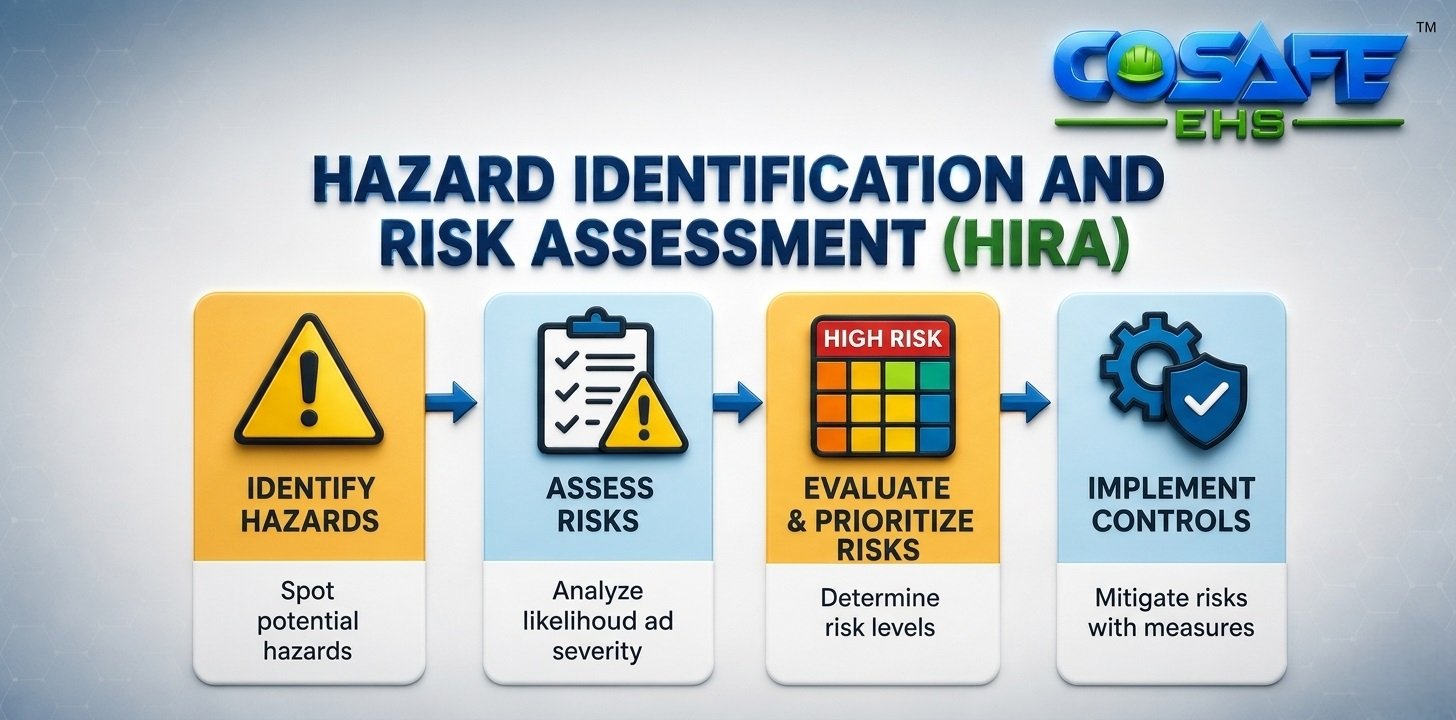
Hazard Identification & Risk Assessment (HIRA) is a systematic and proactive process used to identify workplace hazards, evaluate associated risks, and implement effective control measures before accidents occur. HIRA forms the foundation of every successful Occupational Health, Safety, and Environment (OHSE) Management System and supports compliance with international standards such as ISO 45001.
At Cosafe EHS Bangalore, our HIRA Training Program is designed to equip employees, supervisors, safety officers, engineers, managers, and EHS professionals with the knowledge and practical skills required to identify hazards, assess risks, prioritize controls, and create safer workplaces. The program focuses on real-world industrial applications, enabling participants to conduct effective risk assessments and develop practical risk control strategies.
What is HIRA?
HIRA stands for:
- Hazard Identification – Identifying anything that has the potential to cause harm.
- Risk Assessment – Evaluating the likelihood and severity of harm resulting from the identified hazard.
- Risk Control – Implementing measures to eliminate or reduce risks to an acceptable level.
HIRA is an ongoing process that should be conducted whenever new work activities are introduced, workplace changes occur, incidents happen, or periodic reviews are required.
Why HIRA Training is Important
Many workplace incidents occur because hazards are not recognized before work begins. Effective HIRA helps organizations:
Prevent workplace accidents and injuries
Improve hazard awareness
Reduce operational risks
Strengthen safety culture
Improve legal compliance
Support Permit-to-Work (PTW) systems
Enhance Job Safety Analysis (JSA) processes
Reduce downtime and financial losses
Improve employee participation in safety
Strengthen risk management systems
Organizations that implement effective HIRA programs can significantly improve workplace safety performance and reduce incident rates.
Types of Workplace Hazards Covered in HIRA
Participants learn to identify various hazards including:
Physical Hazards
Mechanical Hazards
Electrical Hazards
Chemical Hazards
Biological Hazards
Ergonomic Hazards
Fire and Explosion Hazards
Environmental Hazards
Psychosocial Hazards
Confined Space Hazards
Work at Height Hazards
Transportation Hazards
Objectives of HIRA Training
The key objectives include:
Understanding hazard identification techniques
Learning risk assessment methodologies
Conducting workplace risk evaluations
Using risk matrices effectively
Applying hierarchy of controls
Developing risk registers
Improving workplace inspections
Supporting safety management systems
Enhancing compliance with safety regulations
Building proactive safety culture
Industries Benefiting from HIRA Training
This training is highly beneficial for:
Manufacturing Industries
Construction Projects
Oil & Gas Facilities
Chemical Industries
Pharmaceutical Companies
Logistics and Warehousing Operations
Mining Operations
Power Plants
Healthcare Facilities
Infrastructure Projects
Facility Management Companies
Educational Institutions
Benefits of HIRA Training
Organizations implementing HIRA effectively achieve:
Reduced workplace incidents
Improved hazard recognition
Better risk control implementation
Stronger compliance performance
Enhanced employee engagement
Improved operational efficiency
Better decision-making
Reduced insurance and compensation costs
Improved emergency preparedness
Stronger safety culture
Who Should Attend?
This program is ideal for:
Safety Officers
EHS Managers
Supervisors
Engineers
Team Leaders
Project Managers
Plant Managers
Maintenance Personnel
Operations Personnel
Contractors
HSE Professionals
Business Leaders
At Cosafe EHS Bangalore, our HIRA Training is customized according to industry-specific hazards, operational processes, and organizational safety requirements.
Hazard Identification & Risk Assessment is one of the most powerful tools for preventing workplace accidents and building a proactive safety culture. Organizations that effectively identify hazards, assess risks, and implement appropriate controls can significantly reduce incidents, improve compliance, enhance operational efficiency, and protect their workforce.
At Cosafe EHS Bangalore, our HIRA (Hazard Identification & Risk Assessment) Training Program equips safety professionals, supervisors, engineers, managers, and workers with the knowledge, practical skills, and confidence required to identify hazards, evaluate risks, and implement effective control measures. Through hands-on workshops, real-world case studies, and practical risk assessment exercises, we help organizations strengthen workplace safety and achieve sustainable operational excellence.
Identify the Hazard. Assess the Risk. Control the Danger. Choose Cosafe EHS Bangalore for Professional HIRA Training in Bangalore.
Training Modules
Module 1: Introduction to HIRA
Participants receive a comprehensive understanding of Hazard Identification and Risk Assessment fundamentals.
Topics include:
- Definition of hazard and risk
- Importance of HIRA
- Objectives of HIRA
- Risk management principles
- Legal and compliance requirements
- Role of HIRA in safety management systems
Participants develop a strong foundation in workplace risk management.
Module 2: Understanding Workplace Hazards
Hazard recognition is the first step toward accident prevention.
Training includes:
- Physical hazards
- Chemical hazards
- Biological hazards
- Mechanical hazards
- Electrical hazards
- Ergonomic hazards
- Environmental hazards
- Psychosocial hazards
Participants learn to identify hazards across different workplace environments.
Module 3: Hazard Identification Techniques
Participants learn systematic hazard identification methods.
Topics include:
- Workplace inspections
- Safety observations
- Job Hazard Analysis (JHA)
- Job Safety Analysis (JSA)
- Safety audits
- Checklists
- Incident reviews
- Employee consultations
These techniques improve hazard detection and prevention.
Module 4: Risk Assessment Process
This module focuses on evaluating workplace risks.
Training includes:
- Risk identification
- Exposure evaluation
- Likelihood assessment
- Severity assessment
- Risk scoring
- Risk prioritization
- Documentation requirements
Participants learn how to conduct structured risk assessments.
Module 5: Risk Matrix Methodology
Risk matrices help prioritize corrective actions.
Topics include:
- Risk ranking systems
- Likelihood criteria
- Severity criteria
- Risk classification
- Risk acceptance criteria
- Decision-making processes
Participants gain practical experience using risk matrices.
Module 6: Hierarchy of Risk Controls
Control measures are critical for reducing risks.
Training includes:
- Elimination
- Substitution
- Engineering controls
- Administrative controls
- Personal Protective Equipment (PPE)
- Control effectiveness evaluation
Participants learn how to apply the hierarchy of controls effectively.
Module 7: Job Safety Analysis (JSA) and Task Risk Assessment
Participants learn how to assess job-specific risks.
Topics include:
- Task breakdown techniques
- Hazard identification
- Risk evaluation
- Control implementation
- Safe work procedures
- Documentation requirements
This module strengthens operational risk management.
Module 8: Permit-to-Work (PTW) and HIRA Integration
HIRA supports permit-controlled activities.
Training includes:
- Hot Work Permits
- Confined Space Entry Permits
- Work at Height Permits
- Electrical Work Permits
- Excavation Permits
- Contractor Safety Controls
Participants learn how HIRA integrates with PTW systems.
Module 9: Industry-Specific Hazard Assessment
Different industries face unique hazards.
Topics include:
- Construction HIRA
- Manufacturing HIRA
- Chemical Risk Assessment
- Warehouse Risk Assessment
- Office Safety Assessment
- Facility Management Risk Assessment
Participants learn industry-specific applications.
Module 10: Behavioral and Human Factor Risks
Human behavior significantly influences workplace safety.
Training includes:
- Unsafe acts
- Human error analysis
- Fatigue management
- Communication failures
- Competency gaps
- Behavioral safety concepts
Participants understand how human factors impact risk.
Module 11: Incident-Based Risk Assessment
Past incidents provide valuable learning opportunities.
Topics include:
- Near miss investigations
- Incident trend analysis
- Root cause identification
- Risk reassessment
- Corrective action planning
- Preventive measures
Participants learn how to use incident data to improve safety.
Module 12: Risk Register Development
Risk registers help organizations manage hazards systematically.
Training includes:
- Hazard documentation
- Risk recording
- Control tracking
- Risk review procedures
- Accountability assignment
- Continuous improvement
Participants learn how to create and maintain risk registers.
Module 13: HIRA Documentation and Reporting
Proper documentation supports compliance and continuous improvement.
Topics include:
- HIRA formats
- Risk assessment reports
- Action plans
- Control tracking
- Compliance records
- Audit readiness
Participants strengthen documentation capabilities.
Module 14: Practical HIRA Workshops
Participants perform hands-on HIRA exercises.
Activities include:
- Hazard identification exercises
- Workplace inspections
- Risk matrix development
- Control selection
- Group assessments
- Presentation of findings
These workshops build practical competency.
Module 15: Case Studies and Industry Applications
Real-world examples strengthen learning outcomes.
Exercises include:
- Construction risk assessments
- Manufacturing hazard analysis
- Chemical safety assessments
- Warehouse safety evaluations
- Maintenance risk assessments
- Office safety reviews
Participants apply HIRA techniques to realistic scenarios.
Training Methodology
At Cosafe EHS Bangalore, our HIRA Training follows a practical, interactive, and competency-based approach designed to develop confident risk assessment professionals.
Interactive Classroom Sessions
Participants receive structured instruction through:
- Multimedia presentations
- Industry case studies
- Safety management discussions
- Hazard identification workshops
- Risk assessment exercises
- Best-practice sharing
This establishes a strong theoretical foundation.
Workplace Hazard Recognition Exercises
Participants learn through:
- Hazard spotting activities
- Safety observation exercises
- Workplace inspection simulations
- Hazard classification activities
- Group discussions
- Real-life examples
These activities improve hazard awareness.
Practical Risk Assessment Workshops
Participants perform:
- Risk identification exercises
- Risk matrix calculations
- Severity assessments
- Likelihood evaluations
- Risk ranking activities
- Control measure selection
Hands-on workshops strengthen practical skills.
Industry-Specific Case Studies
Participants analyze:
- Construction hazards
- Manufacturing risks
- Chemical safety incidents
- Electrical hazards
- Ergonomic concerns
- Logistics and warehouse risks
Case studies provide practical industry applications.
Group Learning and Team Exercises
Participants work collaboratively to:
- Conduct hazard assessments
- Develop risk registers
- Create action plans
- Present findings
- Solve safety challenges
This strengthens teamwork and analytical skills.
HIRA Documentation Practice
Participants learn through:
- Risk assessment forms
- Hazard registers
- Action tracking systems
- Reporting exercises
- Compliance documentation
- Audit preparation activities
These exercises improve documentation competency.
Scenario-Based Learning
Participants evaluate realistic workplace situations involving:
- High-risk activities
- Contractor operations
- Maintenance work
- Emergency situations
- Process changes
- New project activities
This develops decision-making capability.
Competency Assessment and Certification
Participants are evaluated through:
- Written assessments
- Hazard identification exercises
- Risk assessment workshops
- Case study analysis
- Practical evaluations
- Group presentations
Certificates are awarded upon successful completion of the training program.
Why Choose Cosafe EHS Bangalore for HIRA Training?
- Experienced EHS and safety professionals
- Industry-focused training methodology
- Practical hazard identification exercises
- Real-world risk assessment workshops
- Comprehensive HIRA documentation training
- Customized corporate training solutions
- Competency-based assessments
- Industry-specific case studies
- Interactive learning approach
- Strong focus on prevention and risk reduction