Bangalore Office
Warehouse No 4, Survey No 198/6, Janatha Colony, Dommsandra Bangalore Karnataka 562125
Warehouse No 4, Survey No 198/6, Janatha Colony, Dommsandra Bangalore Karnataka 562125
First Floor, Santhosh Reddy Complex, 23-171/1, Madhura Nagar, Shamshabad, Hyderabad, Telangana 501218
+91 7892978960
corporate@cosafe.in
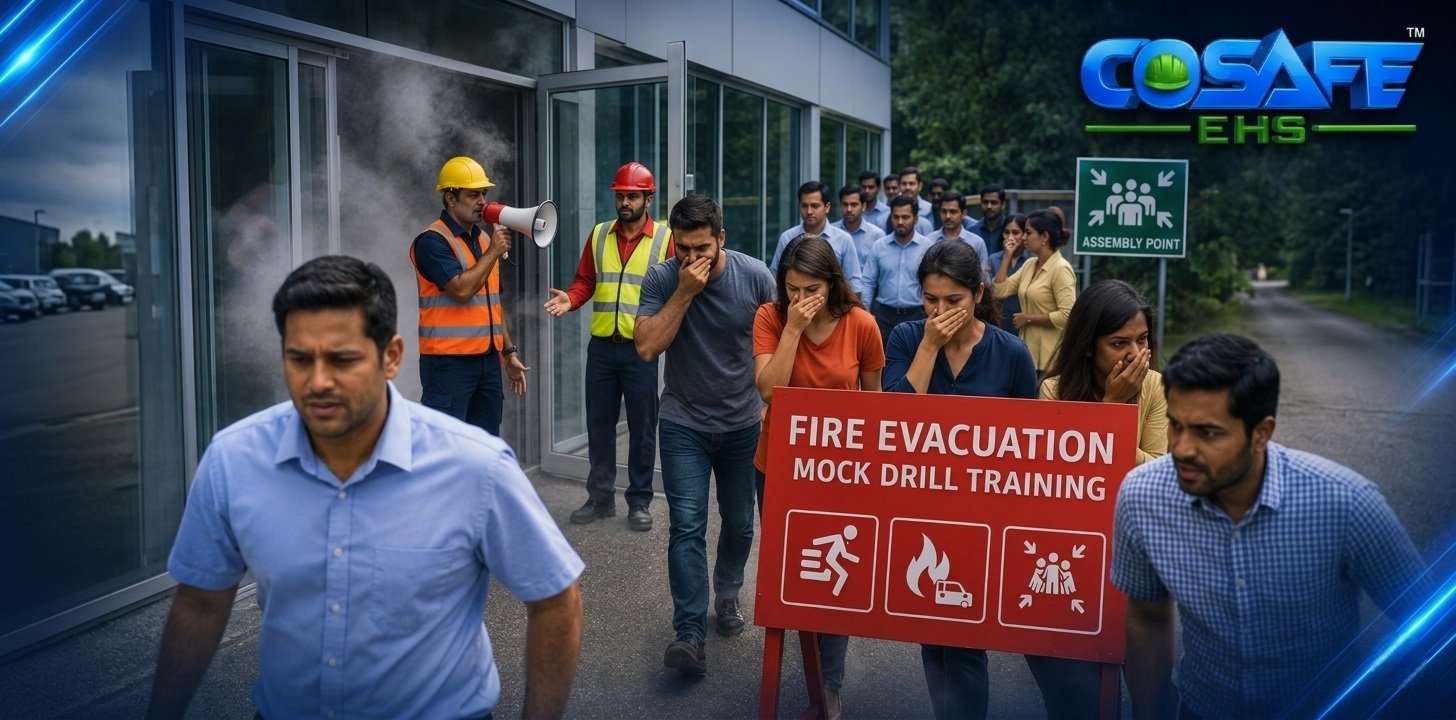
Fire emergencies can occur without warning in workplaces, factories, warehouses, hospitals, schools, shopping malls, high-rise buildings, IT parks, construction sites, and industrial facilities. In such situations, panic, delayed evacuation, lack of coordination, and untrained employees can lead to severe injuries, fatalities, operational disruption, and major property losses. This is why Fire Evacuation Mock Drill Training is considered one of the most critical components of workplace emergency preparedness and occupational safety management.
At Cosafe EHS Bangalore, we provide practical, industry-oriented Fire Evacuation Mock Drill Training programs designed to help organizations strengthen emergency response capability, improve evacuation efficiency, and ensure workforce readiness during real-life fire emergencies. Our training programs are structured according to workplace safety standards, fire safety norms, industrial emergency preparedness requirements, and organizational risk profiles.
A Fire Evacuation Mock Drill is a simulated emergency exercise conducted to test the effectiveness of fire safety systems, emergency communication procedures, evacuation planning, emergency exits, assembly point management, and workforce response during a fire incident. These drills help organizations identify gaps in preparedness, improve emergency coordination, and create a proactive safety culture.
Modern workplace safety regulations and EHS compliance systems increasingly emphasize the importance of regular fire drills and emergency evacuation training. Organizations conducting periodic mock drills demonstrate stronger safety preparedness, faster emergency response capability, reduced panic during incidents, and improved compliance with occupational safety requirements. Practical fire drill programs are widely recognized as essential for improving workplace emergency management systems.
At Cosafe EHS Bangalore, our Fire Evacuation Mock Drill Training programs focus on real-world emergency preparedness rather than theoretical learning alone. We conduct realistic evacuation exercises, live fire response demonstrations, emergency communication drills, and scenario-based simulations that help employees respond confidently during emergencies.
Organizations that conduct regular mock drills improve workforce preparedness, reduce evacuation time, strengthen incident coordination, and build a safer working environment for employees, contractors, visitors, and stakeholders.
Fire emergencies can escalate rapidly, but a properly trained workforce can significantly reduce risks, injuries, and operational disruption through organized and effective evacuation procedures.
At Cosafe EHS Bangalore, our Fire Evacuation Mock Drill Training programs empower organizations with practical emergency preparedness skills, evacuation coordination capability, and real-world fire response readiness required to build safer and more resilient workplaces.
Prepare Your Workforce. Improve Emergency Readiness. Build a Safer Workplace with Cosafe EHS Bangalore.
This foundational module introduces participants to the importance of emergency evacuation systems and workplace fire preparedness.
Topics covered include:
Participants gain awareness of how organized evacuation can save lives during emergencies.
Employees learn how fire incidents develop and how preventive actions reduce workplace risks.
This module focuses on safe and systematic evacuation techniques during emergencies.
Participants learn:
Special emphasis is placed on preventing panic and ensuring orderly evacuation.
Effective evacuation requires trained emergency coordinators.
This module covers:
Participants understand how leadership and coordination improve emergency response effectiveness.
Early fire control can prevent escalation into major emergencies.
Training includes:
Hands-on practice improves confidence and firefighting awareness.
Clear communication is essential during emergencies.
Participants are trained in:
This module improves response coordination and minimizes confusion during emergencies.
Smoke inhalation is one of the leading causes of fatalities during fires.
Topics covered:
Participants learn techniques for safe evacuation under low-visibility conditions.
Certain emergencies may require rescue support before professional responders arrive.
This module includes:
Practical demonstrations help improve emergency response capability.
A structured command system improves emergency management efficiency.
Participants learn:
This module is particularly valuable for supervisors, EHS teams, and emergency coordinators.
This is the core practical component of the training program.
Activities include:
Practical mock drills help organizations evaluate preparedness levels and identify improvement opportunities.
11. Post-Drill Evaluation & Corrective Actions
Continuous improvement is essential for emergency preparedness.
This module focuses on:
Organizations gain actionable insights to strengthen emergency management systems.
At Cosafe EHS Bangalore, we follow a highly practical, scenario-based, and industry-oriented training methodology designed to improve real-world emergency preparedness and workforce confidence. Our programs are conducted by experienced EHS professionals, fire safety experts, and industrial emergency response trainers with hands-on operational expertise.
Interactive Classroom Sessions
Participants receive structured theoretical training through:
This builds strong foundational understanding of fire evacuation principles and emergency response systems.
Practical Fire Safety Demonstrations
Practical learning is one of the most important aspects of our training approach.
Participants receive hands-on exposure to:
Live demonstrations significantly improve practical confidence and emergency readiness.
Scenario-Based Mock Drill Simulations
We conduct realistic emergency simulations based on actual workplace risks.
Simulation activities include:
These exercises help employees develop faster reaction time and organized emergency response capability.
Team-Based Emergency Coordination Exercises
Emergency response requires coordination between multiple teams and departments.
Our methodology includes:
Participants learn how teamwork improves evacuation efficiency and reduces confusion during emergencies.
Real-Time Evacuation Assessment & Evaluation
Every mock drill is evaluated to identify strengths and improvement areas.
Assessment includes:
Detailed feedback and corrective action recommendations are provided after every drill.
Compliance-Focused Documentation Support
Organizations often require proper emergency preparedness documentation for audits and regulatory compliance.
Our support includes:
This helps organizations strengthen workplace safety management systems and audit readiness.
Cosafe EHS Bangalore has successfully conducted multiple ERT and Fire Mock Drill Training programs for organizations across Bangalore, helping companies strengthen workplace safety culture and emergency response preparedness.
Industries We Serve
Duration: 2–3 Hours (Including Drill)
Certification: Participation Certificate (if required)
Validity: As per company safety policy
Languages: Kannada / Hindi / English / Telugu