






Overview
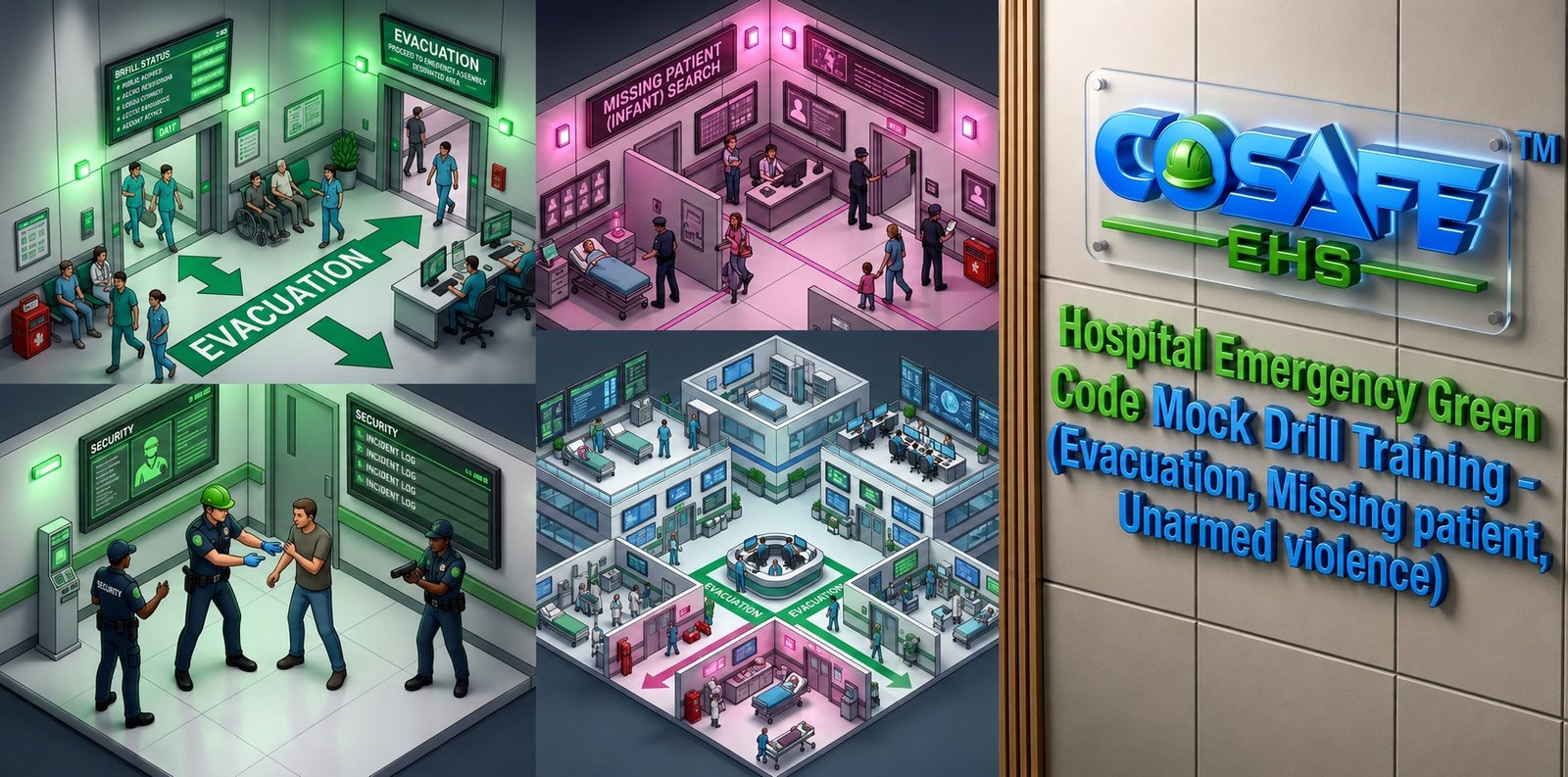
Hospital Emergency Green Code Mock Drill Training in Bangalore
Professional Hospital Emergency Green Code Mock Drill Training by Cosafe EHS Bangalore
Hospitals operate in dynamic environments where emergencies can arise without warning, requiring immediate action to protect patients, healthcare workers, visitors, and critical infrastructure. Among the most important hospital emergency preparedness exercises is the Green Code Mock Drill, which focuses on evacuation readiness, missing patient management, and response to unarmed violent or aggressive behavior.
At Cosafe EHS Bangalore, our Hospital Emergency Green Code Mock Drill Training Program is designed to strengthen hospital emergency preparedness, improve patient safety, enhance staff coordination, validate emergency procedures, and ensure rapid response during critical incidents. Through realistic simulations, practical exercises, tabletop drills, and full-scale mock drills, healthcare organizations can identify response gaps, improve communication, and build confidence among staff members.
It is important to understand that Hospital Emergency Color Codes are not universally standardized across the world. The meaning of Green Code may vary depending on the country, healthcare system, and hospital policy. However, in many Canadian healthcare systems, Code Green is formally associated with evacuation or relocation procedures, while missing patients and violent situations are often managed through separate emergency codes. Therefore, hospitals should always follow their approved emergency code policy and internal emergency response framework.
What is Hospital Emergency Green Code?
In many healthcare facilities, particularly within Canadian hospital emergency code systems, Green Code is used to indicate:
Partial evacuation
Full hospital evacuation
Internal relocation
External evacuation
Emergency patient movement
Facility emergency relocation
A Green Code may be activated due to:
Fire emergencies
Structural damage
Bomb threats
Hazardous material incidents
Gas leaks
Infrastructure failure
Flooding
Natural disasters
Security incidents
Utility failures
Many hospitals also integrate missing patient management and unarmed violence response into broader emergency preparedness exercises because these incidents can lead to evacuations, lockdowns, or emergency relocations.
Countries Where Green Code Systems Are Commonly Used
Hospital emergency code systems incorporating Green Code evacuation procedures are widely used in:
Canada
United Kingdom (selected healthcare organizations)
Australia (facility-specific systems)
New Zealand
India (hospital-specific emergency frameworks)
Singapore
Malaysia
United Arab Emirates (UAE)
Saudi Arabia
Qatar
South Africa
Hong Kong
In Canada, provincial hospital emergency code frameworks commonly identify Code Green as Evacuation, while Code Yellow often refers to Missing Person and Code White refers to Violent or Behavioral Situations. Because emergency codes differ globally, healthcare facilities should train staff according to their local emergency code structure.
Why Hospital Green Code Mock Drills are Important
Healthcare facilities face numerous emergency situations that can require evacuation, patient accountability, and security intervention.
Common challenges include:
Patient evacuation difficulties
Critical patient movement
Missing patient incidents
Aggressive visitor behavior
Unarmed workplace violence
Communication failures
Delayed emergency response
Resource coordination challenges
Staff confusion during emergencies
Regulatory compliance concerns
Regular Green Code Mock Drills help hospitals:
Improve emergency preparedness
Strengthen evacuation readiness
Enhance patient accountability
Improve missing patient recovery procedures
Strengthen workplace violence response
Improve communication systems
Validate emergency plans
Increase staff confidence
Protect patients and visitors
Improve operational resilience
Objectives of Green Code Mock Drill Training
The primary objectives include:
Understanding Green Code activation procedures
Improving evacuation preparedness
Strengthening patient accountability systems
Enhancing missing patient response
Improving unarmed violence management
Strengthening emergency communications
Improving multidisciplinary coordination
Testing emergency procedures
Enhancing patient safety
Building organizational resilience
Key Benefits of Green Code Mock Drills
Hospitals conducting regular Green Code drills benefit through:
Faster emergency response
Improved evacuation efficiency
Better patient tracking
Enhanced workplace safety
Reduced emergency confusion
Stronger staff coordination
Improved communication effectiveness
Better compliance readiness
Increased emergency preparedness
Enhanced hospital resilience
Who Should Attend?
This training is ideal for:
Hospital Administrators
Medical Superintendents
Nursing Supervisors
Department Heads
Emergency Response Teams
Security Personnel
Safety Officers
Facility Managers
Patient Care Coordinators
Hospital Incident Command Teams
EHS Professionals
Emergency Planning Committees
Hospital emergencies involving evacuation, missing patients, and unarmed violence require rapid action, clear communication, effective coordination, and well-practiced response procedures. Regular Hospital Emergency Green Code Mock Drills help healthcare facilities validate emergency plans, improve preparedness, strengthen patient safety, and ensure operational continuity during critical incidents.
At Cosafe EHS Bangalore, our Hospital Emergency Green Code Mock Drill Training Program equips healthcare professionals with the practical skills, emergency response knowledge, and confidence required to effectively manage complex hospital emergencies while protecting patients, staff, visitors, and critical healthcare operations. By conducting realistic simulations and structured evaluations, we help hospitals build safer, stronger, and more resilient healthcare environments.
References for international code usage: Green Code is commonly used for hospital evacuation in several Canadian healthcare systems, while missing patient and violent behavior are often managed through separate codes such as Yellow and White, highlighting the importance of facility-specific training and emergency code awareness.
Prepare. Protect. Respond. Choose Cosafe EHS Bangalore for Professional Hospital Emergency Green Code Mock Drill Training in Bangalore.
Training Modules
Module 1: Introduction to Hospital Emergency Preparedness
Participants gain a comprehensive understanding of healthcare emergency management principles.
Topics include:
- Emergency preparedness fundamentals
- Healthcare risk management
- Emergency response systems
- Patient safety principles
- Crisis management frameworks
- Organizational resilience
Module 2: Understanding Hospital Emergency Green Code
Participants learn the purpose and activation process of Green Code emergencies.
Training includes:
- Green Code definitions
- Activation criteria
- Escalation procedures
- Emergency notifications
- Response expectations
- Staff responsibilities
Special emphasis is placed on facility-specific emergency code policies.
Module 3: Hospital Evacuation Planning and Management
Participants learn how to safely evacuate healthcare facilities.
Topics include:
- Partial evacuation procedures
- Full hospital evacuation
- Internal relocation
- External evacuation
- Safe patient movement
- Evacuation prioritization
Module 4: Horizontal and Vertical Evacuation Procedures
Hospitals require specialized evacuation methods.
Training includes:
- Horizontal evacuation
- Vertical evacuation
- Bed-bound patient movement
- ICU patient evacuation
- Special care patient relocation
- Evacuation equipment usage
Participants practice safe patient evacuation techniques.
Module 5: Missing Patient Response and Recovery
Patient accountability is a critical healthcare responsibility.
Topics include:
- Missing patient identification
- Search procedures
- Patient tracking systems
- Area isolation
- Security coordination
- Recovery and reporting procedures
Participants learn structured missing patient management protocols.
Module 6: Patient Accountability and Census Verification
Accurate accountability reduces risk during emergencies.
Training includes:
- Occupancy verification
- Patient census reconciliation
- Visitor accountability
- Staff accountability
- Documentation procedures
- Emergency reporting
Module 7: Unarmed Violence and Aggressive Behavior Response
Healthcare workers frequently encounter aggressive behaviors.
Topics include:
- Violence prevention principles
- Threat recognition
- Behavioral warning signs
- Verbal de-escalation techniques
- Conflict management
- Staff protection strategies
Participants learn safe response methods for non-weapon-related incidents.
Module 8: Workplace Violence Prevention
Training focuses on maintaining a safe healthcare environment.
Topics include:
- Violence risk assessment
- Prevention strategies
- Reporting mechanisms
- Incident management
- Security collaboration
- Employee safety awareness
Module 9: Hospital Security and Access Control
Participants learn emergency security procedures.
Training includes:
- Access control measures
- Visitor management
- Restricted area security
- Emergency lockdown support
- Perimeter protection
- Security communication systems
Module 10: Emergency Communication Systems
Effective communication is essential during emergencies.
Topics include:
- Emergency notifications
- Public address systems
- Staff communication protocols
- Incident reporting
- Escalation procedures
- Crisis communications
Module 11: Hospital Incident Command System (HICS)
Participants understand structured emergency leadership.
Training includes:
- Incident command principles
- Leadership roles
- Emergency coordination
- Resource allocation
- Decision-making processes
- Documentation requirements
Module 12: Multi-Department Coordination During Emergencies
Emergency response requires teamwork across departments.
Topics include:
- Clinical coordination
- Security integration
- Administration support
- Engineering response
- Housekeeping coordination
- External agency communication
Module 13: Emergency Resource Management
Participants learn effective resource utilization.
Training includes:
- Emergency equipment deployment
- Personnel management
- Transportation resources
- Evacuation aids
- Communication resources
- Medical support resources
Module 14: Full-Scale Green Code Mock Drill Simulation
Participants engage in realistic scenarios involving:
- Hospital evacuation
- Missing patient incidents
- Aggressive visitor situations
- Unarmed violence response
- Emergency communication activation
- Incident command deployment
- Security coordination
- Patient accountability verification
These drills replicate realistic hospital emergency conditions.
Module 15: Post-Drill Evaluation and Continuous Improvement
Participants learn continuous preparedness improvement techniques.
Training includes:
- Performance evaluation
- Response gap analysis
- Corrective action planning
- Lessons learned reviews
- Emergency plan updates
- Future preparedness recommendations
Training Methodology
At Cosafe EHS Bangalore, our Hospital Emergency Green Code Mock Drill Training follows a practical, simulation-based, and healthcare-focused methodology designed to improve hospital readiness and patient safety.
Interactive Classroom Sessions
Participants receive expert instruction through:
- Emergency preparedness presentations
- Healthcare case studies
- Safety workshops
- Group discussions
- Emergency planning sessions
- Interactive learning activities
This creates a strong theoretical foundation.
Facility Risk Assessment Workshops
Participants engage in:
- Hazard identification exercises
- Vulnerability assessments
- Evacuation route evaluations
- Security assessments
- Resource reviews
- Preparedness gap analysis
These workshops strengthen proactive risk management.
Tabletop Emergency Simulations
Participants work through realistic scenarios involving:
- Evacuation emergencies
- Missing patient incidents
- Aggressive behavior situations
- Infrastructure failures
- Facility emergencies
- Security incidents
These exercises improve decision-making and coordination.
Practical Evacuation Exercises
Participants practice:
- Horizontal evacuation
- Vertical evacuation
- Patient relocation
- Equipment movement
- Accountability verification
- Emergency communication
These activities build operational confidence.
Violence Prevention and De-Escalation Simulations
Training includes:
- Conflict management scenarios
- Verbal de-escalation exercises
- Aggressive behavior response
- Staff safety techniques
- Security collaboration
- Incident reporting procedures
Participants develop effective workplace violence response skills.
Full-Scale Green Code Mock Drill Execution
Participants actively perform:
- Green Code activation
- Emergency evacuation
- Missing patient search operations
- Security deployment
- Incident command activation
- Communication coordination
- Accountability verification
- Emergency response documentation
These drills replicate real-world hospital emergencies.
Multi-Department Coordination Exercises
Training involves:
- Nursing Services
- Clinical Teams
- Security Departments
- Facility Management
- Administration
- Emergency Response Teams
- Engineering Departments
- Safety Committees
This ensures hospital-wide preparedness.
Post-Drill Debriefing and Evaluation
Following every drill:
- Response effectiveness is measured
- Communication performance is reviewed
- Evacuation efficiency is assessed
- Security response is evaluated
- Improvement opportunities are identified
- Corrective action plans are developed
This supports continuous emergency preparedness improvement.
Competency Assessment and Certification
Participants are evaluated through:
- Written assessments
- Emergency simulations
- Team participation
- Practical exercises
- Mock drill performance reviews
- Competency evaluations
Certificates are awarded upon successful completion.