






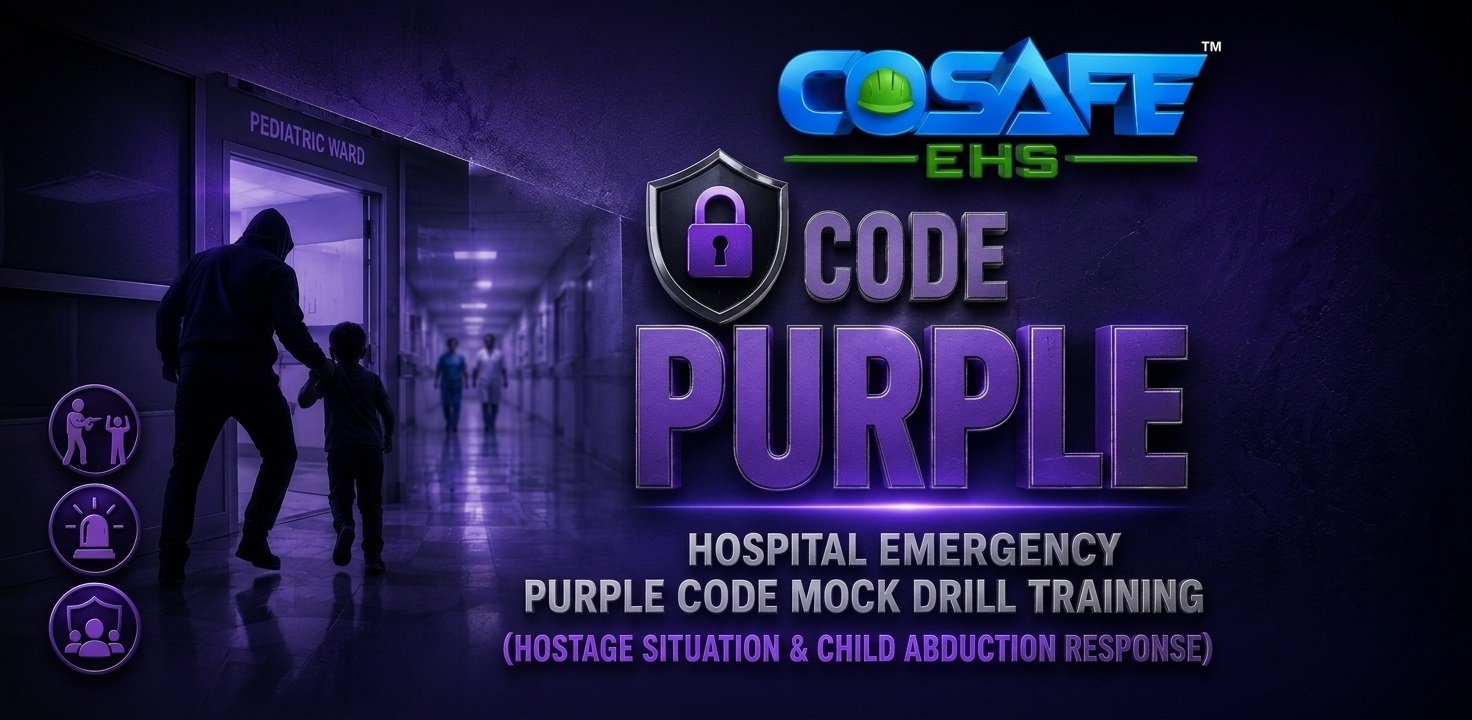
Overview
Professional Hospital Emergency Purple Code Mock Drill Training by Cosafe EHS Bangalore
(Hostage Situation & Child Abduction Response)
Hospitals are designed to provide safe and secure healthcare services, yet they remain vulnerable to rare but extremely high-risk security incidents such as hostage situations, attempted child abductions, unauthorized removal of pediatric patients, custody disputes, and security breaches. These incidents demand an immediate, coordinated, and well-rehearsed response involving hospital security, clinical teams, administration, and law enforcement.
At Cosafe EHS Bangalore, our Hospital Emergency Purple Code Mock Drill Training Program is designed to strengthen hospital security preparedness, improve emergency coordination, validate response protocols, and enhance staff confidence in managing high-risk security emergencies. Through realistic simulations, scenario-based exercises, tabletop drills, and full-scale mock drills, healthcare facilities can evaluate their readiness, identify vulnerabilities, and improve response effectiveness while ensuring the safety of patients, staff, visitors, and critical hospital operations.
Important Note: Hospital emergency colour codes are not internationally standardized. The meaning of Code Purple varies significantly between countries, states, and healthcare organizations. In many Canadian hospitals, Code Purple commonly indicates a hostage situation, while in some United States hospital systems it is used for child abduction, particularly distinguishing older children from infants, where Code Pink often refers to infant abduction. Other hospitals use entirely different codes such as Code Silver or Code Amber for similar incidents. Therefore, every healthcare organization should train staff according to its officially approved emergency code policy.
What is Hospital Emergency Purple Code?
Depending on the hospital's emergency code system, Hospital Emergency Purple Code may be activated for:
Hostage situations
Child abduction
Attempted child abduction
Unauthorized removal of pediatric patients
Child custody disputes
High-risk security incidents
Security lockdowns
Criminal threats involving children
Armed or unarmed hostage events (facility dependent)
Some healthcare organizations use Purple Code exclusively for hostage situations, while others reserve it for child abduction. Hospitals should always follow their own approved emergency management plan.
Countries Where Hospital Purple Code Systems Are Commonly Used
Hospital emergency colour code systems that include Purple Code or equivalent emergency responses are commonly found in:
Canada
United States
Australia (selected healthcare organizations)
New Zealand
India (hospital-specific emergency code systems)
Singapore
Malaysia
United Arab Emirates (UAE)
Saudi Arabia
Qatar
Oman
South Africa
Hong Kong
Examples include:
Canada (Ontario and several hospitals): Code Purple commonly refers to Hostage Taking.
United States (many healthcare systems): Code Purple is frequently used for Child Abduction, while Code Pink often refers to Infant Abduction.
Because emergency colour codes differ globally, hospitals should ensure all employees receive facility-specific emergency code training.
Why Hospital Purple Code Mock Drills are Important
Security emergencies involving hostages or missing children require rapid, coordinated action to prevent harm.
Potential challenges include:
Delayed emergency activation
Ineffective communication
Delayed lockdown implementation
Failure to monitor exits
Poor coordination with police
Delayed child recovery
Staff uncertainty
Visitor panic
Security breaches
Inadequate documentation
Regular Purple Code Mock Drills help hospitals:
Improve emergency response speed
Strengthen security awareness
Improve child protection
Enhance hostage response coordination
Validate lockdown procedures
Improve communication systems
Strengthen multidisciplinary teamwork
Build staff confidence
Improve regulatory preparedness
Enhance patient and visitor safety
Objectives of Hospital Emergency Purple Code Mock Drill Training
The primary objectives include:
Understanding Purple Code activation procedures
Strengthening child protection systems
Improving hostage incident preparedness
Enhancing emergency communication
Strengthening hospital security response
Improving access control
Developing lockdown capabilities
Coordinating with law enforcement
Testing emergency response plans
Building organizational resilience
Key Benefits of Purple Code Mock Drills
Hospitals conducting regular Purple Code drills benefit through:
Faster emergency activation
Improved child recovery procedures
Enhanced hospital security
Stronger multidisciplinary coordination
Better emergency communications
Reduced security vulnerabilities
Improved incident command
Increased staff confidence
Better compliance readiness
Improved patient and visitor safety
Hostage situations and child abduction incidents are among the most sensitive and high-risk security emergencies a hospital may face. A structured Hospital Emergency Purple Code Mock Drill enables healthcare organizations to validate security procedures, improve emergency communication, strengthen coordination with law enforcement, and enhance the protection of patients, children, visitors, and staff. Because Purple Code meanings differ between countries and even between hospitals, organizations should always ensure that drills reflect their own approved emergency code system.
At Cosafe EHS Bangalore, our Hospital Emergency Purple Code Mock Drill Training Program equips healthcare professionals with the knowledge, practical skills, and confidence required to manage complex hospital security emergencies through realistic simulations, structured evaluations, and continuous improvement.
Protect Every Child. Secure Every Patient. Strengthen Hospital Security. Choose Cosafe EHS Bangalore for Professional Hospital Emergency Purple Code Mock Drill Training in Bangalore.
Training Modules
Module 1: Introduction to Hospital Security Emergency Management
Participants gain an understanding of healthcare security principles.
Topics include:
- Hospital security fundamentals
- Emergency preparedness
- Security risk management
- Patient protection
- Threat recognition
- Emergency planning
Module 2: Understanding Hospital Emergency Purple Code
Participants learn facility-specific Purple Code procedures.
Training includes:
- Purple Code definitions
- Activation criteria
- Notification procedures
- Escalation processes
- Staff responsibilities
- Documentation requirements
Special emphasis is placed on understanding that Purple Code meanings vary internationally.
Module 3: Child Protection and Abduction Prevention
Participants learn proactive child protection measures.
Topics include:
- Infant and pediatric security
- Visitor verification
- Patient identification systems
- Custody verification
- Child movement controls
- Prevention strategies
Module 4: Child Abduction Response Procedures
Training includes:
- Immediate response actions
- Hospital lockdown procedures
- Exit monitoring
- Search coordination
- CCTV review awareness
- Law enforcement notification
- Family communication
- Recovery procedures
Participants learn structured child recovery protocols.
Module 5: Hostage Situation Awareness and Response
Participants gain awareness of hostage incident management.
Topics include:
- Hostage recognition
- Initial response priorities
- Personal safety
- Area isolation
- Communication principles
- Incident stabilization
The focus is on protecting life, preserving evidence, and coordinating with law enforcement rather than direct intervention.
Module 6: Hospital Lockdown Procedures
Participants learn effective lockdown management.
Training includes:
- Full lockdown
- Partial lockdown
- Department isolation
- Access control
- Visitor restrictions
- Controlled movement
Module 7: Emergency Communication Systems
Communication is critical during security emergencies.
Topics include:
- Emergency notifications
- Public address announcements
- Silent communication methods
- Staff alerts
- Escalation pathways
- Information management
Module 8: Hospital Security Operations
Training includes:
- Access control
- Security patrol coordination
- CCTV monitoring awareness
- Visitor screening
- Identity verification
- Perimeter security
Participants strengthen hospital security practices.
Module 9: Incident Command System (HICS)
Participants understand emergency leadership.
Topics include:
- Incident command activation
- Leadership roles
- Resource coordination
- Decision-making
- Situation reporting
- Documentation
Module 10: Coordination with External Emergency Agencies
Participants learn inter-agency coordination.
Training includes:
- Police coordination
- Emergency medical services
- Government authorities
- Child protection agencies
- Public safety agencies
- Media management awareness
Module 11: Behavioral Threat Recognition
Participants learn early identification of security concerns.
Topics include:
- Suspicious behavior
- Threat assessment
- Visitor monitoring
- Risk indicators
- Escalation criteria
- Preventive intervention
Module 12: Family Assistance and Communication
Training focuses on:
- Family notification
- Crisis communication
- Emotional support
- Information management
- Privacy protection
- Patient relations
Module 13: Security Technology Awareness
Participants gain familiarity with:
- CCTV systems
- Access control systems
- Electronic identification
- Alarm systems
- Communication devices
- Security reporting tools
Module 14: Full-Scale Purple Code Mock Drill
Participants actively perform:
- Purple Code activation
- Hospital lockdown
- Security deployment
- Child search operations
- Hostage response coordination
- Incident command activation
- Communication management
- Law enforcement coordination
These drills simulate realistic hospital security emergencies.
Module 15: Post-Drill Evaluation and Continuous Improvement
Training concludes with:
- Response time analysis
- Security assessment
- Communication evaluation
- Gap analysis
- Corrective action planning
- Emergency plan improvements
Training Methodology
At Cosafe EHS Bangalore, our Hospital Emergency Purple Code Mock Drill Training follows a practical, simulation-based, and security-focused methodology designed specifically for healthcare facilities.
Interactive Classroom Sessions
Participants receive expert instruction through:
- Healthcare security presentations
- Emergency planning workshops
- Security case studies
- Interactive discussions
- Video-based learning
- Question-and-answer sessions
This establishes a strong theoretical foundation.
Hospital Security Risk Assessment Workshops
Participants engage in:
- Security vulnerability assessments
- Child protection reviews
- Access control evaluations
- Lockdown planning
- Threat assessments
- Emergency planning exercises
These workshops strengthen proactive risk management.
Tabletop Emergency Simulations
Participants work through realistic scenarios involving:
- Child abduction attempts
- Hostage situations
- Unauthorized patient removal
- Hospital lockdowns
- Security breaches
- Communication failures
These exercises strengthen leadership and decision-making.
Practical Security Demonstrations
Hands-on demonstrations include:
- Access control procedures
- Lockdown implementation
- Exit monitoring
- Visitor verification
- Communication systems
- Incident documentation
Participants gain practical operational knowledge.
Full-Scale Purple Code Mock Drill Execution
Participants actively perform:
- Purple Code activation
- Emergency communication
- Hospital lockdown
- Child search procedures
- Security deployment
- Incident command activation
- Law enforcement coordination
- Family communication
These drills replicate realistic healthcare security incidents.
Multi-Department Coordination Exercises
Training involves:
- Security Departments
- Nursing Teams
- Pediatric Units
- NICU Personnel
- Maternity Services
- Administration
- Facility Management
- Emergency Response Teams
This strengthens organization-wide emergency preparedness.
Performance Evaluation and Debriefing
Following every drill:
- Response times are measured
- Security performance is assessed
- Communication is evaluated
- Lockdown effectiveness is reviewed
- Operational gaps are identified
- Improvement plans are developed
This supports continuous preparedness enhancement.
Competency Assessment and Certification
Participants are evaluated through:
- Written assessments
- Security simulations
- Team participation
- Practical exercises
- Mock drill performance
- Competency evaluations
Certificates are awarded upon successful completion.
Why Choose Cosafe EHS Bangalore for Hospital Emergency Purple Code Mock Drill Training?
- Specialized healthcare security training expertise
- Experienced emergency preparedness consultants
- Realistic hostage and child protection simulations
- Hospital-specific security planning
- Practical lockdown exercises
- Comprehensive emergency evaluations
- Incident Command System integration
- Regulatory and accreditation support
- Detailed post-drill improvement reports
- Strong commitment to patient, child, and staff safety