






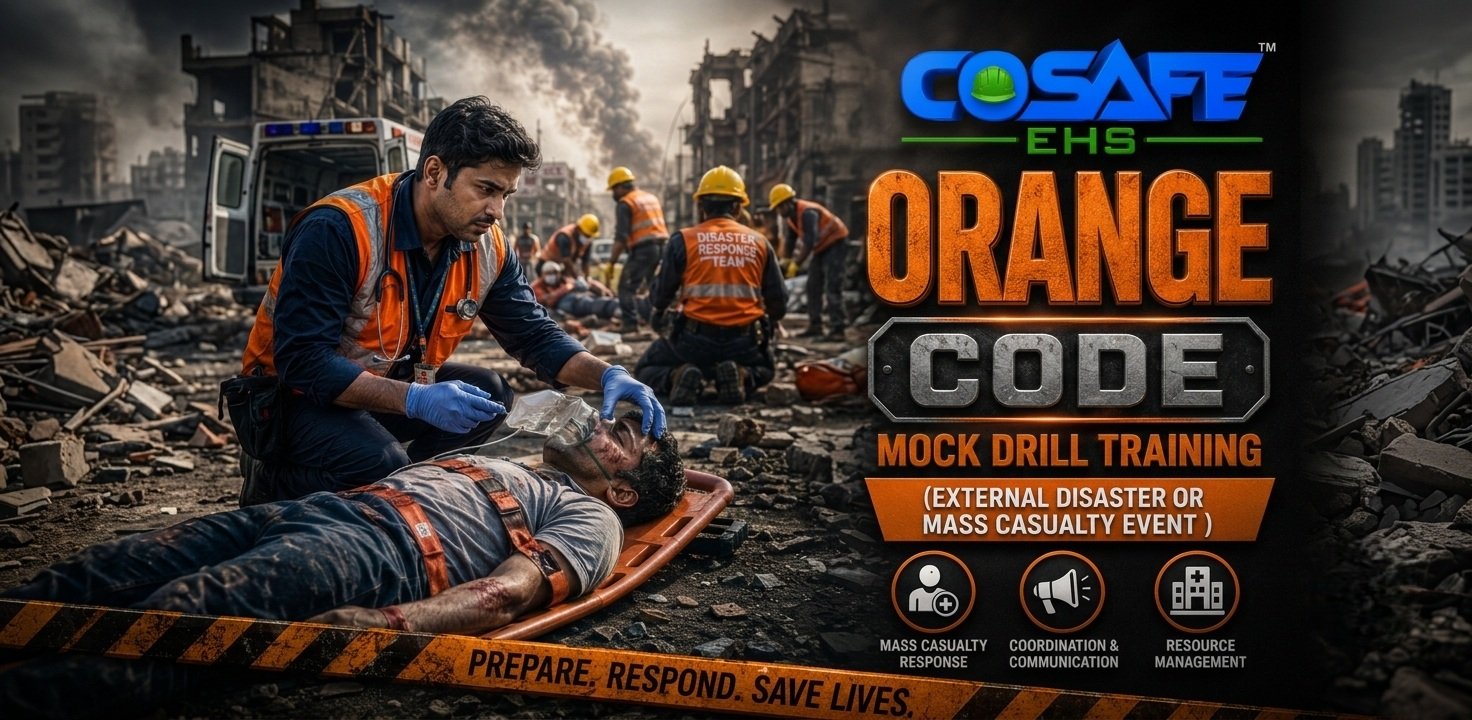
Overview
Professional Orange Code Mock Drill Training (External Disaster & Mass Casualty Event) by Cosafe EHS Bangalore
External disasters and mass casualty incidents (MCIs) are among the most challenging emergencies faced by organizations, industries, healthcare facilities, educational institutions, airports, and public infrastructure. Unlike internal emergencies, these incidents originate outside an organization's premises but can significantly impact operations, employee safety, business continuity, and emergency response capabilities. Major road traffic accidents, industrial explosions, earthquakes, floods, terrorist attacks, chemical releases, railway derailments, aviation accidents, and large public incidents require rapid coordination, effective communication, and structured emergency response.
Cosafe EHS Bangalore offers comprehensive Orange Code Mock Drill Training (External Disaster & Mass Casualty Event) to help organizations prepare for high-impact emergencies through realistic simulations, emergency planning, Incident Command System (ICS) implementation, evacuation management, inter-agency coordination, and crisis response exercises. Our practical mock drills enable participants to respond confidently, minimize casualties, protect critical infrastructure, and ensure compliance with emergency preparedness requirements.
Our training combines global best practices in emergency management, occupational health and safety, disaster preparedness, business continuity, and crisis management to build resilient organizations capable of effectively managing external disasters.
What is an Orange Code?
An Orange Code is commonly used in many hospitals, healthcare organizations, and emergency management systems to indicate an External Disaster or Mass Casualty Event (MCI) requiring immediate activation of emergency response plans. Although emergency colour codes vary between organizations and countries, Code Orange is widely recognized in many healthcare systems as an alert for external emergencies that may overwhelm normal operational capacity.
An Orange Code may be activated during:
Major road traffic accidents
Multi-vehicle collisions
Railway derailments
Aircraft accidents
Industrial explosions
Chemical plant incidents
Large fires affecting nearby communities
Natural disasters such as earthquakes, floods, cyclones, or landslides
Terrorist attacks
Building collapses
Public gathering incidents
Hazardous material transportation accidents
Community-wide emergencies
Mass casualty incidents requiring coordinated emergency response
The objective of an Orange Code is to activate emergency management procedures, mobilize emergency response teams, coordinate with government agencies, ensure effective communication, and protect lives while maintaining essential organizational operations.
Countries Where Orange Code Systems Are Commonly Applied
Emergency colour-code systems differ worldwide; however, Orange Code (External Disaster / Mass Casualty Incident) is commonly implemented in healthcare and emergency management organizations across:
India
Canada
United States (selected healthcare organizations)
Australia
New Zealand
Singapore
Malaysia
United Arab Emirates (UAE)
Saudi Arabia
Qatar
Oman
South Africa
Ireland
Hong Kong
Many Canadian healthcare facilities officially use Code Orange to indicate an external disaster or mass casualty event, while several hospitals and organizations in other countries adopt similar emergency notification systems. Organizations should always follow their approved Emergency Response Plan (ERP), Disaster Management Plan (DMP), Business Continuity Plan (BCP), and applicable local regulations.
Why Orange Code Mock Drills are Important
External disasters often occur unexpectedly and can overwhelm organizational resources within minutes. Without regular emergency preparedness exercises, organizations may experience delayed response, communication failures, poor coordination, confusion regarding roles and responsibilities, inadequate evacuation, resource shortages, and prolonged business disruption.
Regular Orange Code Mock Drill Training helps organizations:
Strengthen emergency preparedness
Improve emergency communication systems
Validate disaster management plans
Enhance Incident Command System implementation
Improve emergency decision-making
Strengthen interdepartmental coordination
Increase employee confidence
Improve coordination with emergency responders
Support business continuity planning
Reduce operational downtime and financial losses
Objectives of Orange Code Mock Drill Training
The training program is designed to:
Understand Orange Code activation procedures
Improve disaster preparedness and response capabilities
Strengthen Incident Command System (ICS) implementation
Develop effective emergency communication skills
Improve casualty management awareness
Enhance evacuation and shelter management
Strengthen coordination with external emergency agencies
Improve resource mobilization during emergencies
Validate emergency response plans
Build a proactive organizational safety culture
Who Should Attend?
This training is recommended for:
EHS Managers
Safety Officers
Fire & Safety Officers
Emergency Response Teams (ERT)
Crisis Management Teams
Security Personnel
Facility Managers
Operations Managers
Plant Managers
HR Managers
Engineering & Maintenance Personnel
Business Continuity Teams
Disaster Management Teams
Healthcare Staff
Educational Institution Administrators
Airport & Transport Personnel
Manufacturing Employees
Logistics & Warehouse Teams
Government Emergency Coordinators
External disasters and mass casualty incidents demand rapid coordination, effective leadership, structured communication, and well-practiced emergency response procedures. Regular Orange Code Mock Drill Training enables organizations to validate emergency plans, improve operational readiness, strengthen disaster resilience, and protect employees, visitors, assets, and business operations.
At Cosafe EHS Bangalore, our Orange Code Mock Drill Training (External Disaster & Mass Casualty Event) equips organizations with internationally aligned emergency management practices, practical simulations, and competency-based learning that prepare teams to respond confidently during major emergencies. Through realistic mock drills, continuous improvement, and professional guidance, we help organizations build a safer, more resilient, and emergency-ready workplace.
Training Modules
Module 1: Introduction to Orange Code Emergency Management
Participants learn the fundamentals of external disaster management, emergency preparedness, mass casualty response, organizational resilience, legal responsibilities, and disaster risk reduction principles.
Module 2: Understanding External Disasters and Mass Casualty Incidents
Training covers disaster classification, natural and man-made disasters, emergency escalation, casualty surge management, community emergencies, and organizational response priorities.
Module 3: Hazard Identification and Risk Assessment
Participants identify external hazards, assess organizational vulnerabilities, evaluate potential consequences, and implement preventive measures using internationally recognized risk assessment techniques.
Module 4: Emergency Response Planning
Participants understand Emergency Response Plans (ERP), Disaster Management Plans (DMP), Business Continuity Planning (BCP), Emergency Operations Centers (EOC), and emergency activation procedures.
Module 5: Incident Command System (ICS)
Training includes ICS principles, command structure, emergency leadership, communication hierarchy, resource coordination, documentation, and decision-making during complex emergencies.
Module 6: Emergency Communication Systems
Participants learn emergency notification systems, public address procedures, emergency reporting, crisis communication, stakeholder communication, media management, and information control.
Module 7: Evacuation and Assembly Management
Training includes evacuation planning, emergency exits, assembly point management, accountability procedures, mobility assistance, and safe evacuation techniques.
Module 8: Mass Casualty Management Awareness
Participants gain awareness of casualty triage principles, emergency medical coordination, casualty transportation, temporary treatment areas, and coordination with emergency medical services.
Module 9: Coordination with External Emergency Agencies
Participants understand coordination procedures with Fire & Rescue Services, Police, Emergency Medical Services (EMS), Disaster Management Authorities, Civil Defence, Local Government Authorities, and Mutual Aid Partners.
Module 10: Resource Mobilization and Emergency Logistics
Training covers emergency equipment deployment, manpower allocation, emergency supplies, transportation planning, logistics coordination, and resource prioritization during large-scale emergencies.
Module 11: Crisis Leadership and Decision-Making
Participants develop emergency leadership, teamwork, communication under pressure, situational awareness, and effective crisis decision-making capabilities.
Module 12: Business Continuity and Recovery
Topics include protecting critical business functions, continuity planning, operational recovery, damage assessment, recovery planning, and organizational resilience.
Module 13: Full-Scale Orange Code Mock Drill
Participants perform realistic emergency simulations involving Orange Code activation, Incident Command implementation, emergency communication, evacuation, coordination with emergency agencies, accountability procedures, and recovery planning.
Module 14: Post-Drill Evaluation
Participants review response times, communication effectiveness, emergency coordination, evacuation performance, identified gaps, lessons learned, and corrective actions.
Module 15: Continuous Improvement
Organizations develop action plans, revise emergency procedures, strengthen preparedness programs, conduct periodic audits, and establish continuous improvement strategies for emergency readiness.
Training Methodology
At Cosafe EHS Bangalore, our Orange Code Mock Drill Training follows a competency-based, practical, and simulation-driven approach designed to improve real-world emergency preparedness.
Our methodology combines interactive classroom sessions, disaster management workshops, hazard identification exercises, tabletop simulations, emergency planning activities, Incident Command System implementation, evacuation drills, communication exercises, and full-scale mock drill execution. Participants actively engage in realistic emergency scenarios that simulate external disasters, allowing them to apply theoretical knowledge in controlled practical environments.
Hands-on demonstrations include emergency notification procedures, emergency operations center activation, evacuation management, casualty coordination awareness, resource deployment, emergency communication systems, and interdepartmental coordination. Participants also practice decision-making under pressure while working alongside emergency response teams and organizational leadership.
The training emphasizes coordination between management, security personnel, Emergency Response Teams (ERT), engineering departments, maintenance teams, HR, administration, facility management, and external emergency agencies to ensure a unified emergency response.
Each mock drill concludes with a structured debriefing where response performance, communication efficiency, evacuation effectiveness, resource utilization, and Incident Command implementation are evaluated. Detailed observations are documented, improvement opportunities are identified, and corrective action plans are developed to continuously strengthen organizational preparedness.
Participants are assessed through written evaluations, practical demonstrations, emergency simulations, teamwork exercises, and mock drill participation. Upon successful completion, participants receive certification demonstrating competency in Orange Code emergency preparedness and external disaster response.