






Overview
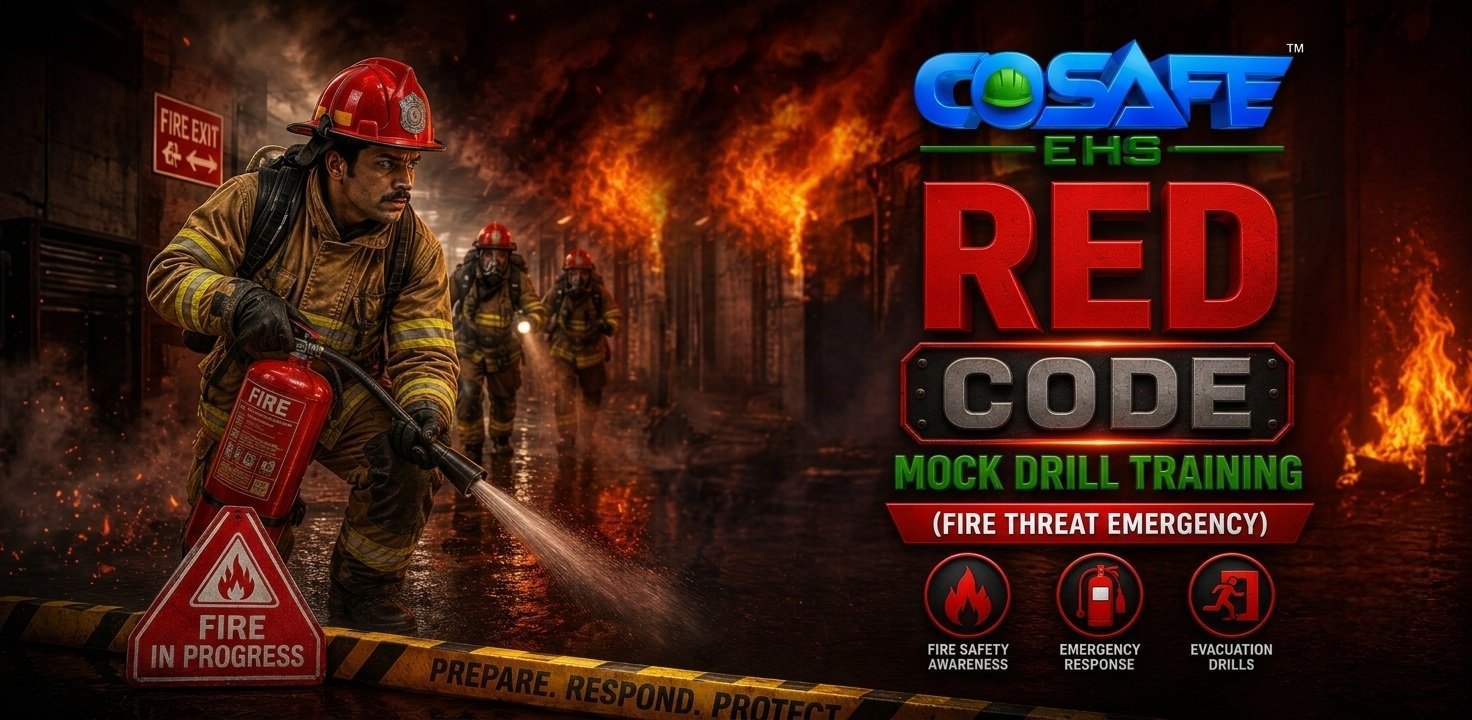
Professional Red Code Mock Drill Training (Fire Threat Emergency) by Cosafe EHS Bangalore
Fire emergencies are among the most serious workplace incidents, capable of causing injuries, fatalities, business interruption, environmental damage, and significant property losses within minutes. Whether caused by electrical faults, flammable liquids, combustible materials, hot work activities, gas leaks, equipment failures, or human error, every fire emergency demands an immediate, coordinated, and well-practiced response.
At Cosafe EHS Bangalore, our Red Code Mock Drill Training (Fire Threat Emergency) is designed to prepare organizations with the knowledge, practical skills, and confidence required to effectively manage fire emergencies. Through realistic fire simulations, emergency evacuation exercises, Incident Command System (ICS) implementation, fire extinguisher demonstrations, emergency communication drills, and full-scale mock exercises, participants learn how to respond quickly while protecting lives, property, and business continuity.
Our training combines internationally recognized fire safety principles, emergency preparedness, fire prevention strategies, evacuation planning, and practical emergency response techniques to build a proactive fire safety culture across organizations.
What is a Red Code?
A Red Code is an emergency notification activated when a fire, smoke, burning smell, or suspected fire threatens the safety of people or property within an organization. In many hospitals and organizations worldwide, Code Red is widely recognized as the emergency alert for a fire or smoke incident, although organizations should always follow their own approved emergency response procedures because emergency code systems are not globally standardized.
A Red Code may be activated due to:
Fire outbreak
Smoke detection
Burning smell
Electrical fire
Flammable liquid fire
LPG or combustible gas fire
Chemical fire
Machinery fire
Warehouse fire
Office fire
Kitchen fire
Industrial fire
Fire alarm activation
Suspected fire emergency
The objective of a Red Code is to rapidly detect the incident, protect occupants, control the emergency where safe to do so, coordinate evacuation, notify emergency services, and minimize damage.
Countries Where Red Code (Fire Emergency) Systems Are Commonly Applied
Emergency colour-code systems or equivalent fire emergency notification systems are widely implemented across:
India
United States
Canada
Australia
New Zealand
Singapore
Malaysia
United Arab Emirates (UAE)
Saudi Arabia
Qatar
Oman
South Africa
Ireland
Hong Kong
In many healthcare facilities and organizations across North America, Australia, and New Zealand, Code Red commonly indicates a fire, smoke, or suspected fire emergency. However, terminology may differ between industries and countries, so every organization should train according to its approved Emergency Response Plan (ERP), Fire Safety Plan, and local fire regulations.
Why Red Code Mock Drills are Important
Fire emergencies can escalate within seconds. Without regular practice, organizations may experience:
Delayed emergency response
Panic during evacuation
Improper use of fire extinguishers
Communication failures
Unsafe evacuation
Blocked escape routes
Business interruption
Property damage
Regulatory non-compliance
Loss of life
Regular Red Code Mock Drills help organizations:
Improve fire emergency preparedness
Strengthen evacuation procedures
Enhance fire prevention awareness
Validate emergency response plans
Improve communication systems
Strengthen Incident Command implementation
Increase employee confidence
Improve coordination with Fire & Rescue Services
Protect lives and assets
Support business continuity
Objectives of Red Code Mock Drill Training
The program aims to:
Understand Red Code activation procedures
Identify fire hazards and ignition sources
Strengthen fire prevention practices
Improve emergency communication
Practice safe evacuation
Develop fire extinguisher competency
Improve Incident Command System implementation
Coordinate with Fire & Rescue Services
Test emergency response plans
Build organizational resilience
Key Benefits of Red Code Mock Drill Training
Organizations conducting regular Red Code drills benefit through:
Faster emergency response
Improved evacuation efficiency
Enhanced fire safety awareness
Better emergency leadership
Reduced fire-related risks
Improved teamwork
Stronger regulatory compliance
Better business continuity
Increased employee confidence
Enhanced organizational resilience
Who Should Attend?
This training is ideal for:
EHS Managers
Safety Officers
Fire & Safety Officers
Emergency Response Teams (ERT)
Fire Wardens
Security Personnel
Facility Managers
Operations Managers
HR Managers
Engineering & Maintenance Teams
Administration Teams
Manufacturing Personnel
Warehouse Personnel
Logistics Teams
Corporate Employees
Educational Institution Staff
Hotel & Hospitality Personnel
Healthcare Support Teams
Industrial Workers
A Red Code (Fire Threat Emergency) requires immediate action, effective communication, disciplined evacuation, and coordinated emergency response. Regular Red Code Mock Drills enable organizations to validate fire emergency procedures, strengthen employee preparedness, improve evacuation efficiency, and enhance overall resilience against fire-related emergencies.
At Cosafe EHS Bangalore, our Red Code Mock Drill Training (Fire Threat Emergency) equips organizations with the knowledge, practical skills, and confidence needed to respond effectively to workplace fire emergencies while protecting people, property, and business operations. Through realistic simulations, structured evaluations, and internationally recognized fire safety practices, we help organizations build safer workplaces, stronger emergency response capabilities, and resilient business operations.
Prevent. Prepare. Respond. Protect. Choose Cosafe EHS Bangalore for Professional Red Code Mock Drill Training (Fire Threat Emergency) in Bangalore.
Training Modules
Module 1: Introduction to Fire Emergency Management
Participants gain a comprehensive understanding of:
- Fire safety fundamentals
- Fire emergency management
- Red Code principles
- Fire prevention
- Emergency preparedness
- Organizational resilience
Module 2: Understanding Fire Behaviour
Topics include:
- Fire triangle and fire tetrahedron
- Stages of fire development
- Heat transfer
- Fire spread mechanisms
- Smoke hazards
- Flashover and backdraft awareness
Participants understand how fires develop and spread.
Module 3: Fire Hazard Identification and Risk Assessment
Training includes:
- Fire hazard recognition
- Ignition source identification
- Fuel source assessment
- Workplace fire risk assessment
- Housekeeping practices
- Preventive controls
Module 4: Fire Detection and Alarm Systems
Participants learn:
- Fire alarm systems
- Smoke detectors
- Heat detectors
- Manual call points
- Emergency notification systems
- Alarm response procedures
Module 5: Red Code Activation Procedures
Training includes:
- Fire reporting procedures
- Alarm activation
- Emergency communication
- Internal notification
- Escalation procedures
- Incident documentation
Module 6: Portable Fire Extinguisher Training
Participants receive practical training on:
- Types of fire extinguishers
- Fire classes (A, B, C, D, Electrical & Cooking Oil)
- PASS Technique
- Safe extinguisher operation
- Extinguisher selection
- Practical demonstrations
Module 7: Fire Suppression Systems
Training covers:
- Fire hydrants
- Hose reels
- Automatic sprinkler systems
- Fire pumps
- Fire water storage
- Fixed suppression systems
Participants gain familiarity with installed fire protection systems.
Module 8: Emergency Evacuation Procedures
Topics include:
- Emergency evacuation planning
- Exit route management
- Assembly point procedures
- Occupant accountability
- Evacuation for persons requiring assistance
- Re-entry authorization
Module 9: Incident Command System (ICS)
Participants learn:
- ICS principles
- Emergency leadership
- Resource coordination
- Command responsibilities
- Decision-making
- Documentation
Module 10: Fire Warden Roles and Responsibilities
Training includes:
- Fire Warden duties
- Area searches
- Occupant guidance
- Assembly point management
- Accountability procedures
- Emergency reporting
Module 11: Coordination with Emergency Services
Participants learn how to coordinate with:
- Fire & Rescue Services
- Emergency Medical Services
- Police
- Disaster Management Authorities
- Facility Management
- Mutual Aid Teams
Module 12: Business Continuity During Fire Emergencies
Topics include:
- Business continuity planning
- Critical operations protection
- Emergency recovery
- Damage assessment
- Operational restoration
- Lessons learned
Module 13: Fire Investigation Awareness
Training includes:
- Incident preservation
- Fire scene awareness
- Initial reporting
- Root cause awareness
- Corrective actions
- Preventive measures
Module 14: Full-Scale Red Code Mock Drill
Participants actively perform:
- Red Code activation
- Fire emergency response
- Alarm activation
- Emergency communication
- Fire extinguisher deployment (where safe)
- Building evacuation
- Occupant accountability
- Incident Command activation
- Coordination with Fire & Rescue Services
These simulations replicate realistic workplace fire emergencies.
Module 15: Post-Drill Evaluation and Continuous Improvement
Training concludes with:
- Performance evaluation
- Response time analysis
- Evacuation assessment
- Communication review
- Gap identification
- Corrective action planning
- Emergency plan updates
Training Methodology
At Cosafe EHS Bangalore, our Red Code Mock Drill Training (Fire Threat Emergency) follows a practical, competency-based, and simulation-driven methodology designed to improve real-world emergency preparedness.
Interactive Classroom Sessions
Participants receive expert instruction through:
- Fire safety presentations
- Fire prevention workshops
- Emergency preparedness seminars
- Interactive discussions
- Fire case studies
- Group learning sessions
These sessions build a strong understanding of fire hazards and emergency response.
Fire Risk Assessment Workshops
Participants engage in:
- Fire hazard identification
- Workplace inspections
- Vulnerability assessments
- Emergency planning
- Fire load evaluation
- Preventive action planning
These workshops strengthen proactive fire risk management.
Practical Fire Fighting Demonstrations
Hands-on demonstrations include:
- Portable fire extinguisher operation
- Fire hose reel familiarization
- Hydrant system awareness
- Alarm activation
- Fire suppression techniques
- Safe response procedures
Participants gain practical confidence in initial fire response.
Tabletop Emergency Simulations
Participants work through realistic scenarios involving:
- Electrical fires
- Warehouse fires
- Office fires
- LPG fires
- Smoke emergencies
- Evacuation decision-making
- Incident Command coordination
These exercises improve strategic decision-making and teamwork.
Full-Scale Red Code Mock Drill Execution
Participants actively perform:
- Red Code activation
- Fire emergency response
- Alarm notification
- Building evacuation
- Occupant accountability
- Fire Warden deployment
- Incident Command implementation
- Coordination with emergency responders
These drills simulate realistic organizational fire emergencies.
Multi-Department Coordination Exercises
Training involves:
- Management Teams
- Fire Wardens
- Security Personnel
- Emergency Response Teams
- Engineering Departments
- Maintenance Teams
- HR Departments
- Operations Personnel
This strengthens organization-wide emergency preparedness.
Performance Evaluation and Debriefing
Following every drill:
- Response times are evaluated
- Evacuation performance is assessed
- Communication effectiveness is reviewed
- Fire response procedures are analyzed
- Operational gaps are identified
- Corrective action plans are developed
Competency Assessment and Certification
Participants are evaluated through:
- Written assessments
- Practical fire extinguisher demonstrations
- Scenario-based exercises
- Emergency response performance
- Team participation
- Mock drill evaluations
Certificates are awarded upon successful completion of the training program.
Why Choose Cosafe EHS Bangalore for Red Code Mock Drill Training?
- Experienced fire safety and emergency preparedness consultants
- Practical, scenario-based fire emergency simulations
- Industry-specific fire emergency planning
- Incident Command System (ICS) integration
- Comprehensive evacuation and accountability training
- Hands-on fire extinguisher training
- Customized on-site mock drills
- Detailed post-drill evaluation reports
- Regulatory compliance and audit readiness support
- Strong focus on life safety, fire prevention, and business continuity