






Overview
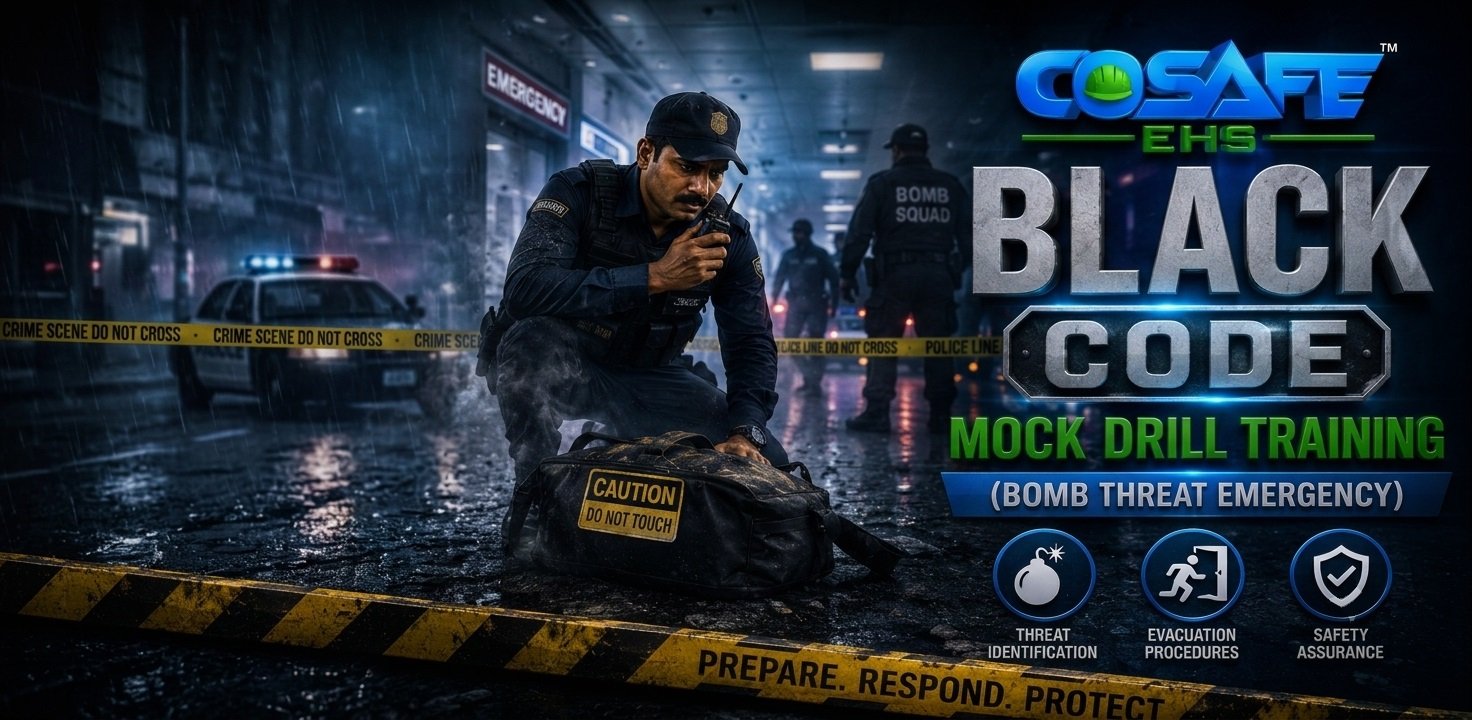
Professional Black Code Mock Drill Training (Bomb Threat Emergency) by Cosafe EHS Bangalore
A Bomb Threat Emergency is one of the most critical security incidents an organization can face. Whether communicated through a phone call, email, written note, social media message, suspicious package, or verbal warning, every bomb threat must be treated as a genuine emergency until assessed by competent authorities. An inappropriate response can lead to panic, operational disruption, property damage, injuries, or loss of life.
At Cosafe EHS Bangalore, our Black Code Mock Drill Training (Bomb Threat Emergency) is designed to prepare organizations with the knowledge, practical skills, and confidence required to effectively manage bomb threats and related security emergencies. Through realistic scenario-based simulations, emergency evacuation exercises, Incident Command System (ICS) implementation, security awareness training, and comprehensive mock drills, participants learn how to respond calmly, coordinate effectively, and minimize risks while ensuring the safety of employees, visitors, contractors, and business assets.
The program follows internationally recognized emergency preparedness principles, organizational security best practices, business continuity planning, and emergency response methodologies to help organizations strengthen resilience against security threats.
What is a Black Code?
A Black Code is an emergency notification activated when an organization faces a Bomb Threat Emergency or another serious security threat requiring immediate assessment, coordinated response, evacuation, and communication with emergency authorities.
A Black Code may be activated due to:
Bomb threat received via telephone
Email bomb threat
Suspicious package or parcel
Improvised Explosive Device (IED) threat
Vehicle-borne explosive threat
Anonymous security threats
Terrorism-related threats
Explosive device discovery
Security intelligence alerts
Coordinated external threats
The objective of a Black Code is to ensure rapid threat assessment, protect occupants, coordinate emergency services, minimize disruption, and safely restore normal operations.
Countries Where Black Code or Similar Bomb Threat Emergency Systems Are Commonly Applied
Although emergency colour codes vary between organizations and countries, structured Bomb Threat Emergency Response systems are widely adopted across:
India
United States
Canada
United Kingdom
Australia
New Zealand
Singapore
Malaysia
United Arab Emirates (UAE)
Saudi Arabia
Qatar
Oman
South Africa
Ireland
Hong Kong
Many organizations use Black Code for bomb threats or major security emergencies, while others may use alternative emergency terminology or security alert systems. Therefore, every organization should conduct training according to its approved Emergency Response Plan (ERP), Security Management System, Business Continuity Plan (BCP), and local legal requirements.
Why Black Code Mock Drills are Important
Bomb threats are often intended to create fear, disrupt operations, or test organizational preparedness. Even when a threat is ultimately determined to be false, every incident demands a disciplined and professional response.
Without proper preparedness, organizations may experience:
Delayed emergency response
Panic among employees
Unsafe evacuation
Communication failures
Poor coordination
Operational disruption
Property damage
Regulatory non-compliance
Financial losses
Reputational damage
Regular Black Code Mock Drills help organizations:
Strengthen emergency preparedness
Improve evacuation efficiency
Enhance security awareness
Validate emergency response plans
Improve decision-making under pressure
Strengthen communication systems
Build employee confidence
Improve coordination with emergency agencies
Protect lives and assets
Improve business continuity
Objectives of Black Code Mock Drill Training
The program aims to:
Understand Black Code activation procedures
Identify different types of bomb threats
Improve threat assessment capabilities
Strengthen emergency communication
Practice safe evacuation procedures
Enhance security awareness
Improve Incident Command System implementation
Coordinate with police and bomb disposal units
Test emergency response plans
Build organizational resilience
Key Benefits of Black Code Mock Drill Training
Organizations conducting regular Black Code drills benefit through:
Faster emergency response
Improved evacuation performance
Enhanced employee safety
Better security preparedness
Stronger leadership during emergencies
Improved communication
Reduced operational downtime
Better compliance with safety standards
Enhanced business continuity
Increased stakeholder confidence
Who Should Attend?
This training is suitable for:
EHS Managers
Safety Officers
Security Officers
Fire & Safety Personnel
Emergency Response Teams (ERT)
Incident Response Teams
Facility Managers
Operations Managers
HR Managers
Administration Teams
Engineering & Maintenance Personnel
Business Continuity Teams
Crisis Management Teams
Corporate Employees
Educational Institution Staff
Manufacturing Personnel
Logistics & Warehouse Teams
Airport and Aviation Personnel
Hotel & Hospitality Staff
Healthcare Support Teams
A Black Code (Bomb Threat Emergency) requires calm leadership, rapid assessment, effective communication, disciplined evacuation, and seamless coordination with emergency authorities. Regular Black Code Mock Drills enable organizations to validate emergency plans, strengthen preparedness, reduce response times, and improve overall resilience against security threats.
At Cosafe EHS Bangalore, our Black Code Mock Drill Training (Bomb Threat Emergency) equips organizations with the knowledge, practical skills, and confidence needed to effectively manage bomb threat incidents while protecting people, assets, and business operations. Through realistic simulations, structured evaluations, and internationally aligned emergency management practices, we help organizations create safer workplaces, stronger emergency response systems, and resilient operations.
Prepare. Assess. Evacuate. Protect. Partner with Cosafe EHS Bangalore for Professional Black Code Mock Drill Training (Bomb Threat Emergency) in Bangalore.
Training Modules
Module 1: Introduction to Hospital Emergency Codes
Participants gain a comprehensive understanding of healthcare emergency code systems.
Topics include:
- Hospital emergency management fundamentals
- Emergency code classifications
- Black Code concepts
- Security threat recognition
- Emergency response activation
- Healthcare emergency preparedness
Module 2: Understanding Hospital Black Code Emergencies
This module focuses on identifying and assessing Black Code situations.
Training includes:
- Bomb threats
- Suspicious packages
- Terrorism-related threats
- Security incidents
- Hostile intruder situations
- Critical external threats
Participants learn how to recognize and report potential threats.
Module 3: Hospital Incident Command System (HICS)
Participants learn structured emergency management principles.
Topics include:
- Incident Command System (ICS)
- Hospital Incident Command System (HICS)
- Command roles and responsibilities
- Emergency operations center activation
- Resource management
- Coordination structures
Module 4: Threat Identification and Risk Assessment
Early threat recognition is critical for effective response.
Training includes:
- Threat assessment procedures
- Risk evaluation techniques
- Security vulnerability assessment
- Suspicious behavior recognition
- Threat reporting protocols
- Risk prioritization methods
Module 5: Emergency Communication Systems
Effective communication prevents confusion and panic.
Topics include:
- Black Code activation procedures
- Emergency announcements
- Internal communication systems
- Staff notification protocols
- Communication hierarchy
- Public information management
Module 6: Hospital Security Response Procedures
Security personnel play a vital role during Black Code incidents.
Training includes:
- Security team activation
- Perimeter control
- Access management
- Crowd control
- Restricted area management
- Threat containment procedures
Module 7: Patient Protection and Evacuation Planning
Patient safety remains the highest priority.
Topics include:
- Horizontal evacuation
- Vertical evacuation
- Critical care patient movement
- ICU evacuation planning
- Emergency transport coordination
- Patient tracking systems
Participants learn safe patient movement techniques.
Module 8: Staff Accountability and Emergency Coordination
Effective coordination ensures organized responses.
Training includes:
- Staff accountability systems
- Departmental coordination
- Shift management
- Emergency staffing plans
- Resource allocation
- Emergency reporting
Module 9: Lockdown and Access Control Procedures
Some Black Code events require controlled access measures.
Topics include:
- Lockdown procedures
- Controlled entry and exit
- Visitor management
- Access control systems
- Security screening
- Emergency restrictions
Module 10: Coordination with External Agencies
Successful responses require multi-agency collaboration.
Training includes:
- Police coordination
- Bomb disposal squad coordination
- Fire department interaction
- Emergency medical services
- Government authorities
- Disaster management agencies
Module 11: Emergency Evacuation and Shelter-in-Place Procedures
Participants learn appropriate protective actions.
Topics include:
- Evacuation decision-making
- Safe assembly points
- Shelter-in-place procedures
- Area isolation
- Movement control
- Occupant accountability
Module 12: Crisis Management and Leadership
Leadership becomes critical during emergencies.
Training includes:
- Emergency leadership principles
- Decision-making under pressure
- Crisis communication
- Situation assessment
- Resource prioritization
- Operational continuity
Module 13: Business Continuity and Recovery Planning
Hospitals must continue critical operations during emergencies.
Topics include:
- Continuity planning
- Essential service protection
- Recovery procedures
- Operational restoration
- Incident documentation
- Lessons learned processes
Module 14: Full-Scale Hospital Black Code Mock Drill Simulation
Participants engage in realistic emergency exercises involving:
- Bomb threat simulation
- Suspicious package response
- Emergency communication activation
- Security deployment
- Patient protection measures
- Incident command operations
These exercises replicate real-world emergency conditions.
Module 15: Post-Drill Evaluation and Corrective Action Planning
Continuous improvement is essential.
Training includes:
- Drill performance evaluation
- Gap identification
- Corrective actions
- Improvement planning
- Emergency plan updates
- Future preparedness strategies
Training Methodology
At Cosafe EHS Bangalore, our Black Code Mock Drill Training follows a practical, competency-based, and simulation-driven methodology aligned with international emergency preparedness standards.
Interactive Classroom Sessions
Participants receive expert instruction through:
- Emergency preparedness presentations
- Bomb threat awareness workshops
- Security management discussions
- Case study analysis
- Interactive learning sessions
- Group discussions
These sessions establish a strong theoretical foundation.
Threat Assessment Workshops
Participants engage in:
- Hazard identification
- Security risk assessments
- Vulnerability analysis
- Threat recognition exercises
- Scenario planning
- Emergency response planning
These workshops enhance proactive security awareness.
Tabletop Emergency Simulations
Participants work through realistic bomb threat scenarios involving:
- Telephone bomb threats
- Suspicious packages
- Email threats
- Security alerts
- Evacuation decision-making
- Incident command coordination
These exercises improve strategic thinking and leadership.
Practical Emergency Response Demonstrations
Hands-on demonstrations include:
- Black Code activation
- Emergency communication
- Safe evacuation
- Occupant accountability
- Security perimeter establishment
- Coordination with emergency services
Participants gain operational confidence through guided practice.
Full-Scale Black Code Mock Drill Execution
Participants actively perform:
- Bomb threat response
- Emergency notification
- Building evacuation
- Occupant accountability
- Security operations
- Incident Command implementation
- Emergency coordination
- Recovery planning
These simulations replicate realistic organizational emergency conditions.
Multi-Department Coordination Exercises
Training involves:
- Management Teams
- Security Personnel
- Emergency Response Teams
- Fire Wardens
- Facility Management
- HR Departments
- Engineering Teams
- Operations Personnel
This strengthens organization-wide emergency preparedness.
Performance Evaluation and Debriefing
Following every drill:
- Response times are measured
- Communication effectiveness is evaluated
- Evacuation efficiency is reviewed
- Operational gaps are identified
- Lessons learned are documented
- Improvement plans are developed
Competency Assessment and Certification
Participants are assessed through:
- Written knowledge evaluations
- Scenario-based exercises
- Practical demonstrations
- Team performance
- Mock drill participation
- Emergency response competency assessments
Certificates are awarded upon successful completion of the training program.
Why Choose Cosafe EHS Bangalore for Black Code Mock Drill Training?
- Experienced emergency preparedness and security consultants
- Practical, scenario-based bomb threat simulations
- Industry-specific emergency planning
- Incident Command System (ICS) integration
- Comprehensive evacuation and accountability training
- Coordination with emergency response agencies
- Customized on-site mock drills
- Detailed post-drill evaluation reports
- Regulatory compliance and audit readiness support
- Strong focus on life safety, business continuity, and organizational resilience